

How to Hire AI Engineers: The 7 Skills That Predict Production Success
Seven cross-role skills that predict whether an AI engineer or vendor ships to production with the question, the strong answer, and the disqualifying answer for each. Screen better.

Quick answer: Seven cross-role skills predict whether an artificial intelligence engineer or vendor reaches production: evaluation discipline, failure-mode literacy, data access realism, cost awareness, rollback design, handoff documentation, and the ability to refuse a badly scoped request. Score each 0, 1, or 2. Below 9 of 14, the candidate ships demos, not systems.
The observation that reorganised how we screen
Look at what your current screen actually measures. The portfolio the candidate assembled. The demo they recorded and re-recorded. The certification they studied for. The benchmark number they chose to put on the résumé. Every one of those artifacts was produced under conditions the candidate fully controlled: their data, their laptop, their timeline, their definition of done.
Production is the opposite. A data-access request that comes back denied. A finance partner asking what one resolved ticket costs. A claims adjuster deciding whether to trust the output at 7 AM on a Tuesday. A regulator asking who pressed stop and when.
You are screening the half of the candidate’s working life they authored. Production is decided by the half they did not.
Below are the seven signals that survive that inversion, each with the question, the strong answer, and the answer that should end the interview, plus the four signals the market over-weights that predict nothing. The same screen runs on an internal hire and on a vendor’s technical due-diligence session, which is the point.
What does "predicts production success" actually mean for an AI hire?
Production success means the system the person builds is still running, still trusted, and still measured twelve months after the pilot ended. That is a narrower bar than most hiring loops assume, and the failure data explains why it has to be.
MIT’s Project NANDA study found only about 5% of integrated enterprise generative AI pilots produced measurable profit-and-loss impact. S&P Global Market Intelligence put the share of companies abandoning most of their AI initiatives at 42%, up from 17% the prior year, with the average organisation scrapping 46% of proofs of concept before production. Gartner forecasts more than 40% of agentic AI projects cancelled by the end of 2027, attributing it to escalating costs, unclear business value, and inadequate risk controls. None
of those three causes is a model-quality problem. All three are decisions a person makes.
A hire predicts production success when the person makes those decisions correctly under pressure. Four conditions define it:
- The system survives a data reality it did not choose. The corpus is messier, more permissioned, and more fragmented than the pilot corpus.
- The system has a number attached to it that a finance partner recognises, not a metric that only the builder recognises.
- The system can be stopped by someone who is not the person who built it.
- The system outlives the builder’s tenure. Someone else can operate it from written material.
Why is your current screen measuring the wrong half?
Because personnel-selection research has been saying for decades that self-authored evidence is weak, and the artificial intelligence hiring market has spent three years building a screen out of nothing else.
Schmidt and Hunter’s 1998 meta-analysis of eighty-five years of selection research put structured interviews at an operational validity of about .51, with unstructured conversation at .38 and years of experience alone at .18, plateauing after roughly five years. Sackett and colleagues revisited the corrections in 2022 and found structured interviews came out as the single strongest predictor at about .42, with unstructured interviews collapsing to about .19. Read those two lines together: fixed questions, behavioural anchors, and systematic scoring make an interview roughly twice as predictive as the same conversation held informally.
Now look at what a typical 2026 artificial intelligence screen contains. A portfolio review. A demo walkthrough. A conversation about frameworks. A glance at certifications. That is an unstructured interview wearing technical vocabulary.
The control inversion is the fix. Score only what was produced under conditions the candidate did not set. A candidate can rehearse a demo. A candidate cannot retroactively invent the regression suite they never wrote, the escalation they absorbed at 2 AM, or the scope they refused.
Every signal that predicts production is observed under conditions the candidate does not control. Every signal that predicts nothing is authored under conditions they do. That single line reorganises the entire screen.
The 7-Signal Control-Inversion Screen
Each signal below carries three things: the question you ask, the shape of a strong answer, and the answer that should end the session. Use the same wording every time. The consistency is where the predictive validity comes from, not the cleverness of the question.
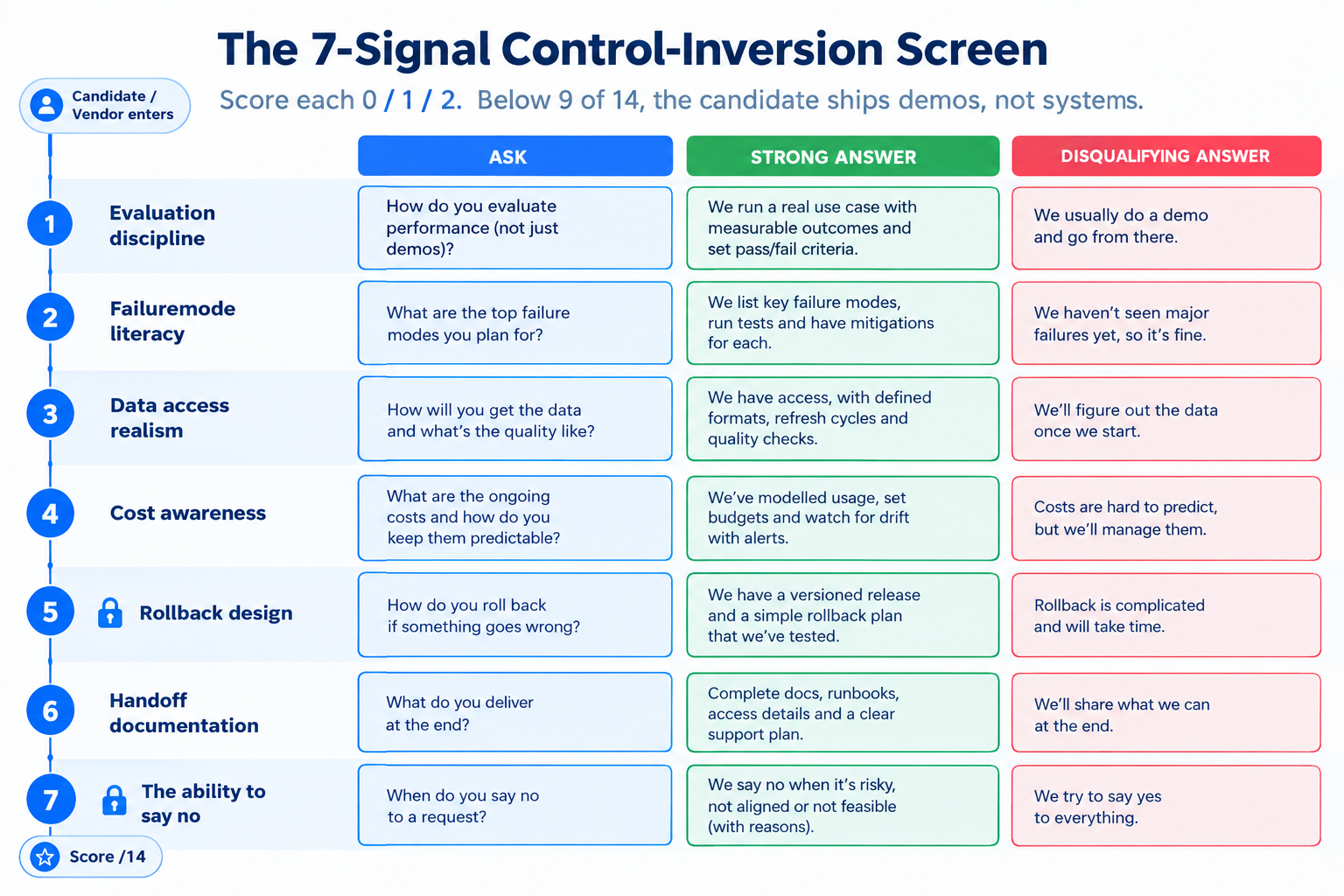
Signal 1 – Evaluation discipline
Ask: “Walk me through the eval harness on your last system. What was in the regression suite, and what did you do when a change made one case better and another worse?”
Strong answer: A versioned dataset of real cases with expected outputs, a scoring method they can defend, and a regression suite that runs before every prompt, model, or retrieval change. They name the trade-off rule: which cases were not allowed to regress. They may mention Ragas, DeepEval, promptfoo, Braintrust, LangSmith, or an internal harness. The tool is not the signal. A fixed test set that predated the change is the signal.
Disqualifying answer: “We tested it manually and it looked good.” Or evaluation that happened once, at the end, as a sign-off gate. A system without a regression suite cannot be changed safely, so it either freezes or drifts. Both are production failures.
Signal 2 – Failure-mode literacy
Ask: “Give me the failure taxonomy for a system you shipped. What were the top three ways it produced a wrong answer, and how did each one present to the user?”
Strong answer: Named, distinct categories with different fixes. For a retrieval system that might be stale chunks, retrieval misses on abbreviation-heavy queries, and confident synthesis across two documents that should never have been joined. Critically, the candidate distinguishes failures that are visible to the user from failures that are silent. Silent failures are the expensive ones.
Disqualifying answer: “Hallucination.” That is a category label, not a taxonomy. Anyone who has debugged a live system for six months has three or four named sub-modes and can tell you which one wakes them up.
Signal 3 – Data access realism
Ask: “On your last project, what did the data access audit turn up, and how long did it take from request to first row of production data?”
Strong answer: A timeline measured in weeks and a specific obstacle: a data owner who had never been asked, a retention policy that removed the very records the model needed, a permissioning model forcing a per-role retrieval index rather than one. Gartner forecasts organisations will abandon 60% of artificial intelligence projects unsupported by production-ready data through 2026, with 63% of surveyed organisations unsure they hold the right data management practices. A candidate who has shipped has met that wall.
Disqualifying answer: “We got a data dump at the start.” A dump is a pilot artifact. It tells you nothing about whether the person can get the same data on a recurring, permissioned, governed basis, which is the only kind that supports a production system.
Signal 4 – Cost awareness
Ask: “What was the cost per resolved task on your last system, and how did you calculate it?”
Strong answer: A number that includes the escalation. Published 2026 unit economics for enterprise agent deployments put a realistic attempt at roughly $0.15 to $0.30, while a failed task escalates to a human costing around $7.40, putting a fully loaded resolved task between roughly $0.94 and $4.55 depending on resolution rate. Strong candidates have internalised that lifting resolution rate matters far more than shaving tokens, and that agentic architectures burn several times the tokens of a single-turn system for the same job.
Disqualifying answer: A cost figure quoted per million tokens with no denominator. That is a vendor’s number, not an operator’s number. It cannot be put in front of a finance partner and it cannot be defended at a renewal.
Signal 5 – Rollback design
Ask: “Describe the rollback and kill switch on your last deployment. Who could trigger it, and when was it last tested?”
Strong answer: A named mechanism, a named human who is not the engineer, and a date. Strong candidates describe graduated states rather than a binary: route to a deterministic path, fall back to a human queue, then hard stop. They distinguish rolling back the model version from rolling back the prompt, the retrieval corpus, or the tool permissions, because those fail independently. This is now a regulatory expectation. Article 14 of the EU AI Act requires high-risk systems to allow a named, empowered person to intervene, override, or halt the system through a stop procedure, tested rather than merely documented.
Disqualifying answer: “We’d redeploy the previous version.” That is a deployment step, not a kill switch, and it does not answer who or when. If the only person who can stop the system is the person who built it, you do not have oversight. You have a dependency.
Signal 6 – Handoff documentation
Ask: “Show me the runbook for a system you handed to someone else. What did the on-call person do at 2 AM without calling you?”
Strong answer: A runbook keyed to symptoms rather than to architecture: this alert means check that, this score drop means the corpus refresh failed, this latency shape means a tool is retrying. Strong candidates connect the runbook to trace-level observability, because a runbook without traces sends the on-call person to a dashboard showing a healthy request and a wrong answer. In 2026 that means OpenTelemetry GenAI semantic conventions or OpenInference, with evaluation scores written back onto spans so a quality regression surfaces in the same place as a latency regression. OpenTelemetry graduated within the Cloud Native Computing Foundation in May 2026, which makes instrumentation portability a reasonable expectation rather than a preference.
Disqualifying answer: “It’s in the code” or “I’d be available.” Both answers describe a system that cannot outlive one person’s tenure, and tenure in this market is short.
Signal 7 – The ability to say no
Ask: “Tell me about a request you refused or materially rescoped. What were the acceptance criteria you would not sign up to, and what happened next?”
Strong answer: A specific request, a reason grounded in a failure mode rather than in workload, and a counter-proposal. The best version sounds like this: the business asked for an autonomous approval agent, the candidate showed the base rate of the edge case made a wrong approval unaffordable, and shipped a ranked recommendation with a human approver instead. Gartner has noted that many use cases positioned as agentic do not require agentic implementations, and estimates only around 130 of the thousands of vendors claiming agentic capability are building the real thing. Someone who has never rescoped a request has either never been asked for something unreasonable or did not recognise it.
Disqualifying answer: “I build what the business asks for.” Read as agreeable in an interview. Reads as an eight-month write-off in a post-mortem. This is the single most under-weighted signal in the market and the one most predictive of whether a project reaches the twelve-month mark.
How do you score the seven signals?
Score each signal 0, 1, or 2 immediately after the session, against fixed anchors, before any discussion with other interviewers. Total out of 14.
| Score | Anchor | What it looks like |
|---|---|---|
| 2 | Lived it | Specific system, specific number, specific consequence they absorbed |
| 1 | Knows it | Correct concept, no first-hand instance, or an instance from someone else’s project |
| 0 | Disqualifying | The named disqualifying answer, or a redirect to a different question |
| Total | Verdict |
|---|---|
| 12–14 | Hire, or advance the vendor to commercial terms |
| 9–11 | Hire into a team that already carries the missing signals; name the gap in the offer conversation |
| 6–8 | Capable builder, not yet a production owner. Not a lead. Not a sole vendor. |
| 0–5 | No. Regardless of the portfolio. |
Two rules make the rubric hold. A zero on Signal 5 or Signal 7 caps the total at 8 regardless of what else scored, because rollback and refusal are the two signals whose absence produces uncapped downside. And score independently before comparing: the moment interviewers calibrate out loud, the structure that generated the predictive validity is gone and you are back to an unstructured conversation.
Which four signals predict nothing?
These four dominate résumés, vendor decks, and hiring-manager instinct. They correlate with visibility, not with production. Call them the Controlled-Conditions Four.
Framework fluency. LinkedIn’s own 2026 data lists LangChain, retrieval-augmented generation, and PyTorch as the most common skills on artificial intelligence engineer profiles. That is exactly why they carry no signal. A skill held by the modal candidate cannot discriminate between candidates. It also decays faster than anything else on a résumé; the orchestration library that mattered in 2024 is a migration ticket in 2026.
Demo videos and portfolio projects. Produced under conditions the candidate set, on data the candidate chose, against a definition of success the candidate wrote. A demo proves the happy path exists. Production is everything else.
Certifications. I hold one. It is in my byline, and it taught me none of the seven signals above. Certifications verify exposure to a curriculum on a date. The selection literature has been consistent on credential-shaped evidence for decades: years of education alone predicts job performance at roughly r = .10 once ability is controlled. A credential is a fair tiebreaker between two candidates who both scored 12. It is not a screen.
Benchmark scores. The most technically seductive of the four and the least reliable. Static benchmarks in 2026 carry varying contamination, frontier models cluster within noise on the saturated ones, and identical weights can swing ten to twenty percentage points depending on the evaluation harness. A leaderboard position was not produced under your conditions, on your data, with your harness. Ask what they measured on their own eval set instead. That is Signal 1.
A skill held by the modal candidate cannot discriminate between candidates. That is the whole problem with screening on framework fluency in 2026.
How do you run the same screen on a vendor?
Identically, with three adjustments. The seven questions do not change. What changes is who answers, what artifact you request, and what a refusal to produce it means.
Insist the delivery lead answers, not the account lead. Ask for the person who will hold the pager. A vendor who routes technical due diligence through someone who will not be on the project has scored a Signal 6 zero before a question is asked.
Convert three signals into artifact requests. A redacted eval harness structure from a comparable engagement (Signal 1). The rollback runbook (Signal 5). A sample handoff runbook (Signal 6). Mature engineering cultures produce all three within days because they already exist. A vendor who promises to send them after the call rarely sends anything usable even after signature.
Score Signal 7 live, on the call. Bring a deliberately badly scoped request into the session: full autonomy where a human approver belongs, or a use case your data access will not support. A vendor who says yes on the first call will say yes to every change request afterwards, and you will pay for all of them. A vendor who pushes back is showing you the behaviour you are actually buying.
That last move is also the cheapest de-risking available in an evaluation, and it is why this screen belongs in the room before you choose an engagement model. The engagement structure you sign should follow the score, not precede it.
Where should the seven signals live?
The seven signals have to exist somewhere in the delivery system. They do not all have to sit inside one employee. This is the build-versus-buy question restated as a staffing question.
| Criterion | In-house hire | Freelance contractor | Big consulting (BCG / Accenture / Deloitte) | Specialist AI partner (Brainy Neurals) |
|---|---|---|---|---|
| Time to first production ship | 5–9 months (search + ramp) | 4–10 weeks | 9–14 months | 6–10 weeks |
| Who carries Signals 1–7 | One person; gaps are yours | Usually 3–4 of 7 | Distributed across a large team | Architected into the delivery team |
| Eval harness shipped by default | Depends on the hire | Rarely | Yes, at cost | Yes, as a contract deliverable |
| Rollback and kill switch designed in | Depends on the hire | Rarely | Yes, slow to ship | Yes, from specification |
| Handoff runbook and trace-level observability | Depends on the hire | Rarely | Yes, heavyweight | Yes, sized to your on-call |
| Cost per resolved task modelled pre-build | Rare | Rare | Yes | Yes, before the statement of work |
| Intellectual property ownership of weights, models, annotations | Client-owned | Contract-dependent | Client-owned | Client-owned, full transfer |
| Cost of a mis-hire or mis-selection | 6–9 months plus the credibility loss | 4–8 weeks | Contract minimum, often 12 months | Scoped phase, exit at gate |
| What happens at month 9 | Retention risk on the single point of failure | Contractor has moved on | Team rotation | Same architect, documented handoff |
The honest read: for a durable internal capability, hire, and use this screen to hire correctly. For a first production system inside two quarters, a specialist partner carries all seven signals on day one and hands them over with the runbook. The failure pattern is the middle path, where one contractor is asked to carry seven signals no contractor has ever been asked to demonstrate.
If you are screening for one of the two roles that get conflated most often in this market, screening the two most confused roles covers where the question sets diverge. If the system in question is agentic, the agentic specific screen adds the four questions this general screen deliberately leaves out.
Mitesh’s read from the delivery side
“On a document pipeline we run at over 50,000 items a month across 47 distinct formats, the artifact that made the 80% reduction in manual review defensible was not the model. It was the eval harness. We could show, format by format, what the system got right, what it escalated, and what changed when we shipped. Without that harness the same accuracy would have been an opinion, and opinions do not survive a compliance review. When I screen an engineer, Signal 1 is the one I weight hardest, because everything else in the delivery gets rebuilt on top of it.”
– Mitesh Patel, NVIDIA Certified AI Architect, Founder & Director, Brainy Neurals
A confession about how these screens actually go wrong
We have screened engineers into 40+ enterprise artificial intelligence deployments at this point. The pattern is always identical: the candidate who interviews best is the one with the cleanest demo, and the demo is the least informative object in the room. The fix is rarely a harder technical question. It is asking about the parts of the job the candidate did not get to design, and then scoring the answer before anyone in the room says what they thought. We have rewritten 40+ specifications mid-project, and in almost every case someone in the original hiring loop had already met the person who would have refused the bad scope, and passed on them for being difficult.
When does this screen fail?
Four conditions, named plainly, because a framework that never fails is a framework nobody stress-tested.
Research hires. If the role advances a modelling frontier rather than ships a system, five of the seven signals are irrelevant and their absence should not be penalised. Score Signals 1 and 2 only.
Career switchers with adjacent production experience. A distributed-systems engineer moving into applied artificial intelligence scores zero on the AI-specific instances while carrying the underlying disciplines completely. Ask the same seven questions about their previous domain. Someone who ran rollback and oncall for a payments system holds Signals 5 and 6 in full; the vocabulary transfers in weeks.
Organisations with no production surface. If your company has never run anything on-call, a candidate cannot demonstrate fit with practices you do not have, and the strongest scorers leave inside a year because there is nothing to own. Fix the surface first, or hire a partner to build it and hand it over.
Screens run by one interviewer. The rubric’s validity comes from independent scoring across at least two people. One interviewer applying it alone gets a structured conversation: better than nothing, weaker than the research suggests it could be.
What do the numbers say?
- 5% of integrated enterprise generative AI pilots produce measurable profit-and-loss impact – MIT Project NANDA, The GenAI Divide: State of AI in Business 2025
- 42% of companies abandoned most of their artificial intelligence initiatives, up from 17% a year earlier; 46% of proofs of concept scrapped before production – S&P Global Market Intelligence, 2025
- Over 40% of agentic AI projects forecast to be cancelled by the end of 2027 on cost, value, and risk control grounds – Gartner, June 2025
- 60% of AI projects forecast to be abandoned through 2026 without production-ready data, with 63% of organisations unsure they hold the right data management practices – Gartner, February 2025
- 3.4 open AI roles per qualified candidate, with artificial intelligence skills the hardest capability to hire for globally for the first time on record – ManpowerGroup 2026 Global Talent Shortage Survey (n = 39,063 employers, 41 countries)
- Structured interviews predict job performance roughly twice as well as unstructured ones (.42 vs .19 in the 2022 re-analysis; .51 vs .38 in the 1998 original) – Sackett et al. 2022; Schmidt & Hunter 1998
Verify each figure at source before it goes into a board paper or a hiring-committee deck. That is the standard this screen was built to.
FAQ
Frequently asked questions
Seven cross-role skills predict production outcomes: evaluation discipline (a versioned eval harness and regression suite), failure-mode literacy (a named failure taxonomy rather than the word “hallucination”), data access realism (having survived a data access audit), cost awareness (a defensible cost per resolved task including human escalation), rollback design (a tested kill switch someone else can trigger), handoff documentation (a symptom-keyed runbook backed by trace-level observability), and the ability to refuse a badly scoped request. Framework and language proficiency matter for the job but do not discriminate between candidates, because the modal candidate already has them.
Ask seven fixed questions and score each answer 0, 1, or 2 before discussing with other interviewers. Ask what was in their eval harness and regression suite. Ask for their failure taxonomy and which modes were silent. Ask what the data access audit turned up and how long access took. Ask for cost per resolved task and how it was calculated. Ask who could trigger the rollback and when it was last tested. Ask what the oncall person did at 2 AM without calling them. Ask about a request they refused or rescoped. Fixed wording matters more than clever wording.
Four answers should end the session. “We tested it manually and it looked good” means no regression suite exists. “Hallucination” as a complete failure taxonomy means the system was never debugged at depth. “We’d redeploy the previous version” in place of a kill switch means no one other than the builder can stop the system. “I build what the business asks for” means the person will not refuse an unshippable scope. A fifth, softer flag: a portfolio with no failed project in it, since every engineer with real production tenure has one.
Run the identical seven questions with three adjustments. Require the delivery lead to answer rather than the account lead, because the person who holds the pager is the person being screened. Convert three signals into artifact requests: a redacted eval harness structure, a rollback runbook, and a sample handoff runbook. Mature teams produce all three within days because they already exist. Third, bring a deliberately badly scoped request into the session and score the refusal live. A vendor who agrees to everything on the first call will agree to every change request afterwards, and you will pay for each one.
No. Certifications verify curriculum exposure on a date, which is useful context and a reasonable tiebreaker between two candidates who scored identically on the seven signals. They are not a screen. The personnel selection literature has been consistent for decades that credential-shaped evidence predicts job performance weakly once ability is controlled, with years of education alone landing around r = .10. The same reasoning applies to the interviewer: holding a credential and treating it as predictive of production outcomes are separate claims.
Three reasons compound. Contamination, where benchmark items appear in training data so the score measures recall rather than reasoning. Saturation, where frontier models cluster so tightly on older benchmarks that differences fall inside statistical noise. Harness variance, where identical model weights score ten to twenty percentage points apart depending on how the evaluation was run. A candidate or vendor quoting a leaderboard position is quoting a number produced under someone else’s conditions. Ask what they measured on their own evaluation set against their own regression suite instead.
The seven signals have to exist somewhere in the delivery system, not necessarily inside one person. If the goal is a durable internal capability over two or more years, hire, and use the screen to hire correctly. If the goal is a first production system inside two quarters, a specialist partner carries all seven signals from day one and hands them over with the runbook. The pattern that fails most reliably is asking a single contractor to carry all seven, since almost no contractor has ever been asked to demonstrate more than three or four.
Plan on five to nine months from opening the requisition to a first production ship, split roughly between search and ramp. The search side is constrained by supply: roughly 3.4 open artificial intelligence roles exist per qualified candidate, and ManpowerGroup’s 2026 survey of 39,063 employers found AI skills the hardest capability to hire for globally. The ramp side is constrained by your data access and your production surface, not by the hire. Teams that shorten the total meaningfully do it by removing the data-access blocker before the person starts, not by compressing the interview loop.
About the author

Mitesh
Mitesh has shipped 40+ enterprise AI systems across manufacturing, banking and financial services, healthcare, pharmaceuticals, construction and logistics. Brainy Neurals is an NVIDIA Inception Partner and a member of AWS Activate and Microsoft for Startups, and it runs an ISO 27001 certified security program. He holds status at both the individual and company level, a Top 3% ranking, and brings 12+ years of applied AI experience to every
engagement.
Book a 30-minute AI budget scoping call with Mitesh Patel, NVIDIA Certified AI Architect. You’ll leave the call with your four dials marked, your starting band and a monthly running cost you can take to your finance lead. Book your 30 minutes with AI Consultant