How Much Does AI Development Cost for a Small Business in 2026?
Small business AI costs $5,000 to $250,000 in 2026. See five budget bands with real projects, build times, monthly running costs and the 4 cost drivers.


Quick answer: AI development for a small business costs about $5,000 to $250,000 in 2026. A configured staff assistant lands near $5,000, a single-workflow automation near $15,000, an integrated customer assistant near $40,000 and a custom-trained model near $100,000. Four dials decide your band, namely data readiness, integration depth, accuracy target and hosting model.
An internal assistant that answers 4,200 staff questions a month costs about $3 in model fees on Claude Haiku 5.5 at October 2026 list prices. One firm will still quote you $5,000 to build it, another will quote $40,000, and both quotes can be honest. The model explains almost none of that spread. The spread comes from your side of the table, from the state of your data and the systems the assistant has to touch, and from how often it’s allowed to be wrong and where it has to run.
This post is for owners, managing directors and finance heads at companies of roughly 10 to 250 people who want a budget number before they call any vendor. You’ll get five budget bands, each tied to a concrete project with a build time and a monthly running cost. You’ll also get the four cost drivers that push a project from one band into the next, so you can read your own band before anyone quotes it.
In 2026 the model is the cheapest line on a small-business AI invoice, and what you actually pay is set by four dials you control.
How much does AI development cost for a small business in 2026?
A first AI project for a small business costs between $5,000 and $250,000 in 2026, and in our scoping work the sensible first projects land between $5,000 and $60,000. Monthly running costs after launch range from under $100 for a configured staff assistant to about $6,000 for a model hosted privately on your own servers.
Broad market averages mislead badly at this company size. Clutch’s software development pricing guide, updated in September 2026, puts the average software project at $132,480, while the typical project reviewed on the same page sits in the $10,000 to $49,999 bracket. That average covers all custom software, AI included, and a handful of large builds pull it upward. Clutch lists average agency rates of $25 to $49 an hour, a spread that alone can double a quote for identical scope.
Failure data matters as much as price data. MIT NANDA’s GenAI Divide report found that 95% of organizations saw no measurable return from generative AI, drawing on 300+ public initiatives, 52 interviews and 153 survey responses gathered between January and June 2025. The same research found mid-market firms moving from pilot to full rollout in about 90 days, against nine months or longer at large enterprises. Smaller companies move faster, and a well-scoped first budget gets a shorter road to payback because of it
The five AI budget bands for small businesses (Brainy Neurals practitioner bands, October 2026)
| Band | Typical first project | Build price | Build time | Monthly running cost |
|---|---|---|---|---|
| Band 1, about $5,000 | Internal staff assistant over your own documents | $3,000 to $8,000 | 1 to 2 weeks | $75 to $250 |
| Band 2, about $15,000 | Invoice or order extraction into your accounting system | $8,000 to $25,000 | 3 to 5 weeks | $150 to $500 |
| Band 3, about $40,000 | Customer support assistant with order lookup and human handoff | $25,000 to $60,000 | 8 to 12 weeks | $500 to $1,500 |
| Band 4, about $100,000 | Custom-trained vision inspection on one production line | $60,000 to $150,000 | 4 to 6 months | $600 to $2,000 |
| Band 5, $150,000 to $250,000 | Privately hosted language model across three business systems | $150,000 to $250,000 | 6 to 9 months | $2,500 to $6,000 |
Running costs in the table cover model fees, hosting and monitoring tools, and they leave out any support retainer. Our AI consulting and strategy team scopes first projects against these exact bands, and our companion guide shows which AI scope fits your budget once you know your number. Treat the band table as your opening position, because the four dials described further down are what move a real quote up or down it.
What does each AI budget band buy?
Each band buys a larger amount of custom work wrapped around the same commercial models. Band 1 configures a model, and Band 2 connects one to a single system. Band 3 puts it in front of your customers, Band 4 trains a model of your own, and Band 5 runs the whole stack inside infrastructure you control.
What does a $5,000 AI project look like?
A $5,000 AI project configures a commercial large language model (LLM) around your own documents for internal use, with no customer exposure and no permission to change data in your business systems. The typical Band 1 project is a staff assistant answering questions from 40 policy, pricing and procedure PDFs inside Microsoft Teams or Slack.
The build covers document cleanup and retrieval setup, the prompt and its guardrails, sign-in through your existing accounts and a 50-question test set your team signs off. That takes one to two weeks when the files are digital, current and kept in one place.
Running costs for this example stay small [ILLUSTRATIVE]. Forty staff asking five questions a day across 21 working days produce 4,200 questions a month. At 5,000 input tokens and 400 output tokens per question, Claude Haiku 5.5 bills $0.10 per million input tokens and $0.50 per million output tokens, so the month costs $2.94. Switching to Claude Sonnet 5.5 for harder questions lifts that to $58.80. Hosting, a small vector database and logging add $70 to $190, which puts the full monthly bill between $75 and $250.
If the assistant needs to read live data from your systems, the project has already left Band 1. Our retrieval-augmented generation (RAG) development work starts here and scales into Band 3.
What does a $15,000 AI project look like?
A $15,000 AI project automates one repetitive workflow from start to finish and writes the result into one business system. The standard example is invoice or purchase-order extraction, where an AI model reads supplier documents and posts structured lines into QuickBooks Online, Xero or Sage, with a review queue for every document it’s unsure about.
The build covers mapping your supplier layouts, extraction prompts or a document model, confidence thresholds, a review screen and one write integration. A 200-document test set taken from your real paperwork closes it out, and the build takes three to five weeks.
Take a distributor processing 2,000 invoices a month [ILLUSTRATIVE]. At 3,000 input tokens and 600 output tokens per invoice on Claude Sonnet 5.5, model fees come to $24 a month. Invoices can wait overnight, so the Anthropic Batch API halves that to $12. Hosting, document storage and the review app bring the total to $150 to $500.
Supplier layouts move the price inside this band faster than anything else. Ten clean digital layouts fit comfortably inside the band. Sixty layouts, half of them scanned or handwritten, push the same project toward Band 3, and our document AI services team prices that difference at scoping.
What does a $40,000 AI project look like?
A $40,000 AI project puts an assistant in front of your customers, connected to live business data, with a clean handoff to a human. The typical Band 3 build is a support assistant on your website that answers product questions, looks up order status in Shopify or your ERP and passes hard cases to a person in Zendesk, Freshdesk or HubSpot.
Customers see every mistake, so the build money shifts toward evaluation. We assemble a test set from 300 past support tickets, write guardrails for refunds and anything with legal weight, and log every conversation for review, which puts the build at eight to 12 weeks.
Running costs climb with customer traffic at this band [ILLUSTRATIVE]. Five thousand conversations a month at four turns each is 20,000 model calls. At 6,000 input tokens and 350 output tokens per call on Claude Sonnet 5.5, that’s $310 a month before prompt caching, which bills repeated instructions at 0.05 times the base input rate. Add hosting, a vector database and a monitoring tool such as Langfuse, and the month runs $500 to $1,500. Our AI agent and copilot development team builds this band.
What does a $100,000 AI project look like?
A $100,000 AI project trains a model of your own, because no commercial model has seen your parts, your products or your history. For a small manufacturer, Band 4 is usually vision inspection on one production line, built from two to four industrial cameras, an NVIDIA Jetson Orin edge computer and a YOLO-family detection model trained on 5,000 to 15,000 labelled images.
The model sends a reject signal to the line’s programmable logic controller (PLC) and logs every decision for audit. Expect four to six months, and a good share of that time goes into collecting and labelling images of real defects. Distributors reach the same band with demand forecasting.
Running costs drop at this band in one respect, since inference happens on hardware you own and carries no per-image fee. The $600 to $2,000 a month pays for a cloud dashboard, image storage for retraining, monitoring and a quarterly retrain. On a larger computer vision deployment, we ran YOLO-based inspection on NVIDIA Jetson at 200+ tires an hour with 99.2% defect detection and sub-50ms decisions, and reaching that last stretch of accuracy is exactly what pushes vision work past Band 4. Our AI in manufacturing page covers the wider set of plant use cases
What sits above $100,000 for a small business?
Band 5, from $150,000 to $250,000, covers private hosting combined with several integrations and a compliance burden. A typical case is a 120-person clinic group that wants an assistant drafting referral letters and summarizing records inside its own cloud account, connected to its records system, document store and scheduling tool.
Compliance with the Health Insurance Portability and Accountability Act (HIPAA) drives the architecture there, so the model runs on dedicated graphics processing units (GPUs). Two AWS g6.xlarge instances with NVIDIA L4 GPUs cost $0.8048 an hour each on demand, or about $1,175 a month for the pair, before monitoring, backups and security tooling. The full monthly bill lands between $2,500 and $6,000. Build time runs six to nine months, and our AI in healthcare team handles the clinical integration layer.
Before you accept a Band 5 quote, ask whether a managed model service inside your own cloud account, such as Amazon Bedrock or Azure OpenAI, would satisfy the same data rules at Band 3 prices. Above $250,000 you’ve crossed into an enterprise program, which this post deliberately leaves out.
Why is the model the cheapest line on your AI invoice?
Model fees are the smallest cost in a small-business AI project because token prices have
collapsed. At October 2026 list prices, Claude Haiku 5.5 and OpenAI’s gpt-6-luna both charge $0.10 per million input tokens, so routine business traffic costs a few dollars a month and the build labour dwarfs it.
The price collapse is well documented by independent research. Stanford’s 2025 AI Index reported that the inference cost of a system performing at GPT-3.5 level fell more than 280-fold between November 2022 and October 2024, and prices kept falling through 2026. The table below prices 1,000 typical business requests of 6,000 input tokens and 400 output tokens at each provider’s standard rate.
What 1,000 typical requests cost at October 2026 list prices
| Model | Input per million tokens | Output per million tokens | Cost of 1,000 requests |
|---|---|---|---|
| Claude Haiku 5.5 | $0.10 | $0.50 | $0.80 |
| OpenAI gpt-6-luna | $0.10 | $0.50 | $0.80 |
| Claude Sonnet 5.5 | $2.00 | $10.00 | $16.00 |
| OpenAI gpt-6.1-sol | $2.00 | $10.00 | $16.00 |
| Claude Opus 5.5 | $4.00 | $20.00 | $32.00 |
| OpenAI gpt-6-astra | $10.00 | $50.00 | $80.00 |
Prices come from Anthropic’s pricing page and OpenAI’s API pricing page, both checked on October 26, 2026. Batch processing halves every figure on both platforms for work that can wait.
Cheap tokens help explain why adoption keeps climbing. Small businesses paying for AI reached 50.0% of the small firms in Ramp’s AI Index in September 2026, up from 38.6% in September 2025, based on card and bill-pay transactions across more than 85,000 US businesses. The tool layer is already affordable, so the question worth budgeting for is how much custom work sits between a seat costing tens of dollars a month and the result you want. Our guide to monthly running costs after launch breaks the post-launch bill down line by line, and it makes the same case this section does, that you should pick the model last, after pricing the four dials that drive the rest of the budget.
A small business can run 4,200 assistant questions a month through Claude Haiku 5.5 for about $3 in model fees. The money in an AI budget goes to data, integration and testing.
What are the four cost drivers that move a project between bands?
Four cost drivers move a small-business AI project between bands, namely data readiness,
integration depth, accuracy target and hosting model. We call the set the Four-Dial Quote. Each dial has a cheap setting and an expensive one, and every notch toward the expensive end adds engineering weeks that land on your invoice.
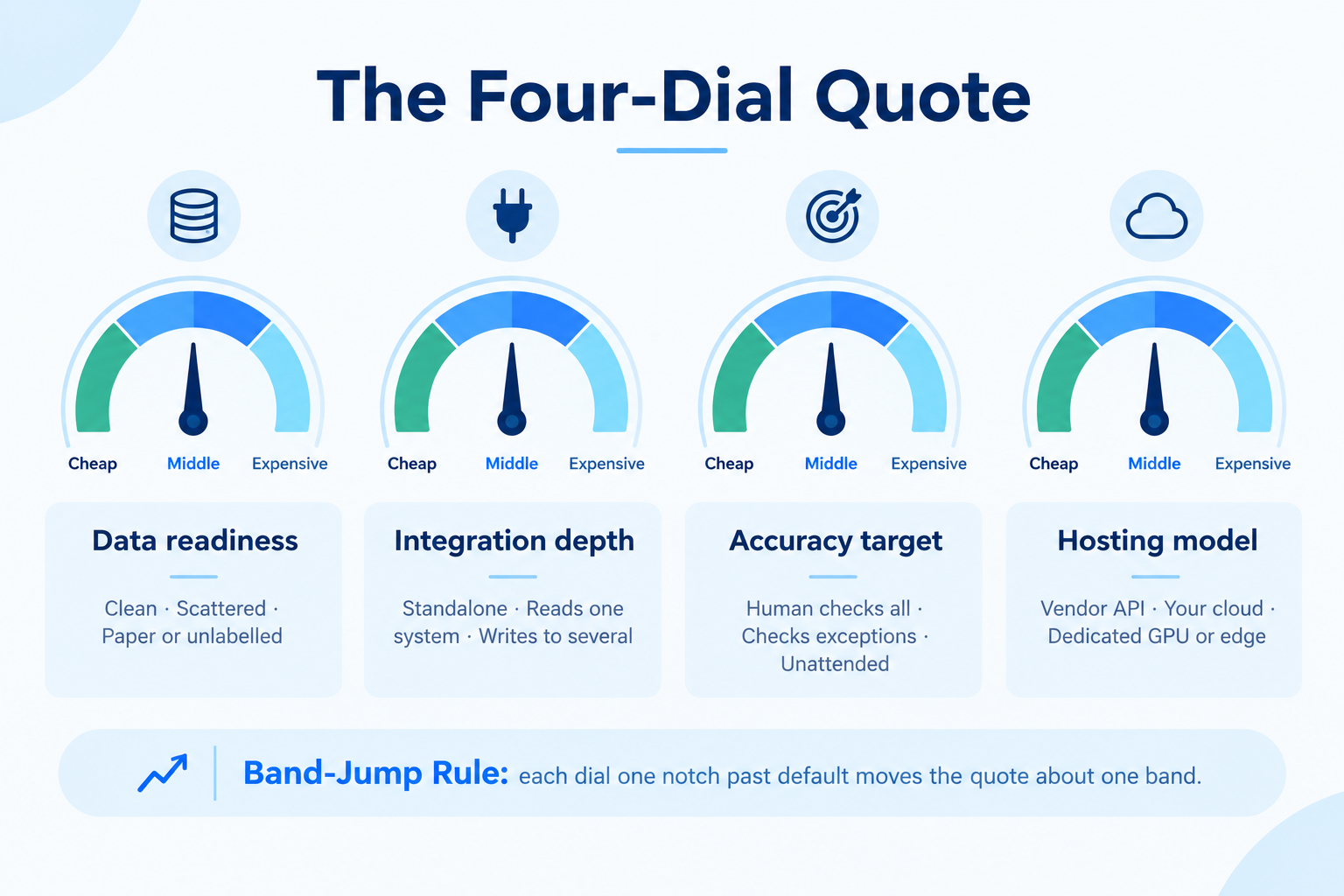
| Dial | Cheap setting | Middle setting | Expensive setting | What the money buys |
|---|---|---|---|---|
| Data readiness | Digital, current and in one system | Digital but spread across drives, inboxes and versions | Paper, scans or unlabelled images | Cleanup, format mapping and labelling |
| Integration depth | Standalone tool or file export | Reads from one system’s API | Writes into two or more systems, or into one with no API | Field mapping, error handling, rollback and testing |
| Accuracy target | A person checks every output | A person checks low-confidence outputs | Runs unattended | Bigger test sets, more training data and monitoring |
| Hosting model | Vendor API, paid per token | Managed model service inside your cloud account | Dedicated GPUs or on-site edge hardware | Infrastructure, security and operations |
Our working rule at scoping is the Band-Jump Rule. Start from the band your project type sits in, then count the dials set one notch past that band’s default. Each notch moves the quote roughly one band up, so a $15,000 invoice project fed by scanned handwritten paperwork and syncing both ways with an ERP becomes a $40,000 to $60,000 project. Read all four dials yourself before you read a vendor’s quote, since every quote reflects how that vendor read them.
How does data readiness change an AI quote?
Data readiness changes a quote by deciding how much cleanup and labelling happens before any model work starts, because a model can only be as good as the examples you can hand it. Clean, digital, labelled data keeps a project in its band. Scattered, scanned or unlabelled data adds cleanup and labelling weeks before any model work starts.
Gartner has put a number on the risk. Its February 2025 release forecast that through 2026, organizations will abandon 60% of AI projects unsupported by AI-ready data, and 63% of organizations either lack or aren’t sure they have the right data practices for AI.
You can test this dial in an afternoon. Try to export 200 representative examples of the task into one folder, whether those are invoices, past tickets or photos of defective parts. If that takes an hour, your dial sits at the cheap setting. If it takes a week of chasing colleagues, budget a band higher, and read why messy data inflates quotes before you sign anything.
How does integration depth change an AI quote?
How does integration depth change an AI quote?
Integration depth changes a quote by how many systems the AI reads from and, above all, how many it writes into. Reading from one system with a modern API costs little. Each write path into QuickBooks Online, Shopify, HubSpot or NetSuite needs field mapping, validation, error handling and a rollback plan, and in our scoping each one adds two to four weeks.
Older systems without modern APIs cost more again. A 15-year-old on-premises ERP with no API needs a database-level connector or a scheduled file exchange, and the testing effort roughly doubles because nobody wants an AI model writing bad rows into the general ledger. One readonly integration fits inside Band 2. Two-way sync with two systems belongs in Band 3 at minimum.
How does the accuracy target change an AI quote?
The accuracy target changes a quote by setting how much evidence the build must collect before you trust it. An assistant whose every answer a person reviews needs a 50-case test set. Exception-only review needs around 300 cases with confidence thresholds, and unattended operation needs 1,000 or more cases plus live monitoring.
The NIST AI Risk Management Framework gives you a free structure for deciding how much measurement a given use carries. Our position for first projects is simple to state. Build for verification first and automation second, because your staff won’t trust a system that doesn’t show its work, and they shouldn’t. Invoice extraction at 95% field accuracy with a review queue fits Band 2, while a promise of 99.5% with no review moves the same project into Band 3 or Band 4.
How does the hosting model change an AI quote?
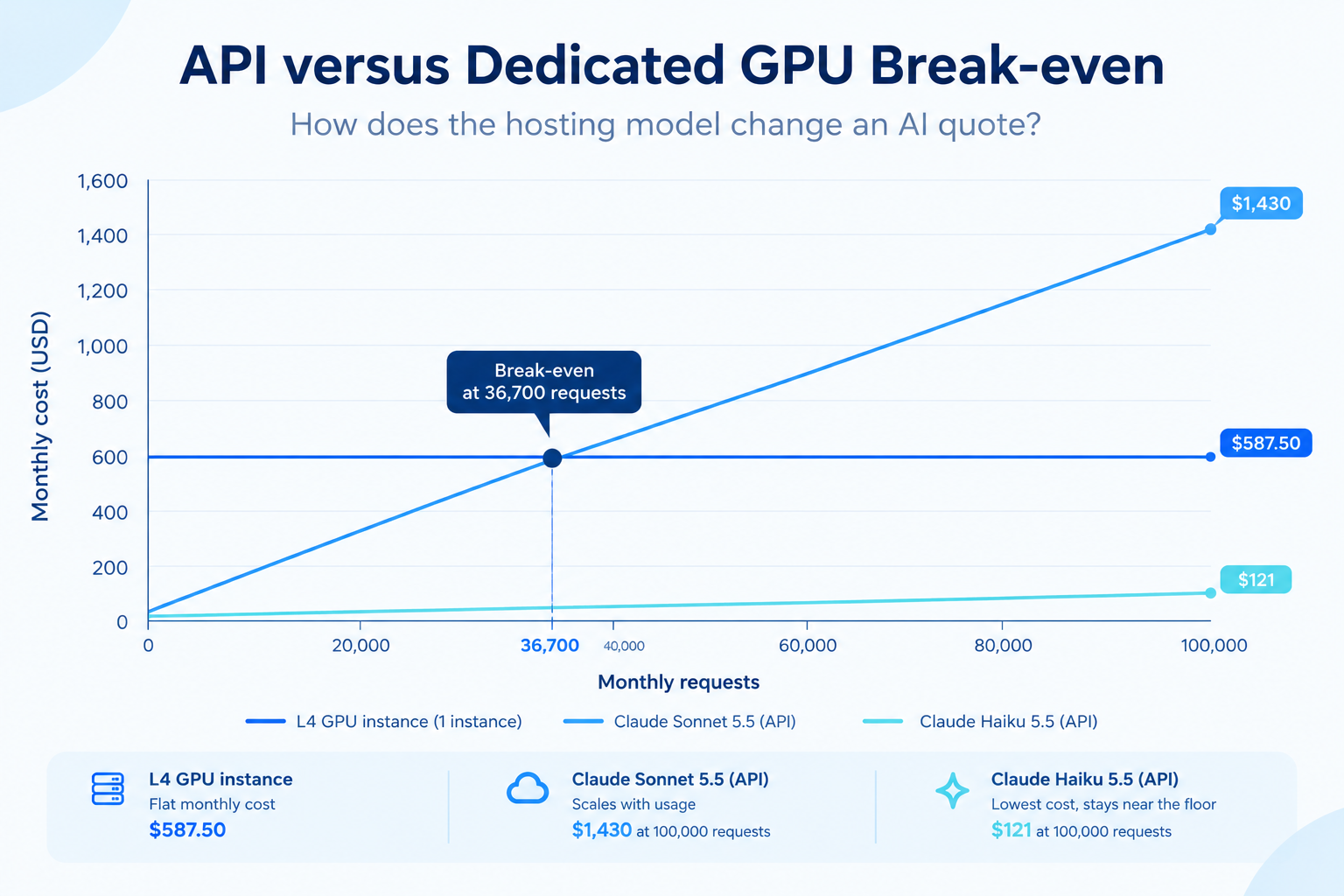
The hosting model changes a quote by swapping per-use fees for fixed infrastructure. A vendor API costs nothing until you use it. A dedicated GPU costs the same every month whether it answers ten questions or ten thousand, and it needs someone to run it, patch it and watch it.
The break-even arithmetic settles this dial for small businesses at typical volumes. One AWS g6.xlarge instance with an NVIDIA L4 GPU costs about $587.50 a month on demand. A typical request of 6,000 input tokens and 400 output tokens costs $0.016 on Claude Sonnet 5.5 and $0.0008 on Claude Haiku 5.5. The GPU only beats the API above roughly 36,700 Sonnet-class requests a month, or about 734,000 Haiku-class requests, and the open-weight model you’d run on that GPU still needs engineering time the API doesn’t.
Below 30,000 requests a month, stay on an API unless a data rule forces private hosting. Edge hardware is a separate case, justified when latency or factory connectivity rules out the cloud, and our edge AI development team scopes it as a Band 4 build.
A $15,000 AI quote becomes a $45,000 quote when one dial moves, and on small-business projects that dial is usually your data.
How do you set a first AI budget in five steps?
Set a first AI budget by pricing the problem before the solution. Work out what the task costs you today, read your four dials honestly, pick the lowest band that pays back within 12 months, and reserve a year of running costs before you sign any statement of work. The five steps below take about one afternoon.
- Price the task you want to remove. Multiply monthly volume by minutes per task and the loaded hourly cost of whoever does it. A team handling 2,000 invoices a month at four minutes each and $35 an hour spends $4,667 a month on that work [ILLUSTRATIVE].
- Read your four dials. Mark data readiness, integration depth, accuracy target and hosting model as cheap, middle or expensive, then apply the Band-Jump Rule to your starting band.
- Pick the lowest band that pays back inside 12 months. A $15,000 Band 2 build costing $300 a month to run that removes 60% of that invoice work saves $2,800 a month and pays back in about six months [ILLUSTRATIVE].
- Reserve 12 months of running costs and a contingency. Multiply the band’s monthly running cost by 12 and add 15% of the build price as contingency for the surprises every data set hides
- Buy a fixed-scope first phase with a written exit. Start with a two-to-four-week paid proof of concept (POC) on your real data, with the pass mark written down before work starts. Our AI proof of concept and MVP development team runs this phase as a fixed-price engagement.
A per-employee benchmark gives you a sanity check on that number. An Atlanta Fed study of senior executives found expected AI spending of $2,068 per employee in 2026 on average, with more than half of firms planning $200 per employee or less. At that median, a 50-person company plans to spend $10,000 or less, which lands squarely in Band 2.
Is a freelancer, an agency or an AI specialist cheaper for a small business?
Off-the-shelf AI software starts at a per-seat subscription, and a freelancer bills by the hour or by the task. A specialist AI partner tends to cost less per working result once data, integration and accuracy work enter the scope, since those three dials are where inexperienced builds overrun. The table compares all four on the rows that decide your 12-month spend.
| What you’re comparing | Off-the-shelf AI software | Freelance developer | Generalist software agency | Specialist AI partner (Brainy Neurals model) |
|---|---|---|---|---|
| How the price is set | Per-seat or per-use subscription | Hourly or fixed bid per task | Hourly, with Clutch-listed averages of $25 to $49 an hour | Fixed-scope phases priced against the five bands |
| Time to first working version | Same day to one week | Two to six weeks | Six to 12 weeks | One to four weeks for a Band 1 or Band 2 proof of concept |
| Data readiness work | You adapt your data to the tool | Often left to you | Scoped as generic data work | Read as a dial at scoping and priced up front |
| Integration depth | Limited to the vendor’s connectors | One integration at a time | Strong on web and app integration | Read and write integrations with error handling and rollback |
| Accuracy evaluation | The vendor’s own claims | Rarely written down | Functional testing, rarely model evaluation | Written test set signed off before the build |
| Ownership of code, model and data | The vendor keeps the product | Set by the contract | Set by the contract | You own the code, prompts, model weights and data |
| Running-cost visibility | Fixed subscription | Often left out of the quote | Hosting estimated, model spend often missed | Monthly running cost stated per band before signature |
| Support after launch | Vendor help desk | Depends on one person | Retainer | Monitoring, quarterly evaluation and retraining options |
Start with the left column whenever a subscription covers the task, because a seat costing tens of dollars a month beats a $5,000 build every time it does the job. Move right only when a dial demands it, insist on full ownership of code, prompts and model weights whoever you hire, and walk away from any vendor who wants to keep the weights.
“Across the 40+ AI projects we’ve shipped to production for 12+ years, the first question I ask on a scoping call is where the data lives and what state it’s in. Our document AI pipeline now handles 50,000+ documents a month across 47 formats and cut manual review by 80%, and those 47 formats set its budget long before anyone picked a model.”Mitesh Patel, NVIDIA Certified AI Architect, Founder & Director, Brainy Neurals
What do the numbers say about AI costs and returns in 2026?
The 2026 numbers say AI has become cheap to buy and remains easy to waste. Adoption among small firms is rising fast, model prices have collapsed, and the projects that fail tend to fail on data and scope. Each figure below maps to one of the four dials.
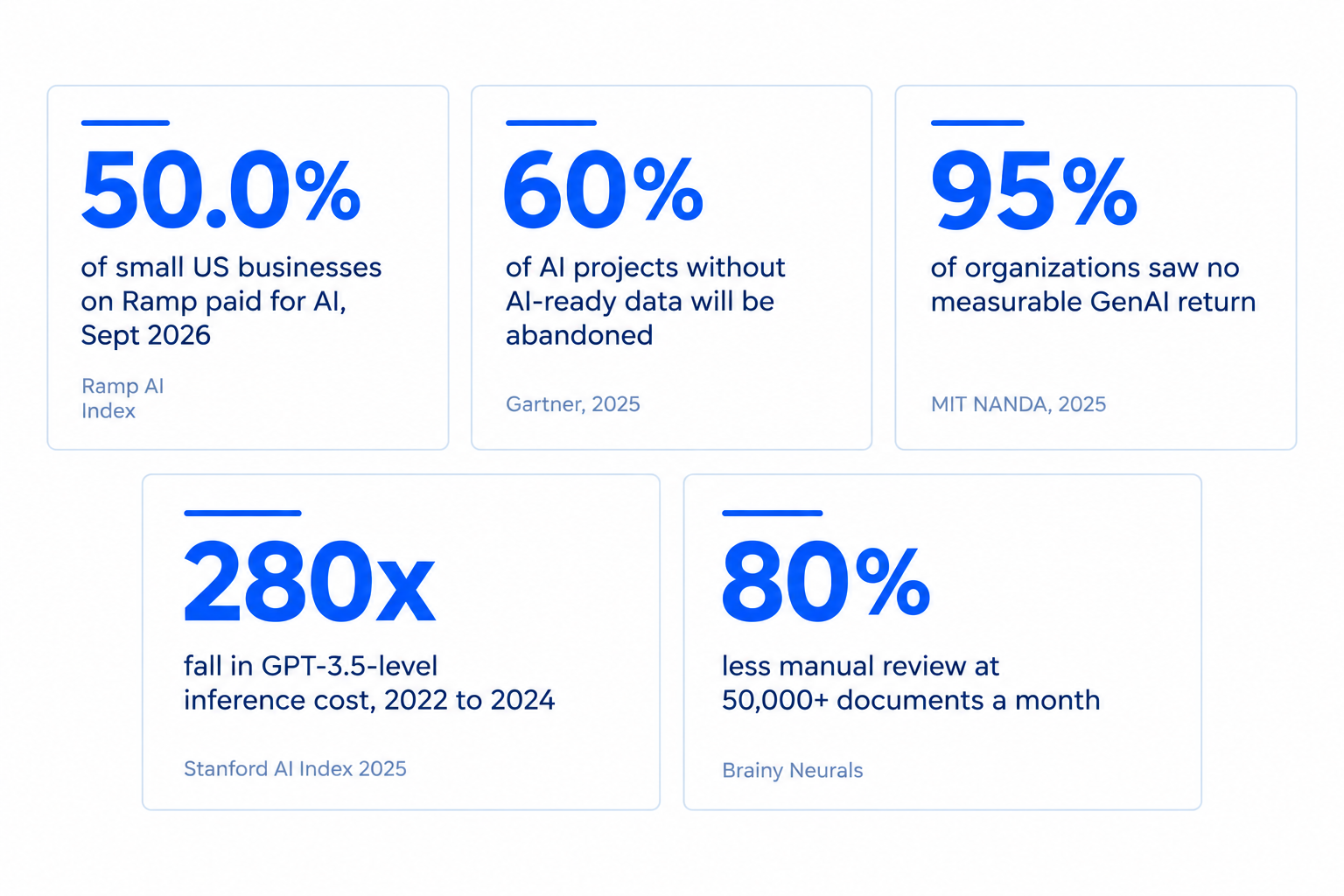
- 50.0% of small US businesses on Ramp paid for AI in September 2026, up from 38.6% a year earlier (Ramp AI Index, 2026).
- 60% of AI projects unsupported by AI-ready data will be abandoned through 2026, by Gartner’s forecast (Gartner, February 2025).
- 95% of organizations saw no measurable return from generative AI in MIT NANDA’s research (MIT NANDA via Virtualization Review, 2025).
- 280x was the fall in GPT-3.5-level inference cost between November 2022 and October 2024 (Stanford AI Index, 2025).
- 80% less manual review came from a Brainy Neurals document pipeline running 50,000+ documents a month across 47 formats (Brainy Neurals project data).
Measurement choices change these figures, so read them with care. The Census Bureau’s Business Trends and Outlook Survey found 19.8% of US businesses using AI to produce goods or services as of May 3, 2026, against 37% of firms with 250 or more employees. Ramp counts any paid AI transaction and put all businesses on its platform at 55.9% in September 2026, while Census asks whether AI is used in production. That difference in method explains why the two figures sit more than 30 points apart.
When is custom AI development the wrong spend for a small business?
Custom AI development is the wrong spend in five situations, and in each one your money earns more somewhere else first. A custom build assumes a repeated task, an owner for it and a budget that runs past launch day. Check all five before you ask for any quote:
- A business seat already does the job. If a paid ChatGPT or Claude seat with your files attached answers the question, buy the seat and stop there. Our guide to choosing between a tool, automation or custom model walks through that decision.
- The task runs fewer than 200 times a month. At four minutes a time and $35 an hour, 200 repetitions cost about $467 a month, so even a $5,000 build needs close to a year to pay back.
- Nobody owns the process or the data access. An AI project with no internal owner stalls at the first data request, and the vendor bills for the waiting.
- You need unattended accuracy on a Band 2 budget. A promise of 99%+ with no human review on a $15,000 budget means somebody skipped the testing math, and you’ll pay for it after launch.
- The budget covers the build and nothing after it. Models drift, suppliers change their invoice layouts and APIs change versions, so a project with no running budget degrades within a year.
What should you do with your AI budget this quarter?
You can set your first AI budget this quarter without talking to a vendor. This week, price the task you want to remove and export 200 real examples of it into one folder. Next week, mark your four dials and pick the lowest band that pays back inside 12 months. Then add a year of running costs to that number. Model prices will keep falling through 2027, so a budget built on token costs gets cheaper by itself, while a budget built on bad data only gets more expensive. If you’d like your dials read by someone who has shipped this work, our AI consulting and strategy team turns that worksheet into a fixed-scope first phase.
FAQ
Frequently asked questions
Building AI for a small business costs about $5,000 to $250,000 in 2026. A staff assistant over your own documents runs $3,000 to $8,000, and an invoice or order automation that writes into your accounting system runs $8,000 to $25,000. A customer-facing assistant with live order lookup runs $25,000 to $60,000, and a custom-trained model starts near $60,000. Your data, integrations, accuracy target and hosting decide where you land
The cheapest start is a paid seat on an existing AI product such as ChatGPT or Claude, at a few tens of dollars per user per month. If the task needs your documents and stays internal, a Band 1 assistant at $3,000 to $8,000 is the next step up. Spend on custom development only when a subscription can’t reach your data, your systems or your accuracy needs.
Monthly running costs range from about $75 for a configured staff assistant to $6,000 for a privately hosted model. Model fees are the smallest part at small-business volumes, since 4,200 questions a month on Claude Haiku 5.5 cost about $3. Hosting, vector databases, monitoring tools, storage and periodic retraining make up the rest. Budget 12 months of running costs before you sign for the build.
Quotes vary because each vendor reads four conditions in your business differently, namely your data readiness, integration depth, accuracy target and hosting model. A vendor who assumes clean data and one read-only integration quotes Band 2. Another vendor, who spots scanned paperwork and a two-way ERP sync behind the same request, quotes Band 3 for the identical idea. Agency hourly rates also span $25 to $49 on Clutch’s 2026 averages, which multiplies the gap.
AI development is both a one-time cost and an ongoing expense. The build is paid once, and the system then needs model fees, hosting, monitoring and periodic retraining every month it runs. Suppliers change document layouts, customers ask new questions and model versions get retired by their vendors. A sound first budget reserves 12 months of running costs plus a 15% contingency on the build price.
A custom AI solution for a small company takes one week to nine months to build, depending on its band. A staff assistant over clean documents ships in one to two weeks, and a single-workflow automation in three to five. Customer-facing assistants need eight to 12 weeks for testing, a custom-trained vision model needs four to six months, and privately hosted systems need six to nine.
Use the API unless a data rule forces private hosting. One dedicated cloud GPU costs about $587.50 a month on demand, and it only beats Claude Sonnet 5.5 pricing above roughly 36,700 typical requests a month. Against Claude Haiku 5.5 the break-even sits near 734,000 requests. If data must stay in your own cloud account, try a managed service such as Amazon Bedrock or Azure OpenAI before buying GPU capacity
Your data is ready if you can export 200 representative examples of the task into one folder in about an hour. Those can be invoices, past support tickets or photos of defects, and they should be digital, current and consistently formatted. If the export takes a week, plan a band higher. Gartner forecasts that 60% of AI projects without AI-ready data will be abandoned through 2026.
About the author

Mitesh
Mitesh has shipped 40+ enterprise AI systems across manufacturing, banking and financial services, healthcare, pharmaceuticals, construction and logistics. Brainy Neurals is an NVIDIA Inception Partner and a member of AWS Activate and Microsoft for Startups, and it runs an ISO 27001 certified security program. He holds status at both the individual and company level, a Top 3% ranking, and brings 12+ years of applied AI experience to every
engagement.
Book a 30-minute AI budget scoping call with Mitesh Patel, NVIDIA Certified AI Architect. You’ll leave the call with your four dials marked, your starting band and a monthly running cost you can take to your finance lead. Book your 30 minutes with AI Consultant