

What Does “AI-Ready Data” Mean in a Pharma Plant? A Beginner’s Checklist
Gartner: 60% of AI projects without AI-ready data will be abandoned. A 7-point plant walk to check yours no software purchase required. Run it.

Quick Answer.
AI-ready data means the records in your plant are findable, readable by a machine, consistent, and trustworthy. Nothing more exotic. You can check all four with a seven-point walk through your file room, QC lab, shop floor, and shared drive no software purchase required.
Gartner predicts that through 2026, organizations will abandon 60% of artificial intelligence (AI) projects that lack AI-ready data. Most plants hear that and look at the server room. After a decade in pharmaceutical quality assurance, I look at the batch record storeroom, the QC logbook shelf, and a shared drive folder named “FINAL_v2.” AI readiness is not an IT project. It’s a filing question with a technical name.
This post gives department heads and documentation officers a plain-language definition, then a seven-point checklist you can run in one afternoon with a notepad, each point anchored to an artifact you already recognize. It will not cover data-lake architecture, master-database builds, or tool selection. Readiness comes first.
What does "AI-ready data" actually mean in a pharma plant?
It means four things. Your records are findable: locatable without asking three people. Readable: a machine can extract the values, not just display the page. Consistent: the same field carries the same name and format every time. And trustworthy: you can prove where each record came from and that nobody altered it. That is the entire definition.
If the fourth attribute sounds familiar, it should. Trustworthy is data integrity, the discipline your plant already trains on under ALCOA+ and the MHRA GXP Data Integrity Guidance. Gartner’s formal definition assumes governed pipelines and a data team: right for a 5,000-person enterprise, useless for a 120-person plant. At plant scale, the four attributes are the definition, and three of them are filing, format, and naming questions rather than technology. The series opener covers what AI actually does in pharma documentation (link target pending publication).
AI-ready is a property of your records, not of your infrastructure.
Why do AI projects fail on data quality?
Because the model is rarely the problem; the records feeding it are. In a Gartner survey, 63% of organizations either lacked, or weren’t sure they had, the right data management practices for AI (2025). MIT’s Project NANDA reported in July 2025 that 95% of generative AI pilots produced no measurable profit-and-loss impact. And IDC puts roughly 90% of organizational data in unstructured formats: documents, PDFs, images — a pharma plant’s native state.
| 60% | 95% | 90% | $12.9M |
|---|---|---|---|
| AI projects predicted abandoned through 2026 without AI-ready data (Gartner) | Generative AI pilots with zero measurable P&L impact (MIT NANDA, 2025) | Organizational data that is unstructured (IDC) | Average annual cost of poor data quality (Gartner) |
On 2 April 2026, the FDA issued Warning Letter 320-26-58 to Purolea Cosmetics Lab, its first with a dedicated section on AI use in manufacturing, after AI-generated specifications and master production records were used without adequate controls.
In a regulated plant, un-ready data doesn’t waste budget quietly. It writes itself into a warning letter.
How do you check readiness? Run the 7-Point Plant Data Walk
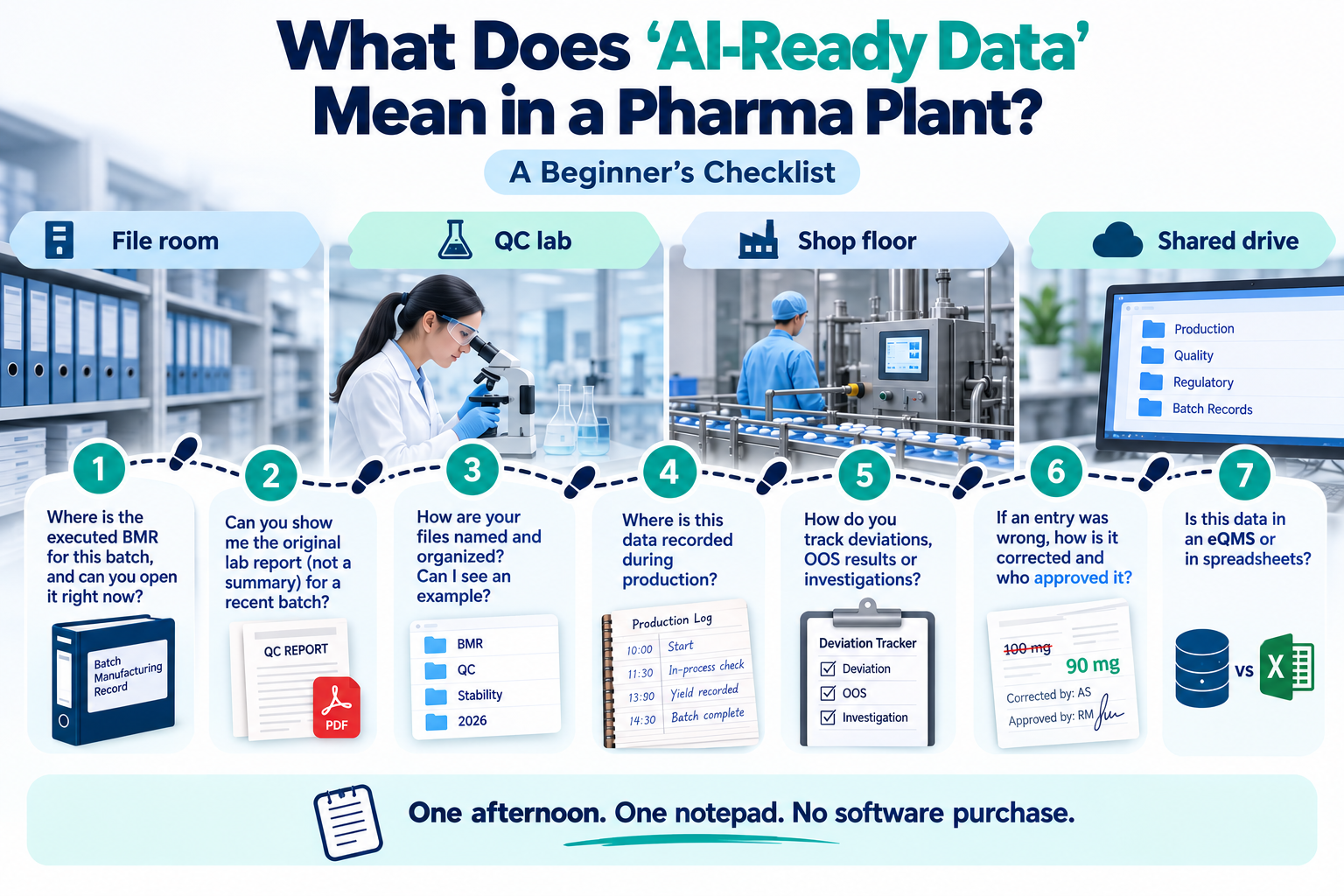
Not with a maturity assessment. With an afternoon, a notepad, and seven questions asked in front of the records themselves. Pick five record types: batch manufacturing records (BMR), certificates of analysis (COA), equipment logbooks, deviation and corrective and preventive action (CAPA) files, and training records. The walk sits inside our foundations series on AI in pharma documentation for small and mid-size QA teams. (Inline CTA, ~30%)
- Where does each record actually live?
- Can a machine read the format it’s in?
- Do your files follow one naming convention?
- Are the records complete, every field, every time?
- Does every record type have one named owner?
- Would the data pass an ALCOA+ spot check?
- Is there one system of truth per record type?
1. Where does each record actually live?
The artifact: the executed batch record an auditor asks for. The test: name a batch from eighteen months ago and time how long the complete record takes to reach the table. In plenty of plants the honest answer involves three people, a storeroom key, and a shrug. Note where each record type’s current version and archive live. More than one honest answer means the point fails.
If finding a record takes tribal knowledge, it isn’t findable — for an inspector or for an AI.
“In ten years of QA, I’ve never seen an inspector ask whether a plant had a data lake. I’ve watched plenty ask for a batch record and time how long it took to appear. Retrieval time is the most honest data-readiness metric a plant owns.”
— Kinjal Patel, Senior Consultant — QMS, Validation & GMP Compliance
2. Can a machine read the format it’s in?
The artifact: the scanned batch record PDF on the shared drive. It looks digital. It isn’t.
“A scanned batch record is a photograph of your data, not your data.
A scan preserves the image of the page, not the temperature entry in step 14 as a value software can use. Sort holdings into three piles: structured records whose values export directly; native Excel and Word files where structure wobbles; and images, scans and paper, where every value needs extraction. Printed text reads well under modern optical character recognition (OCR); handwriting, corrections, and carbonless copies stay error-prone, which is where document AI extraction earns its keep .
The question is never “do we have the data.” It’s “can software reach the values.”
3. Do your files follow one naming convention?
The artifact: BMR_final_v2_REAL.xlsx beside BMR_final_v2.xlsx . A human laughs and picks one; software can’t, and neither can the new QA officer. Consistency runs at file level and field level: no system can guess that “Batch No.”, “B. No.”, “Lot #”, and “BN” are the same field. The check: open ten files of one record type; if the pattern isn’t obvious in ten seconds, it doesn’t exist. The fix costs one written page and the discipline to hold it.
A naming convention is the cheapest data infrastructure a plant will ever buy.
4. Are the records complete, every field, every time?
The artifact: the blank line in the equipment logbook. Completeness is one of the attributes the “+” in ALCOA+ adds, and it matters doubly for AI: a system grounded on records with silent gaps learns the gaps as normal. Pull ten executed records of one type and count empty fields, unexplained “N/A” entries, and missing dates or signatures. If the same field goes blank week after week, that’s a process problem wearing a documentation costume.
Every blank field is a question somebody, or something, will answer wrong.
5. Does every record type have one named owner?
The artifact: the Excel tracker three people update and nobody answers for. Ownership means one named role accountable for a record type’s location, format, and quality not a committee, not “IT.” 21 CFR 211.22(d), which requires quality unit responsibilities and procedures to be written and followed, drew 184 Form 483 citations in FY2024, the most-cited drug GMP observation four years running per RAPS’ analysis of FDA inspection data .Name the one person who would answer for each record type in an audit. Hesitation is a fail.
Data nobody owns is data nobody can vouch for.
6. Would the data pass an ALCOA+ spot check?
The artifact: the corrected entry with no initials and no date, or the uncontrolled photocopy riding a clipboard. Trustworthy is where AI readiness and data integrity become the same discipline. MHRA frames data integrity as keeping data complete, consistent, and accurate across its lifecycle, and PIC/S PI 041-1 carries the same expectations into inspections: attributable, legible, contemporaneous, original, accurate, plus complete, consistent, enduring, and available.15% of FY2025 FDA warning letters cited data integrity (The FDA Group). A site that controls its copies and audit-trails its corrections,what a DRAFT watermark and controlled-print governance protect,
has solved the hardest quarter of readiness already.
“If your plant already runs ALCOA+, you’re closer to AI-ready than the consultants say. The gap is structure, not discipline.”
7. Is there one system of truth per record type?
The artifact: the eQMS that says one thing and the parallel spreadsheet that says another. When two sources disagree, which wins? If the answer is “depends who you ask,” an AI grounded on that corpus retrieves the wrong one confidently the same failure class as drafting from a superseded master instead of the effective version .One system of truth doesn’t mean one system for everything: each record type gets one designated authoritative location, whether Veeva Vault, MasterControl, Qualio, or a disciplined shared drive, and everything else is marked a copy. The designation is a decision, not a database project;building a plant master database comes later.
You don’t need one big system. You need one honest answer per record type.
Paper, scanned PDF, or structured record — how does each score?
Most plants hold all three states at once, with the working set concentrated in the middle column: a starting point, not a crisis.
| Readiness attribute | Paper original (file room) |
Scanned PDF (shared drive) | Structured record (system export) |
|---|---|---|---|
| Findable | Filing + tribal knowledge |
Filename search only | Query by batch, product, date |
| Machine-readable | No; retyping required | Image only; needs OCR | Values available directly |
| Consistent fields | Varies by template revision |
Inherits paper’s variation | Enforced by the system |
| Trustworthy | Wet-ink; manual trail | Copy status often unclear | Audit trail, e-signatures |
| Retrieval time (18-month batch) |
Hours to days | Minutes, if named well | Seconds |
| Review effort | Full manual read | Full read, on screen | Review-by-exception possible |
| Typical failure mode | Misfiled, damaged, lost | The photograph problem; uncontrolled copies |
Structured garbage, in structured garbage out |
| AI usability today | Low without extraction work |
Medium; extraction plus review | High |
Structure guarantees readability, not quality: a system fed inconsistent entries produces well-organized garbage, which is why points 3 through 6 apply to electronic records too.
Column two is a workable starting point. Column one is where retrieval time goes to die.
Get the BMR Review-Readiness Checklist,the printable worksheet version of this walk, built for batch records.[BUILD PENDING] Live fallback:email ai@brainyneurals.com with “BMR checklist” and we’ll send it when it ships — and tell you honestly where your records stand meanwhile.
What does "AI-ready" NOT mean?
It does not mean a transformation program. Four misconceptions do the most damage at small plants:
It doesn’t mean building a data lake first. The architecture conversation is real and it is later, at the master-database stage. Enterprise definitions assume a data team; the walk assumes a notepad.
It doesn’t mean digitizing everything before starting. Readiness is scoped to the record types one use case touches.Digitize-everything programs are how budgets die before value appears.
It doesn’t mean repairing ten years of history. Apply the discipline going forward; backfill only what a defined use case demands.
It doesn’t mean clean data excuses a dirty process. If the logbook grows a new blank line every week, cleaning last year’s logbook changes nothing. Fix the step that creates the gap.
None of it changes the series’ standing governance rule: an AI output is a draft until a qualified reviewer signs it how QA release review treats an AI-drafted record. Readiness prepares the inputs. Humans still own the record.
Readiness is a scoping discipline, not a transformation program.
I’ve pulled records for audits for a decade. The pattern is always identical: the record exists finding it takes three people and a storeroom key. The fix is rarely more filing discipline. It’s deciding, once, where the single source of truth lives for each record type, and writing that decision down.
FAQ
Frequently asked questions
It means the plant’s records are findable, readable by machines, consistent in naming and format, and trustworthy under data-integrity scrutiny. It is a property of the records themselves, not of any platform. A plant with well-organized paper and disciplined ALCOA+ practice can be closer to ready than one with an underused eQMS surrounded by parallel spreadsheets. The walk above tests all four attributes.
Only the record types a specific use case touches. Document-drafting assistance needs the controlled masters, standard operating procedures, and executed batch records for one product family. Deviation analytics needs deviation and CAPA files. Start from the use case, list the records it reads, and run the seven-point walk on those alone, not the whole plant. Scope is the whole trick.
Because models amplify whatever they are fed. Gartner names poor data quality among the leading causes of generative AI project abandonment and predicts 60% of AI projects without AI-ready data will be abandoned through 2026.Inconsistent fields, silent gaps, and duplicate versions do not average out; they become confident wrong answers. In a GMP plant, a confident wrong answer is a potential finding.
Run the walk: pick one use case, list the record types it needs, and score each against the seven points, pass or fail. The fastest single test is retrieval time. Name a batch from eighteen months ago and time how long the complete record takes to appear. Minutes with a clear trail is a strong signal; an afternoon and three phone calls is also an answer.
Partially. Printed text on clean scans extracts well with modern optical character recognition, but handwriting, corrections, stamps, and carbonless copies remain error-prone and need human verification of every extracted value. Treat scans as starting material that requires an extraction-and-review step, not as machine-readable data. That distinction is why the checklist separates a photograph of data from data. Verification stays a human step.
They overlap heavily but are not identical. Data integrity, ALCOA+ as described by MHRA and PIC/S PI 041-1, is the trustworthy attribute: proving records are attributable, legible, contemporaneous, original, and accurate. AI readiness adds findability, machine-readability, and consistency on top. As of Q3 2026, the EU’s draft Annex 22 on artificial intelligence, still unfinalized after its 2025 consultation, points the same way: AI in GMP presumes governed, trustworthy records.
No. Scope readiness to one use case and the record types it touches. Full-plant digitization ahead of a defined use is the most common way small manufacturers spend the budget before any value appears. Going-forward discipline on the records that matter beats a backfill program covering records nothing will ever read. One use case, its record types, its walk done.
One named person per record type: typically the QA documentation officer for batch records, QC for laboratory data, and engineering for equipment logbooks, with QA holding the overall map. Not a committee, and not IT alone. IT owns systems; quality owns records. The walk itself is a one-afternoon job for a single officer with a notepad, and naming the owners comes before naming any tools.
About the author