

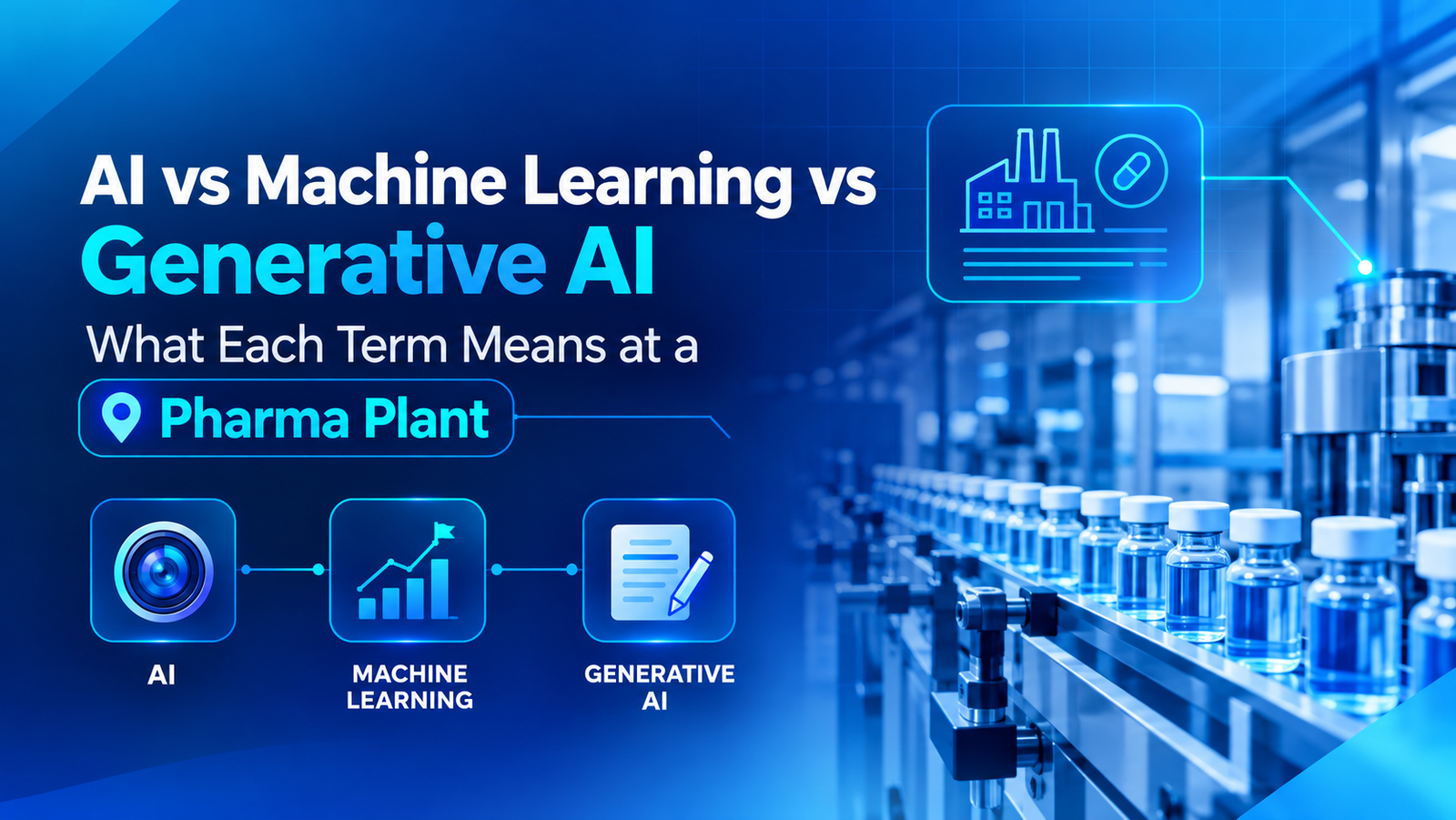
AI vs Machine Learning vs Generative AI: What Each Term Means at a Pharma Plant
Every vendor deck says "Al." At a pharma plant, machine learning, predicts batch trends; generative Al drafts text a human signs. Sort the three terms in one read.

Quick answer: Artificial intelligence (AI) is the umbrella term. Machine learning (ML) is AI that learns rules from historical data and predicts: which batch may drift out of trend. Generative AI creates new content on request: a deviation-summary draft a human then checks and signs. Knowing which is which tells you which tool fits which job, and which risks come along.
Most people treat the three terms as interchangeable jargon. After a decade in pharmaceutical quality assurance, I treat them as three different machines with different risk profiles. One watches. One forecasts. One writes. Mix them up and a plant buys the wrong tool, or trusts the right one with the wrong job.
This guide sorts the three terms with one plant example each, maps tool to job in one table, and closes on the one line about where regulators draw the boundary. Part of our AI foundations series for pharma teams
What does "artificial intelligence" actually mean at a pharma plant?
Artificial intelligence is the umbrella term for software that performs tasks normally requiring human judgment: recognizing, predicting, drafting. The label says nothing about how the software works; hand written rules and learned systems both sit under it.
Traditional automated visual inspection is rule-based AI: engineers write the rejection criteria. Amgen has reported such systems falsely rejecting up to 20% of good vials. Newer systems use deep learning: models that learned defect recognition from thousands of labeled vial images, work Merck documented in ISPE’s Pharmaceutical Engineering (2020).
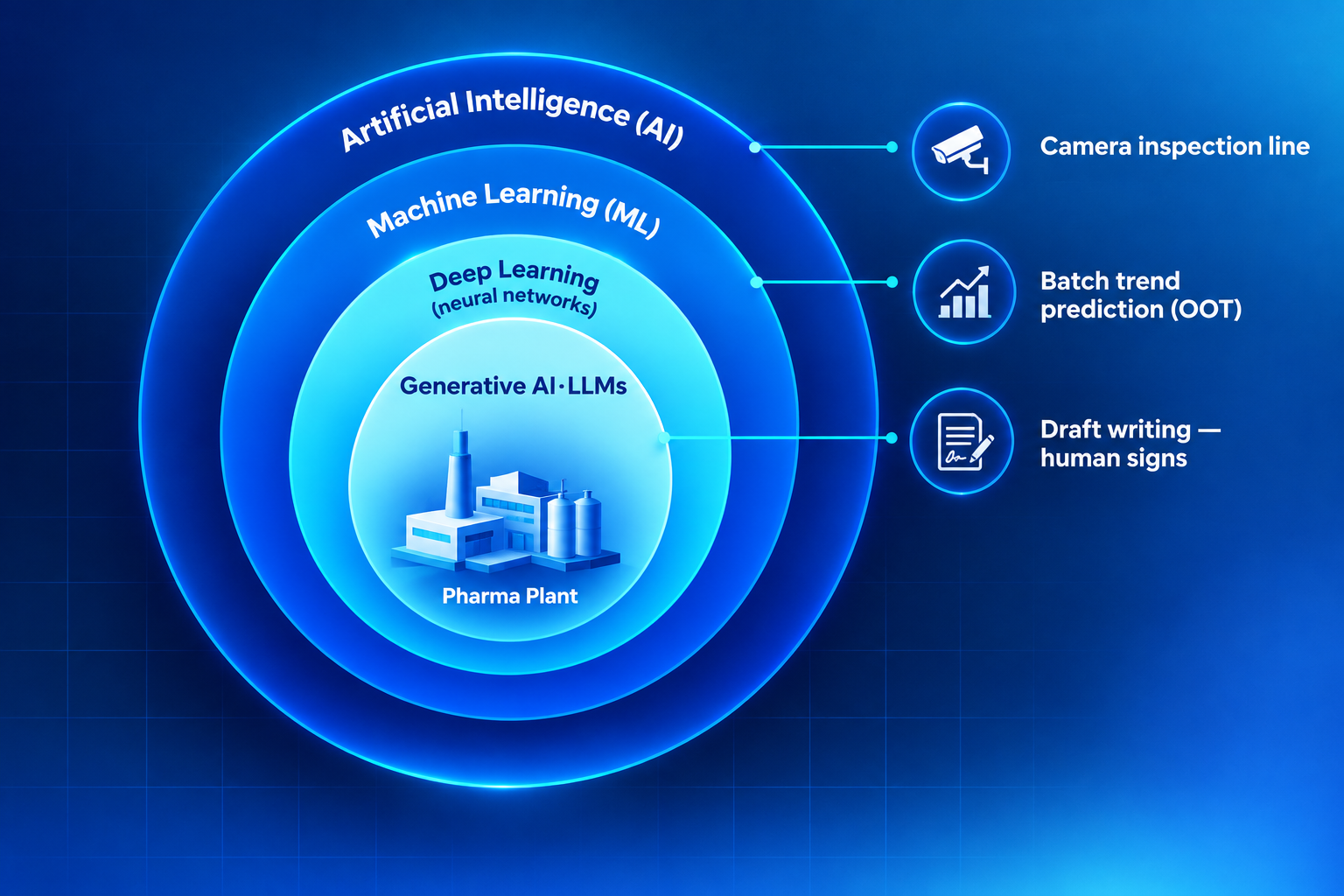
The vocabulary nests like rings: AI outside, machine learning within it, deep learning (neural networks) within that, generative AI at the center ( the ground-level primer).
Takeaway: the label tells you almost nothing; the ring you are buying tells you everything.
“Every vendor deck says AI. The useful question is which kind.”
What is machine learning, and what does it predict on your batches?
Machine learning is AI that learns its rules from historical data rather than having them hand-written. One property matters in a regulated plant: once trained and locked (a static model), it is deterministic. Same input, same output.
Its home is trending. Stage 3 continued process verification produces the time-series data these models digest, and deviations begin as drift long before out-of-specification. A trend model flags which batch is heading toward an out-of-trend (OOT) result while there is time to act; peer reviewed work in 2026 points to time-series models such as LSTMs for this monitoring.
Takeaway: machine learning answers “what will probably happen next.
What is generative AI, and why is a draft not a record?
Generative AI creates new content (text, tables, images) on request. Technically it is a subset of machine learning: ChatGPT and Claude are large language models (LLMs), deep learning applied to producing language, so ChatGPT is machine learning by construction. Behaviorally it differs in the way that matters on a good manufacturing practice (GMP) site: ask twice, and the wording can change.
Its plant-floor job is drafting: the first draft of a batch manufacturing record (BMR) section from the master formula. The output is a draft. It becomes a record only after a qualified person reviews and signs it, the boundary behind page states and DRAFT watermarks in GMP documents. The line is enforced: in April 2026, FDA Warning Letter 320-26-58 put “Inappropriate Use of Artificial Intelligence in Pharmaceutical Manufacturing” in a heading of its own, citing AI-created master production records without adequate quality unit review. More on an AI draft vs the effective version.
Takeaway: generative AI produces text for human judgment, not in place of it.
“Machine learning forecasts your trend. Generative AI drafts; a human signs. Same umbrella, different risk.”
Which kind of AI fits which job? The Perceive-Predict-Produce Map
Place any tool by asking which of three jobs it does. Perceive: reads what is physically there, like vision inspection. Predict: forecasts from history, like trend models. Produce: creates new content, like drafting. The Same-Answer Question cuts through every demo:
- Pick one real input: an image, a dataset, a drafting request.
- Run it twice, unchanged.
- Compare word for word: static models match; a generative model may not.
“In ten years across QA and vendor qualification, ‘AI-powered’ has meant everything from a lookup table to a language model. My demo question: run it twice with the same input. Same answer? Yes and no belong in different risk conversations.”
– Kinjal Patel, Senior Consultant QMS, Validation & GMP Compliance
| Artificial intelligence (umbrella) | Machine learning | Generative AI | |
|---|---|---|---|
| What it is | Software doing tasks needing human judgment | AI that learns rules from history | ML that creates new content on request |
| Plant-floor example | Camera inspection line | Flags a batch drifting toward OOT | Drafts a deviation summary |
| Same input → same output? | Rule-based: yes; learned: see right | Yes, once locked (static) | Not guaranteed; wording varies |
| The human check | Know which kind you bought | Review predictions against reality | Full review and signature before it’s a record |
AI, machine learning, and generative AI perform different jobs. In a pharmaceutical plant, each can support a different part of the process, but human review remains essential.
Where does each label mislead you?
Three misuse patterns cover most of the confusion I see, and all three are labeling failures, not model failures.
“AI-powered” hiding a lookup table. Some tools sold as AI are hand-written rules underneath; fine, but you qualify, price, and trust rules differently.
A trend model trusted outside its history. A new product, supplier, or process change puts the model outside its training data, and predictions degrade silently.
A fluent draft treated as a checked record. Generative output reads confident either way; fluency is not accuracy, which is why review-and-sign is the control.
Why is this vocabulary worth every employee's ten minutes?
94%
— quality leaders naming poor employee adoption of quality systems a top pain point
(MasterControl, 2026)
53%
— manufacturers preferring AI copilots over autonomous agents
(Rootstock, 2025)
500+
— FDA drug submissions with AI components, 2016–2023
(FDA CDER)
I’ve sat through AI vendor demos for years. The pattern is always identical: “AI” is on every slide, and nobody in the room asks which kind. The fix is rarely more technical training. It’s one vocabulary distinction: does this tool predict from history, or produce new content?
FAQ
Frequently asked questions
AI is the umbrella term for software that performs tasks normally needing human judgment. Machine learning is AI that learns rules from historical data and uses them to predict: same input, same output once locked. Generative AI is machine learning that creates new content (text, images, tables) on request. Every generative system is machine learning; the reverse is not true.
Yes. ChatGPT is a large language model: deep learning, a branch of machine learning, trained on text and applied to generating language. So it is machine learning by construction and generative AI by behavior. The distinction that matters at a plant is behavioral: it produces newly worded text on each run rather than returning one fixed, repeatable prediction every time.
In pharmaceutical operations, generative AI means systems that draft content: a batch manufacturing record section assembled from the master formula, a deviation summary built from investigation notes, a first response to a customer data request. The output is always a draft for a qualified reviewer, never a self approving record. Its value is removing retyping from documentation work, not removing judgment.
Yes. Generative AI systems are machine learning models, usually deep learning, trained to produce new content rather than classify or forecast. Picture nested rings: artificial intelligence outside, machine learning inside it, deep learning inside that, and generative models such as large language models at the center. Every generative tool inherits the properties, and the questions, of the rings around it.
Trend prediction is the cleanest example. Models trained on historical batch and continued-process verification data flag which batch is drifting toward an out-of-trend result while there is still time to act, before anything reaches out-of-specification. Deep learning visual inspection is a second example: systems that learned defect recognition from thousands of labeled vial images instead of relying only on hand-written rejection rules
No. Generative AI produces drafts; a record exists only after a qualified person reviews and signs it. The enforcement record already makes the point: in 2026, FDA cited a manufacturer whose AI agents created specifications and master records without adequate quality unit review. The human signature is the control point in GMP documentation, and every credible generative AI use keeps it.
Deep learning is one family of machine learning, the kind built on multi-layer neural networks, which powers vision systems and large language models. All deep learning is machine learning; not all machine learning is deep. Simpler, more explainable methods such as regression and decision trees are machine learning too, and for many plant problems simpler models remain the right tool.
Yes, and the pairing is natural: prediction finds the issue, generation drafts the paperwork. A trend model flags a batch drifting out of trend; a generative system assembles the first draft of the investigation summary; a person reviews, corrects, and signs it. Two kinds of AI joined in one workflow, with deterministic prediction upstream and human judgment closing the loop.