
Will AI Replace Pharma Jobs? What Actually Changes for Operators, Analysts, and QA
AI reshapes pharma work it can't hold GMP accountability. A 10-year QA practitioner maps what stays, shifts, and grows for operators, QC, and QA.

Quick answer: No. Artificial intelligence in good manufacturing practice (GMP) manufacturing is built to assist, not replace. Every quality decision still ends with a qualified person’s review and signature, and regulators have now said so in writing. What changes is the shape of the work: less transcription and searching, more reviewing, investigating, and judging.
On April 2, 2026, the US Food and Drug Administration (FDA) issued Warning Letter 320-26-58 to a small manufacturer whose AI agents had written its specifications, procedures, and master production records. Asked why process validation was never performed, the firm said the AI agent never told them it was required. The FDA rejected that defense: any AI output used in manufacturing must be reviewed and cleared by an authorized human in the quality unit. The first AI enforcement action in pharmaceutical manufacturing was not about software taking jobs. It
was about people stepping back from theirs. This post, part of our series on AI in pharma documentation for small and mid-size QA teams, walks role by role production operator, quality control (QC) analyst, QA reviewer, documentation officer through what stays, what shifts, and what grows, grounded in a fact no vendor slide changes: accountability cannot transfer to software.
Why can't AI take over accountability in a GMP plant?
Because the regulations name people, not systems, as the holders of quality decisions. In the United States, 21 CFR 211.22(c) makes the quality unit responsible for approving or rejecting procedures and specifications. It is the clause FDA cited when Purolea’s AI-written documents entered use unreviewed, with a validation gap under 21 CFR 211.100. In the EU, Annex 16 requires a Qualified Person to certify every batch before release: a personal, legal duty. The EU’s draft Annex 22 (a consultation draft as of Q3 2026; final text targeted late 2026) points the same way. Critical GMP applications are limited to static, deterministic models; generative AI and large language models (LLMs) are allowed only in non-critical roles under human oversight. Data-integrity expectations close the loop: the first letter of ALCOA+ is attributable, and the MHRA GXP Data Integrity Guidance and PIC/S PI 041-1 expect every record action to trace to a person. Software can generate a page. It cannot hold responsibility for one.
Takeaway: the signature is not a formality AI can absorb. It is the legal anchor of the quality system.
Which pharma tasks will AI actually absorb first?
The tasks that move information rather than create it. After a decade in QA, I split every GMP task into two kinds. Transfer work moves facts that already exist:
- transcribing values from logbooks into the batch manufacturing record (BMR)
- collating annexures and certificates for review
- formatting a BMR from the master formula record (MFR)
- hunting for the current standard operating procedure (SOP) revision
- first-pass completeness checks ahead of human review
Truth work creates or judges facts: observing a granulation endpoint, weighing a sample, deciding whether a deviation affects quality, signing a release. AI is genuinely good at transfer work, and that is where it lands first. The WEF Future of Jobs Report 2025 shows the same split economy-wide: clerical and data-entry roles decline fastest. Regulation finishes the sentence: truth work is reserved to qualified people by 211.22, Annex 16, and Annex 22: boundary between an AI draft and an effective GMP version, made visible on paper.
Takeaway: the honest automation list is transcription, collation, formatting, and retrieval: never judgment, never the signature.
AI takes the transfer work. People keep the truth work. The signature stays human because the law puts it there.
What changes role by role on the pharma floor?
The pattern repeats in every role: transfer work thins out, truth work concentrates, and one new duty appears everywhere: checking what the machine produced.
What changes for production operators?
The physical work and its record stay: line clearance, execution, in-process checks, contemporaneous entries, second-person verification.
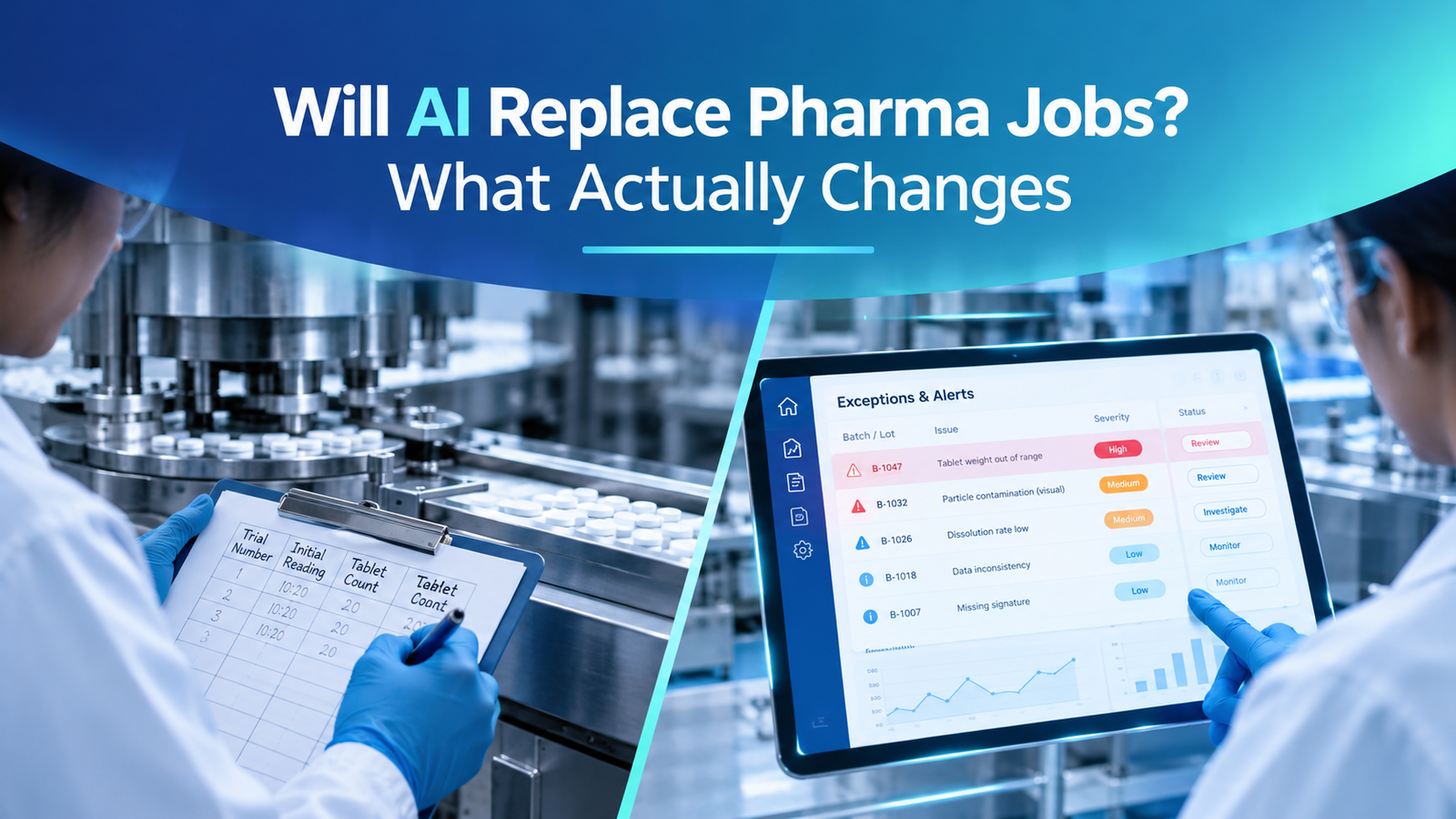
21 CFR 211.188 expects batch records completed as each action is performed; no model observes a granulation endpoint for you. What shifts is the paperwork around the work: cleaner issued documents, fewer values re-copied between logbooks and records, fewer transcription-born corrections. What grows is exception reporting: noticing, and writing down clearly, the thing the template did not anticipate.
What changes for QC analysts?
Sampling, testing, instrument work, and out-of-specification (OOS) judgment stay with the analyst. An OOS investigation under 21 CFR 211.192 is exactly the decision class regulators expect a qualified person to own. What shifts is the clerical shell around the lab: result transcription, certificate collation, specification retrieval. What grows is trending literacy and investigation depth. The analyst who can read a drift before it becomes an OOS gets more valuable as the retyping disappears, not less.
What changes for QA reviewers and documentation officers?
The decisions stay: batch record review conclusions, deviation and corrective and preventive action (CAPA) judgments, approval and rejection authority under 211.22, the release recommendation. What shifts is posture: from reading every field to review-by-exception, where the system surfaces mismatches and the reviewer judges what the flags mean, while document issuance and collation stop being manual crafts. What grows is a skill that barely had a name five years ago: reviewing AI output critically and defending that review to an auditor.
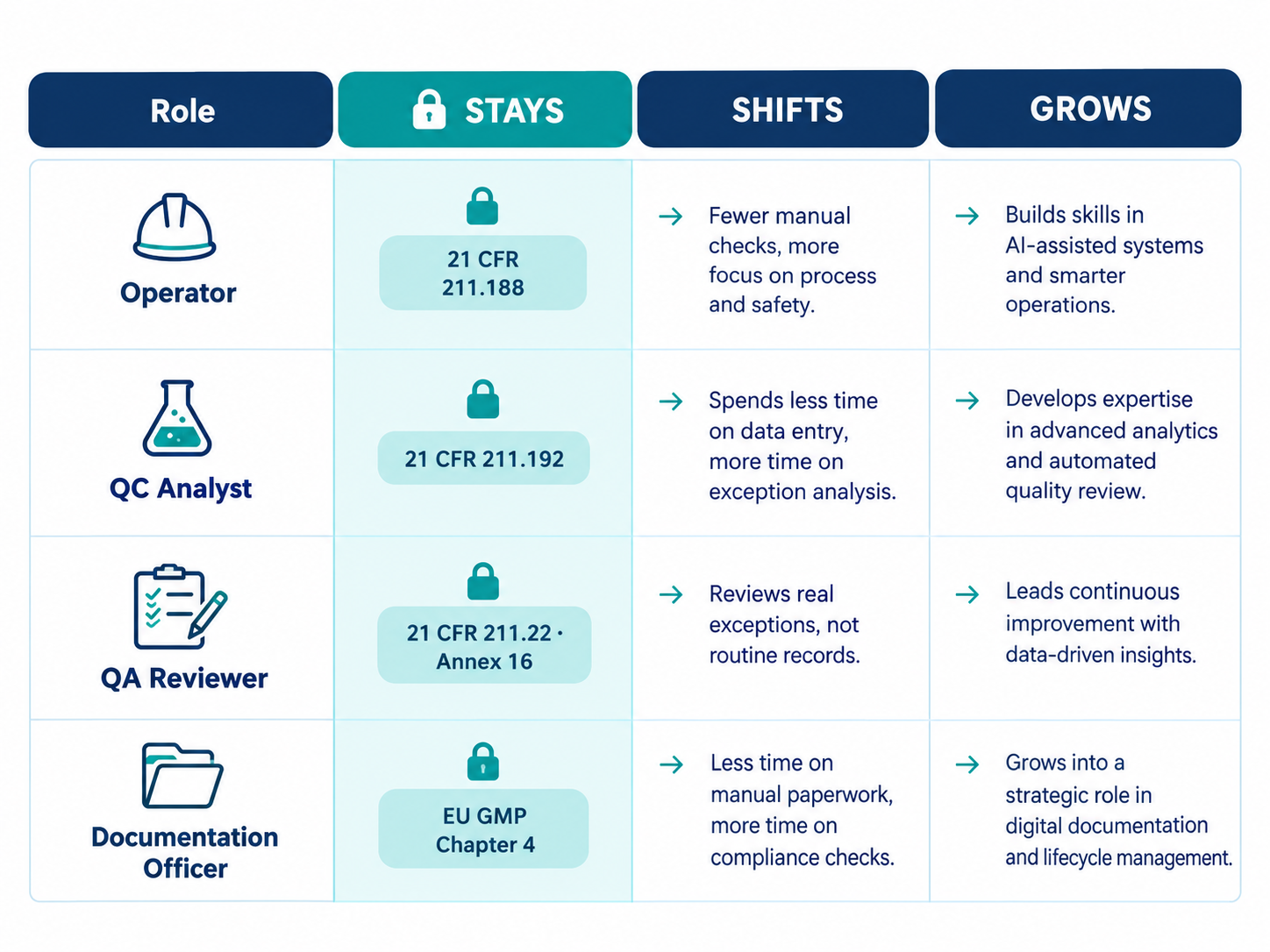
| Role | What stays (anchor) | What shifts with AI assistance | What grows in value |
|---|---|---|---|
| Production operator | Execution, line clearance, contemporaneous entries (21 CFR 211.188) | Re-copying between documents; correction loops | Exception reporting; precise contemporaneous documentation |
| QC analyst | Sampling, testing, OOS investigation judgment (21 CFR 211.192) | Result transcription; certificate collation; spec retrieval | Trending literacy; investigation depth |
| QA reviewer | Approve/reject and release recommendation (21 CFR 211.22; EU Annex 16) | Full-read review → review by-exception | Judging flagged exceptions; audit defense of AI-assisted review |
| Documentation officer | Controlled issuance; document-control ownership (EU GMP Chapter 4) | Manual formatting, collation, revision hunting | Data-integrity oversight of the tools themselves |
Takeaway: no role on this map disappears. Each sheds its clerical shell and concentrates on the calls only a person can sign for.
Which skills grow in value as AI enters the plant?
The ones AI cannot hold accountability for. Three stand out. First, critical review of machine output: after Purolea, “the tool produced it” is formally not a defense, so reviewing AI-drafted documents becomes a named QA competency. Second, data-integrity literacy: applying ALCOA+ to new tools, reading audit trails, knowing what attributable means when a draft came from a system. Third, investigation and root-cause skill, the judgment work that concentrates as transfer work thins. The WEF report puts analytical thinking at the top of core skills for 2030 and expects roughly 39% of skills to change this decade. In a plant, that means training the reviewers you already employ, in your own systems and SOPs.
Takeaway: build review skill, data-integrity literacy, and investigation depth in the people you already have. That is where the value moves.
Where does "AI won't replace you" go wrong?
Three failure modes turn a true statement into false comfort. Accountability outsourcing is the Purolea pattern: AI output flows into use without authorized quality-unit review, and a clause older than the technology, 211.22(c), does the citing. Skill atrophy is quieter: if reviewers stop exercising full review because “the system checks it,” the plant slowly loses the judgment regulation requires it to keep; oversight must be designed and trained, not assumed. Leadership silence is the third: say nothing, and the rumor mill writes the story: resistance, quiet non-use, your best reviewers reading job listings. Workforce communication decides whether a tool gets used honestly or worked around.
Takeaway: the real risk is not AI replacing people. It is people, at any level, stepping back from the parts regulation says are theirs.
What does the workforce math actually say?
1.9M · US manufacturing jobs projected unfilled by 2033, of 3.8M needed (Deloitte / The Manufacturing Institute)
80% · pharmaceutical manufacturers reporting a workforce skills mismatch (industry surveys, 2024–2026)
22% · share of global jobs facing structural churn by 2030 (WEF Future of Jobs Report 2025)
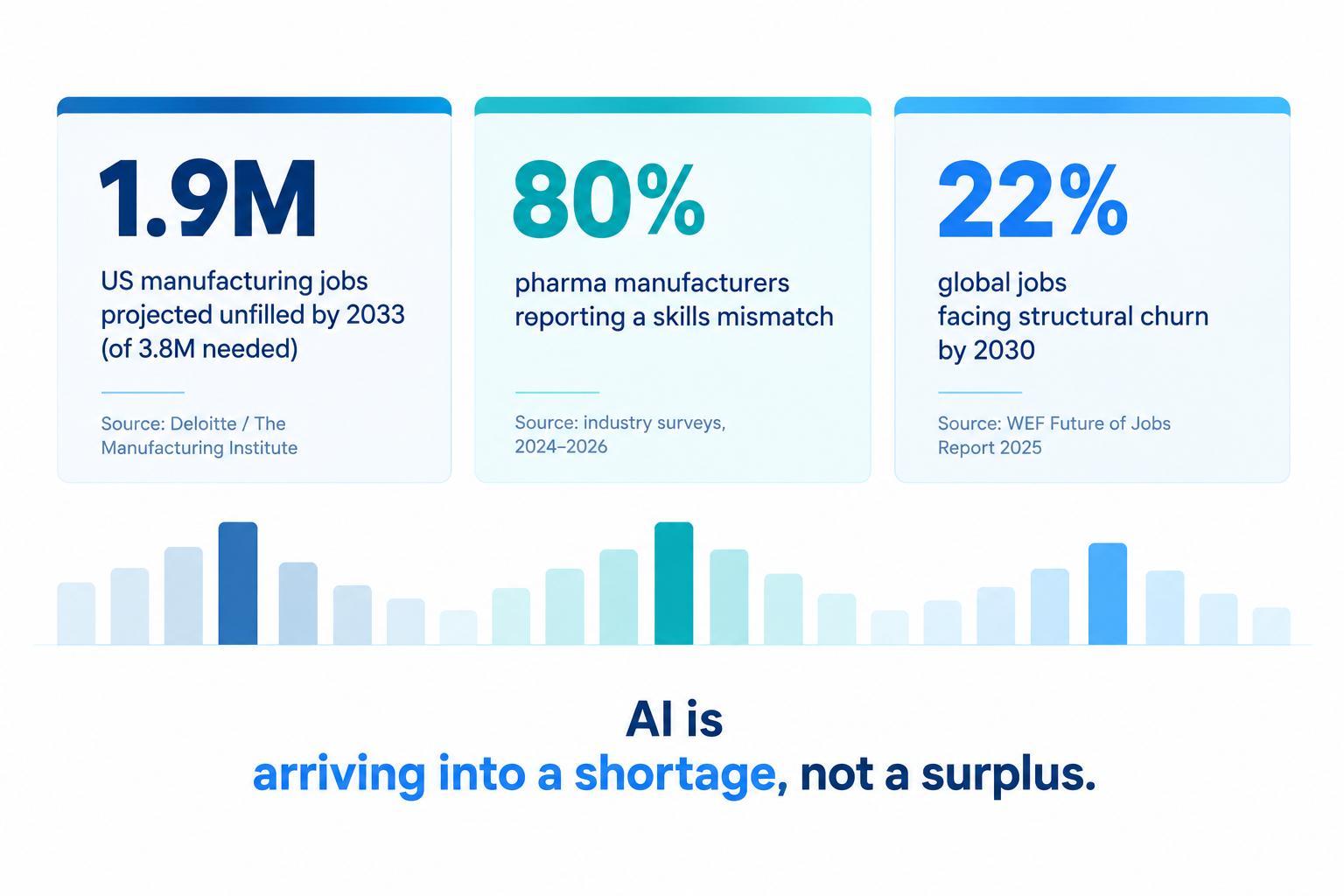
AI is arriving into a shortage, not a surplus. Deloitte’s workforce study and industry reporting through 2026 agree: for a small or mid-size plant, the realistic risk is not automation-driven layoffs but failing to redeploy scarce, qualified people onto the work only they can sign for, the same pressure behind the QA talent gap in pharmaceutical manufacturing. Machines absorbing transfer work is how a 100-person site survives a market this thin.
What should leadership say before the first tool arrives?
The replacement question is settled by regulators, in a warning letter and a draft annex, before the market finished arguing. The open question sits with leadership: will your operators, analysts, and reviewers hear what changes from you, or from a vendor demo and a corridor rumor? Name the three lists out loud for every role you employ (what stays, what shifts, what grows) before any tool is selected. Teams told the truth early become your review capacity. Teams left guessing become your resistance. For the wider map of where it legitimately fits, start with AI in pharma documentation for small and mid-size QA teams.
FAQ
Frequently asked questions
No wholesale takeover is on the evidence. The World Economic Forum projects 170 million roles created and 92 million displaced globally by 2030 (churn, not disappearance) and industry reporting through early 2026 shows biopharma reshaping roles rather than cutting them one-for-one. On a GMP floor, the decisions defining each role are reserved to qualified people by regulation, not by vendor promise.
The core of QA is protected by regulation rather than sentiment: 21 CFR 211.22 places approval and rejection with the quality unit, and EU Annex 16 places batch certification with a Qualified Person. What changes is the task mix (less transcription and collation, more exception judgment) plus one addition: reviewing AI-drafted output is becoming part of the QA job itself.
The ones heaviest in transfer work: document issuance and collation, transcription between records, specification and SOP retrieval, and first-pass completeness checks. Documentation officers and review-heavy QA roles feel the shift earliest, as a change in task mix rather than a disappearance. Roles anchored in physical observation change more slowly, and signature-holding responsibilities do not move at all under any current or drafted rule.
No. In the European Union, release requires certification by a Qualified Person under Annex 16, a personal and legal duty that cannot be delegated to software. In the United States, 21 CFR 211.22 reserves approval and rejection to the quality unit. The EU’s draft Annex 22 reinforces the same boundary, requiring human oversight and excluding large language models from critical applications.
No, and this is now enforcement history, not theory. FDA Warning Letter 320-26-58 (April 2, 2026) cited a firm whose AI agents created specifications, procedures, and master production records that entered use without quality unit review. FDA’s position is explicit: any AI output used for CGMP activities must be reviewed and cleared by an authorized human in the quality unit before use.
Yes, with human oversight. FDA applies existing CGMP requirements to AI-supported work rather than banning the tools; the Purolea letter even describes conditions for resuming production with AI in place. In the EU, draft Annex 22, still in consultation as of Q3 2026 with finalization targeted for late 2026, permits static models in critical applications and generative AI only in non-critical uses.
The workforce math points the other way. Deloitte projects up to 1.9 million US manufacturing jobs unfilled by 2033, and roughly 80% of pharmaceutical manufacturers already report a skills mismatch. Small plants are short of qualified reviewers and release decision-makers, not oversupplied with them, so the realistic outcome is redeployment onto judgment work: review, investigation, and trending, rather than reduction.
Capabilities that compound inside the plant you already work in: ALCOA+ data-integrity fundamentals, audit-trail reading, critical review of machine-drafted documents, and structured deviation and root-cause investigation. These are built on the job, inside your own quality systems and your own SOPs. The practitioner’s edge no tool replicates is knowing, from experience of the process, when an output is plausible but wrong.
About the author

Kinjal Patel
Kinjal has spent 10 years in pharmaceutical quality assurance across QMS, validation, qualification, vendor management, quality risk management, documentation, and in-process quality control, on oral solid and injectable manufacturing including batch document preparation and issuance, batch record review, IPQA, product quality review, and training management.