


What Is a Forward Deployed AI Engineer, and When Do You Need One?
A vendor-neutral sourcing decision: permanent hire, staff augmentation, or embedded pod — tested across four dated checkpoints in the first ninety days.
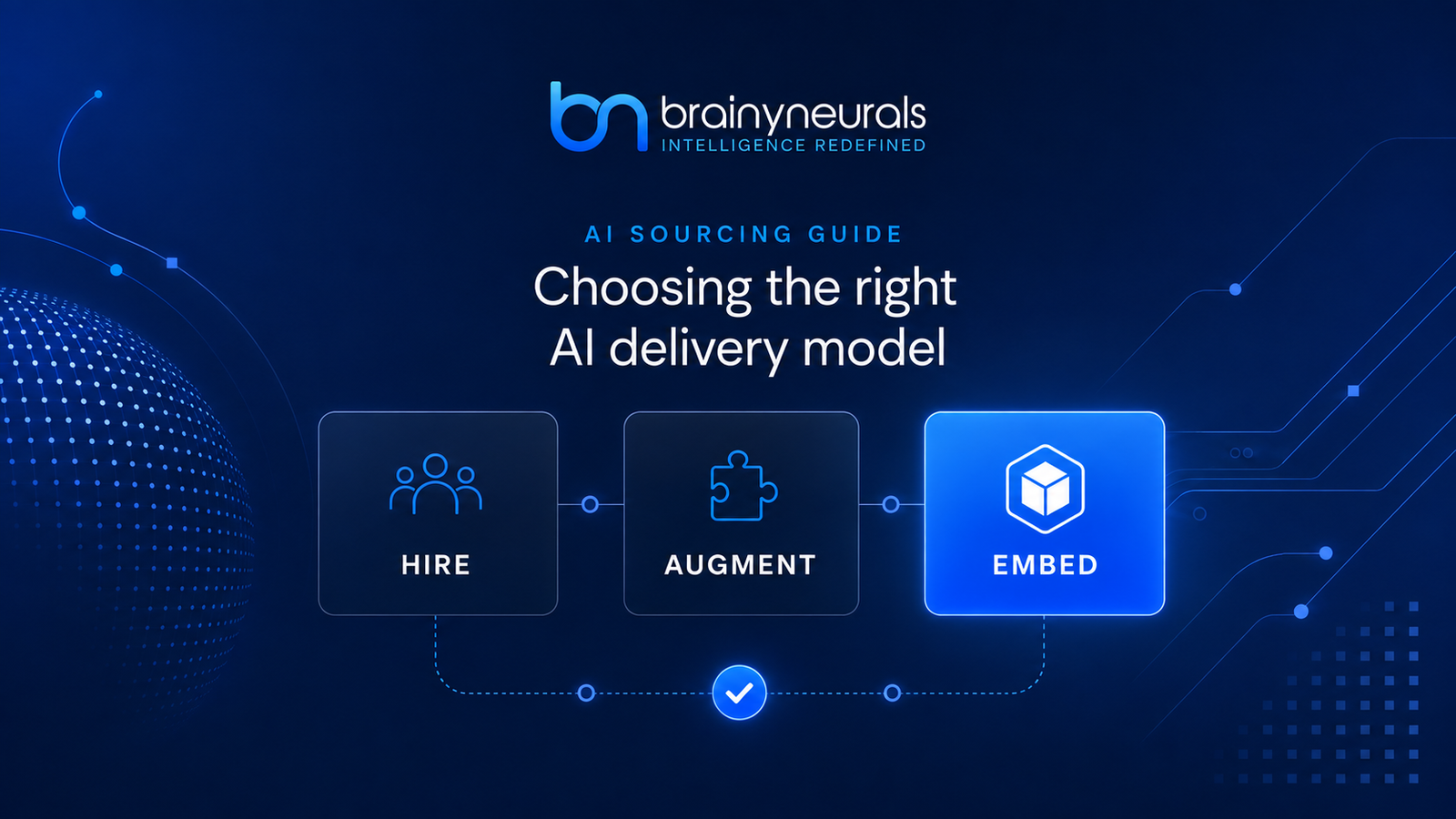
A forward deployed AI engineer is an engineer who works inside your context rather than to your specification, framing the problem, writing code in your stack, and staying accountable through production. The model fits when your problem statement is still wrong. It fails when the workload is permanent, when regulation demands in-house accountability, or when nobody internal is named to receive the handover.
The comparison every buyer runs is the wrong one
You have three proposals on your desk. One is a job description for a permanent hire. One is a staff augmentation agreement priced by the hour. One says “forward deployed engineer,” and you have not seen the term defined anywhere neutral, because the only people writing about it are selling it.
So you do what any budget owner does. You compare rate, headcount, and hours.
Across a ninety-day window, those three numbers land close enough together that they tell you almost nothing. The models differ on one axis, and it is not on the invoice: who owns the problem statement.
A permanent hire inherits yours. Staff augmentation executes yours. A forward deployed engineer rewrites yours. Every other difference, including velocity, integration depth, and what survives after the engagement ends, is downstream of that single fact.
This post defines the model plainly, compares it against the two alternatives across four dated checkpoints in the first ninety days, and names the three conditions under which the embedded model is structurally the wrong answer. It publishes no rate cards and ranks no vendors. If you are earlier in the decision and still working out which role you actually need, start there and come back.
What is a forward deployed AI engineer, precisely?
A forward deployed AI engineer is a senior engineer who embeds inside a client organisation to frame a problem, build the system that solves it, and stay accountable for that system running in production. They write code in the client’s repositories, against the client’s data, behind the client’s authentication.
The role originated at Palantir in the early 2010s, where embedded engineers eventually outnumbered traditional software engineers. It re-emerged sharply through 2025 and 2026 as the enterprise AI deployment gap widened. OpenAI established a forward deployed engineering team in early 2025; Anthropic runs an applied AI engineering function on the same pattern; Ramp built one organised into pods. The capital markets noticed. Anthropic’s enterprise deployment joint venture with Blackstone, Hellman & Friedman, and Goldman Sachs was valued at $1.5 billion, and OpenAI’s parallel development company raised at a $10 billion valuation. Two separate investor syndicates, zero overlap, funding the same structural idea.
Three distinctions matter to a buyer, and the market blurs all three:
- A consultant produces a deliverable and exits. The measure is the quality of the advice. Nothing is running when they leave.
- A solutions architect designs and rarely deploys. They draw the system; someone else builds it.
- A forward deployed engineer ships running code and stays on it. The same person who mapped the problem in week one answers when it breaks in month six.
That end-to-end accountability is the definition. Strip it out and you have re-labelled staff augmentation.
The forward deployed engineering model is also not a headcount unit. In practice it usually arrives as an embedded delivery pod: an engineer plus a fraction of an architect, a data engineer, and a delivery lead under one contracted arrangement. What makes it the same model is the ownership boundary, not the org chart.
How does it differ from a permanent hire and staff augmentation?
The three models diverge on accountability, on what survives the engagement, and on who is legally answerable when a regulator asks. They converge, almost uselessly, on cost per productive week.
| Criterion | Permanent hire | Staff augmentation | Forward deployed / embedded pod |
|---|---|---|---|
| Who owns the problem statement | You do; the hire inherits it | You do; you write the spec | The engineer rewrites it with you |
| Who owns delivery accountability | Your engineering leadership | Your engineering leadership | The pod, contractually |
| Median time to a person at a desk | 38 days mid-level, 54 days senior with generative AI specialisation, agency-assisted (KORE1, Q2 2026); 8–12 weeks unassisted | 1–3 weeks | 2–4 weeks |
| Time to full productive output | Additional 60–120 days of ramp | Fast on execution, gated by your spec quality | Gated by the framing phase, not onboarding |
| Management overhead on your side | Standard line management | High; overhead scales with every contractor added | Low; you review delivery telemetry, not tickets |
| Where the code lives | Your stack | Your stack | Your stack (verify this in the SOW) |
| Knowledge retention at exit | Retained until attrition | Leaves with the contractor | Depends entirely on the knowledge-transfer clause |
| Regulatory accountability | In-house, unambiguous | In-house; the vendor’s compliance is not yours | In-house; the vendor’s compliance is still not yours |
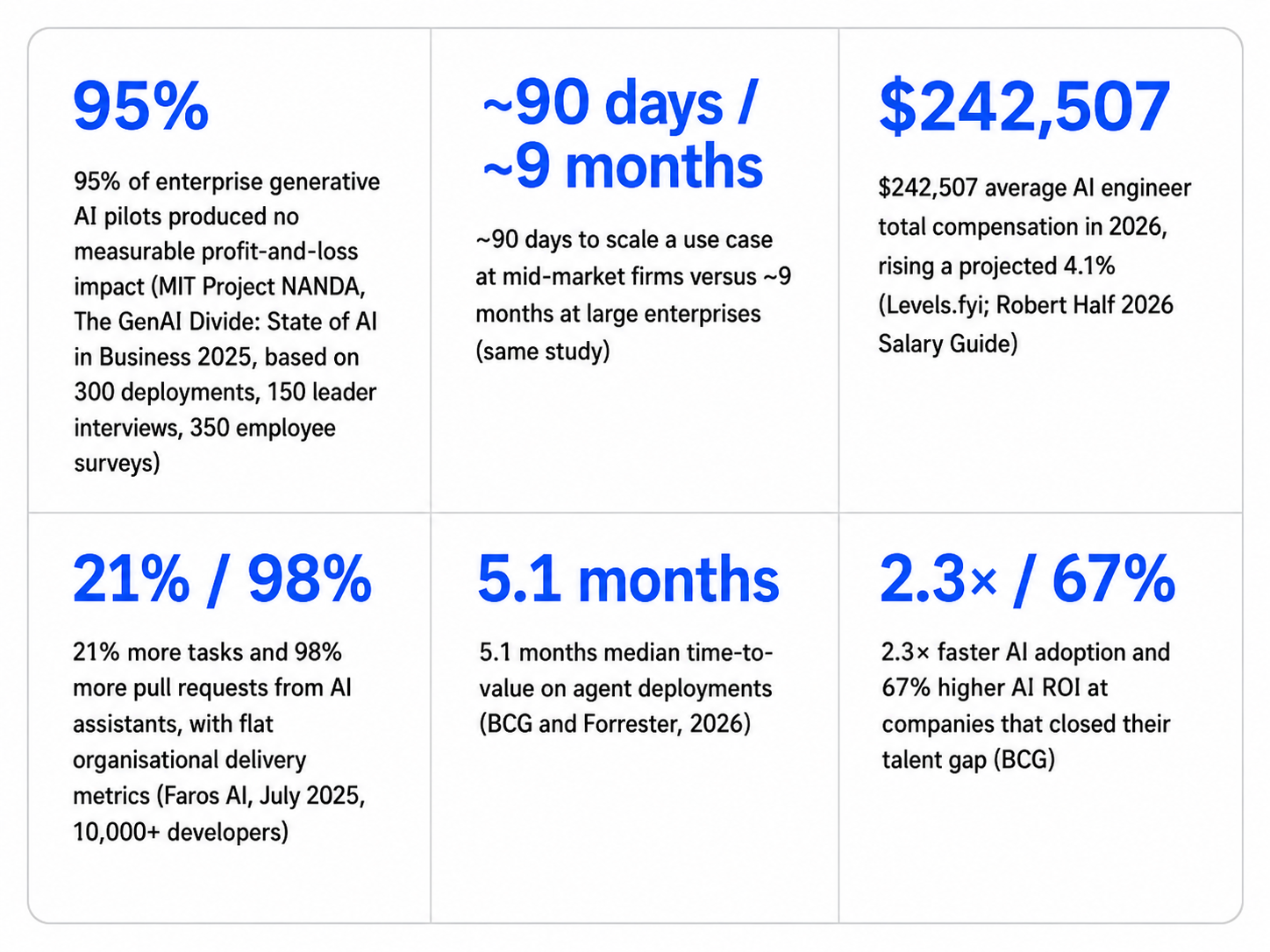
| Cost shape | Fixed and compounding. AI engineer total compensation averaged $242,507 in 2026 (Levels.fyi), with Robert Half projecting a further 4.1% rise | Variable, T&M, uncapped | Fixed-fee or outcome-based, capped by milestone |
| Characteristic failure mode | You hire for the wrong problem and cannot unwind it | Capacity increases, delivery does not | The system ships and nobody internal can run it |
The middle failure mode has hard evidence behind it. Faros AI’s July 2025 analysis of more than 10,000 developers found AI coding assistants lifted individual output substantially, with 21% more tasks completed and 98% more pull requests merged, while organisational delivery metrics stayed flat. Adding capacity, human or synthetic, does not repair a delivery system. That is the strongest argument against reflexively reaching for staff augmentation when an AI programme stalls.
The permanent-hire path is not a fallback you can pull in a hurry either. Only 16% of executives feel confident in their technology talent supply, and 87.5% of technology leaders surveyed by Lemon.io in 2026 rated hiring skilled AI engineers “difficult” or worse. Not one respondent rated it easy.
The three models are not priced differently enough to matter over ninety days. They are governed differently, and governance is what you are actually buying.
The 4-Checkpoint 90-Day Sourcing Gate
Ninety days is the right measurement window because the market already uses it. MIT’s Project NANDA found mid-market firms scale an AI use case in roughly 90 days while large enterprises average nine months, and pilots that drag past the twelve-week mark rarely graduate at all. If a sourcing decision has not produced a specific, checkable artefact by each of the four dates below, it will not produce one later.
Run every proposal against this gate before signing, and run the live engagement against it after.
Day 10The Problem-Statement Checkpoint
The test: has the written problem statement changed from the one in the original request?
If a forward deployed engagement reaches Day 10 with your original problem statement intact, you did not buy the model. You bought hands at a premium. The first deliverable of a genuine embedded engagement is a rewritten problem statement, usually narrower than the one you wrote, usually pointed at a different bottleneck than the one you assumed.
A permanent hire will not pass this test on Day 10 and should not be expected to; they are still finding the wiki. Staff augmentation passes it only if you did the rewrite yourself, which is a legitimate answer when your engineering leadership is strong and your roadmap is settled.
Failure signal: the Day 10 artefact is a project plan rather than a revised problem definition.
Day 30The Stack Checkpoint
The test: is there a merged commit in your repository, running against your data, behind your authentication?
Not a sandbox. Not a vendor-hosted demonstration environment. Not a notebook on someone’s laptop. Your stack, your access controls, your review process.
This checkpoint exists because the pilot trap is an environment problem before it is a technology problem. Teams build in isolated sandboxes that do not reflect their real data infrastructure, security requirements, or workflow complexity, then discover at scale-up that the gap is too wide to bridge on the original timeline. Roughly 78% of enterprise AI projects slip past their initial timeline, with an average delay of 8 to 16 weeks, and the delay concentrates in exactly this transition. Forcing a merged commit into the production stack at Day 30 converts that risk from a month-five surprise into a month-one negotiation.
Failure signal: the Day 30 demonstration runs anywhere other than your infrastructure.
Day 60The Production Inference Checkpoint
The test: has a real user acted on a model output inside a live workflow?
This is time-to-first-production-inference, and it should replace velocity in your governance pack. Not accuracy on a held-out set. Not a dashboard. A named human doing their actual job differently because of something the system produced.
Sixty days is aggressive against market norms. Median time-to-value on agent deployments runs about 5.1 months (BCG and Forrester, 2026), and only around 8.6% of companies have AI genuinely deployed in production. It is meant to be aggressive. The gap between those market numbers and this checkpoint is precisely the gap the embedded model claims to close. If a proposal cannot commit to a Day 60 production inference on a narrow slice, the scope is too wide and should be cut before signature rather than after.
Failure signal: the Day 60 review presents evaluation metrics instead of a user.
Day 90The Bus Factor Checkpoint
The test: can a named person on your payroll deploy the system, roll it back, and explain its failure modes, with the external engineer present but silent?
The bus factor is the number of people who can keep a system running. If yours is still one on Day 90, and that one is the vendor, the engagement failed even though the software works. You converted a capability gap into a dependency, at a higher price.
This is the checkpoint buyers skip, because by Day 90 the system is running and everybody is pleased. It is also the checkpoint that determines whether you own an asset or a subscription you did not intend to buy. Large organisations lose an average of $47 million a year in productivity to inefficient knowledge sharing, with knowledge workers spending 5.3 hours a week recreating undocumented institutional knowledge (Panopto). That is the cost of an ungoverned bus factor, measured across a whole enterprise.
Failure signal: the Day 90 handover is a document rather than a demonstration.
| Day 10: problem statement | Day 30: merged in your stack | Day 60: production inference | Day 90: bus factor ≥ 2 | |
|---|---|---|---|---|
| Permanent hire | No, still onboarding | Possible | Unlikely on a first AI system | Yes, structurally, until they leave |
| Staff augmentation | Only if you wrote it | Yes | Yes, if your spec was right | No, knowledge exits with the contractor |
| Forward deployed pod | Yes, this is the deliverable | Yes | Yes, on a narrow slice | Only if contracted for |
When is the embedded model structurally wrong?
Three conditions disqualify it. Not “make it harder,” but disqualify it. In each case, choosing the embedded model means paying for a structure that cannot deliver what you need.
Disqualifier 1 — The workload is permanent core IP
If the AI capability is the product, differentiating you competitively with no natural end date to the work, you are renting the thing that is supposed to be your moat.
The economics invert around continuity. An embedded pod is priced for a bounded outcome. Stretch it across an open-ended roadmap and you pay a premium indefinitely for capability that should be compounding on your own balance sheet. The honest sequence is to embed first and establish the pattern, then hire against a problem statement the embedded phase has already proven. That is a materially easier hire than the speculative one you would have made at the start.
Regulators do not recognise the sourcing model. They recognise you.
Under the EU AI Act, deployer obligations for high-risk systems require you to assign human oversight to natural persons with the necessary competence, training, and authority. That person sits inside your organisation. It cannot be your vendor’s engineer, however capable. Substantially modify a high-risk system, put your name on it, or change its intended purpose, and you become a provider yourself, inheriting the full provider obligation set. Your vendor’s compliance posture does not transfer to you, any more than a SOC 2 certified supplier makes you SOC 2 compliant.
The timing has just shifted, and the shift is easy to misread. Regulation (EU) 2026/1744, the Digital Omnibus on AI, was published in the Official Journal on 24 July 2026 and entered into force on 27 July, six days before the original high-risk deadline. It moves stand-alone Annex III high-risk obligations from 2 August 2026 to 2 December 2027, and Annex I embedded systems to 2 August 2028. What it does not move: the 2 August 2026 general application date, Article 50 transparency duties, the Article 5 prohibitions in force since February 2025, or the penalty ceilings of €35 million / 7% and €15 million / 3%. Article 4 AI literacy was rewritten from a duty to ensure competence into a duty to take measures supporting it. Still binding on every deployer, with national supervision starting 3 August 2026.
Read that correctly and the deferral bought you build calendar, not accountability. Sixteen extra months is enough time to run an embedded engagement and stand up the internal oversight function that has to own the result. It is not permission to skip the second half.
The picture in financial services is older and blunter. SR 11-7 holds institutions accountable for every model informing a business decision, regardless of whether it was built internally or bought. Vendor models must be validated to the same standard as in-house ones, even where the vendor restricts access to methodology. “We bought it” is not an accepted defence at examination.
Disqualifier 3 — There is no internal owner to receive the transfer
If you cannot name, in full, the person who will own this system in month twelve, the knowledge-transfer clause is decoration and the Day 90 checkpoint is unwinnable.
This is the most common of the three and the least discussed, because it is the one that reflects on the buyer rather than on the model. An embedded engagement transfers capability into an organisation. Without a receiver there is no transfer, only a well-built system with a single point of failure who invoices you monthly.
The test is simple and you can run it today, before any proposal arrives. Write the name down. If you cannot, resolve that first. It is cheaper than discovering it on Day 90.
If your bus factor on Day 90 is still one, and that one is your vendor, the engagement failed even though the software works.
What belongs in the knowledge-transfer clause?
Most contracts treat knowledge transfer as a paragraph near termination. That placement is the problem: it turns a delivery obligation into an exit formality, negotiated when goodwill is lowest.
A knowledge-transfer clause that survives contact with reality has five components. Put them in the statement of work, not the master services agreement, and tie them to payment.
-
A named receiver.
A specific person on your payroll, identified by name and role in the SOW.
Not “the client team.” Not “client personnel to be designated.” The most
consequential word in the entire clause is a proper noun.
-
A reverse-shadow acceptance test.
The named receiver deploys the system, rolls it back, and modifies one
component while the external engineer is present and silent. Dated.
Witnessed. That is what “handover complete” means, rather than a walkthrough
where the vendor drives. Structured pod engagements already run shadowing and
reverse-shadowing as standard practice; the clause makes it a condition instead
of a courtesy.
-
An artefact list, priced in.
Runbook, architecture decision records, evaluation suite with the failing
cases retained, data lineage documentation, credentials inventory, deployment
and rollback scripts. State explicitly that these are included in the contract
price and are not billed separately. That single sentence prevents the most
common transition dispute.
-
A bus factor covenant.
No component of the delivered system may have exactly one person able to
deploy it at Day 90. Measure it; do not assert it. The measurement is the
reverse-shadow test in component 2.
-
An exit window with a maintained plan.
Sixty to ninety days of transition assistance at pre-agreed rates, triggered
by notice. The critical detail: require the transition plan to be maintained
throughout the engagement, not authored after notice is served. An exit clause
drafted on the day of the breakup is worth roughly what the outgoing party
wants it to be worth.
Tie components 2 and 4 to the final milestone payment. Acceptance criteria carrying no financial consequence are aspirations, and aspirations lose to delivery pressure in every organisation I have worked inside.
“Across the enterprise AI systems we have shipped, the number that predicts whether a programme survives is time-to-first-production-inference: the date a real user first acted on a model output in their actual workflow. On our document AI pipeline running 50,000-plus items a month across 47 formats, we hit that date well before classification accuracy was final, and the 80% reduction in manual review followed from operators trusting the system early rather than from a better model later. Teams that optimise for evaluation scores before that date almost always miss it. Teams that optimise for the date almost always beat the score too.” — Mitesh Patel, NVIDIA Certified AI Architect, Founder & Director, Brainy Neurals
How should the engagement be priced?
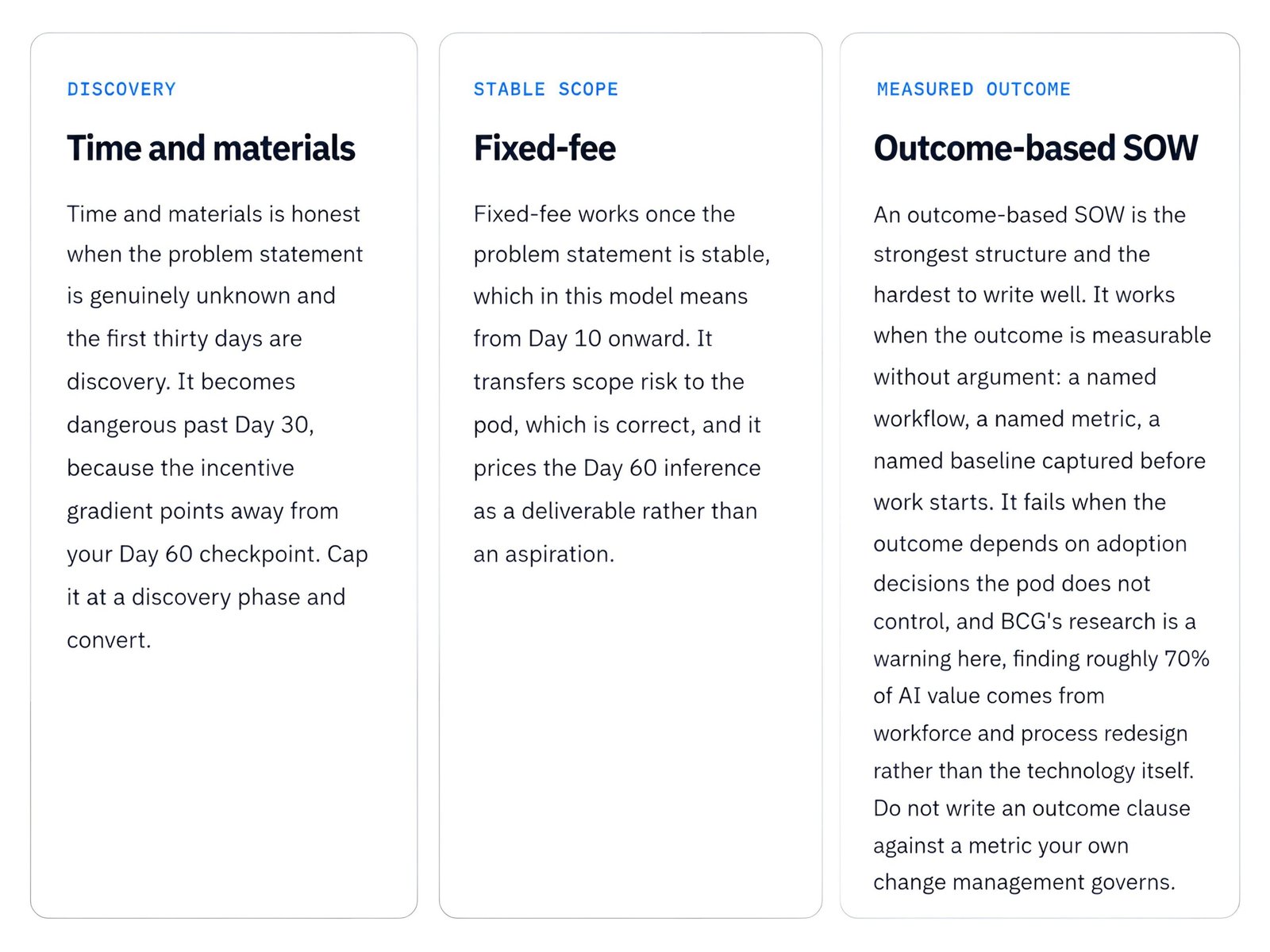
The pricing structure should follow the checkpoint you are buying, which means the T&M vs fixed-fee debate is usually framed backwards.
What the market data actually says:
– Founder Pattern
Where the 4-Checkpoint Gate itself breaks
The gate assumes a particular shape of organisation. It distorts in four conditions worth naming before you apply it.
-
Below roughly 200 employees with no platform team.
Day 30 asks for a merged commit behind your authentication. If your
authentication, data pipeline, and deployment path are all being built
concurrently with the AI work, Day 30 measures your platform maturity
rather than the sourcing decision. Push the checkpoint to Day 45 and
accept that you are running two projects.
-
Where the data does not yet exist.
Gartner projects that 60% of AI projects lacking AI-ready data will be
abandoned through 2026. If your Day 60 inference depends on a dataset
still being assembled, no sourcing model rescues the timeline. Sequence
the data work first and run the gate against that instead.
-
Multi-vendor programmes with split accountability.
The gate assumes one accountable party. Where an integrator owns the
platform and a separate pod owns the model, the Day 90 bus factor test
returns a false pass: each party can operate their own half and neither
can operate the system. Test the seam explicitly, which is why edge
projects stall on handoffs more often than they stall on model performance.
-
Regulated deployments already inside a validation cycle.
Where a validation protocol governs the release, Day 60 collides with a
process carrying its own gates and its own calendar. The checkpoint still
applies; it moves to the first inference in the validation environment
rather than in live production.
What this means for your next ninety days
The sourcing decision in front of you is not a cost decision, and treating it as one is why the market’s pilot-to-production numbers look the way they do. It is a decision about where the problem statement gets written, and who is standing there when it needs rewriting.
Before the next proposal reaches signature, do two things. Write down the name of the person who will own the system in month twelve; that single test resolves the third disqualifier before you spend anything. Then ask each bidder to commit, in writing, to what exists on Day 10, Day 30, Day 60, and Day 90. A proposal that will commit to dated artefacts is a different document from one that will not, and the difference shows up long before the invoice does. For the evaluation questions that go around those dates, that is how to evaluate before you sign.
The systems that reach production in 2027 will not be the ones with the best benchmarks. They will be the ones whose first production inference landed inside the first ninety days, and whose bus factor was greater than one when the engagement ended.
Frequently asked questions
A forward deployed AI engineer is a senior engineer who embeds inside a client organisation to frame a problem, build the system, and remain accountable for it running in production, writing code in the client’s repositories, against the client’s data, behind the client’s authentication. The defining trait is end-to-end accountability: the engineer who maps the problem in week one answers when it breaks in month six. Palantir originated the role in the early 2010s; OpenAI, Anthropic, and Ramp have since built equivalent functions to close the gap between capable models and deployed systems.
A consultant produces a deliverable and exits. The measure is the quality of the advice, and nothing is running when they leave. A forward deployed engineer ships production code and stays accountable for it. The practical difference shows up at the first failure: a consultant’s recommendation is complete once delivered, while an embedded engineer’s work is complete only once a named person inside your organisation can run the system without them. A solutions architect sits between the two, designing systems but rarely deploying them.
Hire AI engineers, when the AI capability is permanent core intellectual property, when regulation demands consistent in-house accountability, or when you already know which problem you are solving. Embed when the problem statement is still wrong and you need someone with production experience to rewrite it. The strongest sequence for most mid-market companies is to embed first and establish the pattern, then hire against a problem statement the embedded phase has proven, which is a materially easier hire than the speculative one. Hiring in 2026 is slow regardless: 87.5% of technology leaders surveyed by Lemon.io rated it difficult or worse.
Staff augmentation supplies capacity. You write the specification, direct the work, and own the result. An embedded pod owns the outcome contractually and brings its own delivery process. The distinction is accountability, not team composition. Faros AI’s July 2025 analysis of over 10,000 developers found capacity increases raised individual output substantially, at 21% more tasks and 98% more pull requests merged, while organisational delivery metrics stayed flat. If your delivery system is the bottleneck, adding contractors to it does not help.
Agency-assisted searches for mid-level AI and machine learning roles averaged 38 days in Q2 2026, rising to 54 days for senior roles with generative AI specialisation (KORE1). Unassisted searches run 60 to 120 days, and 8 to 12 weeks is a common market average for senior roles. Add 60 to 120 days of ramp before full output. An embedded engagement typically places a person within two to four weeks, but the meaningful comparison is not to a start date. It is to the first production inference, which is what the Day 60 checkpoint measures.
You are. Deployer obligations for high-risk systems require human oversight assigned to natural persons with the necessary competence, training, and authority, and those persons sit inside your organisation. A vendor’s compliance posture does not transfer. Substantially modify a high-risk system, apply your name to it, or change its intended purpose, and you become a provider with the full provider obligation set. Regulation (EU) 2026/1744 entered into force on 27 July 2026 and moved stand-alone Annex III high-risk obligations to 2 December 2027. It deferred the build deadline, not the accountability.
Five components: a named receiver identified by name and role in the statement of work; a dated reverse-shadow acceptance test in which the receiver deploys, rolls back, and modifies a component while the external engineer stays silent; an artefact list stated as included in the contract price and not billed separately; a bus factor covenant requiring at least two people able to deploy each component at Day 90; and an exit window of 60 to 90 days with a transition plan maintained throughout the engagement rather than written after notice. Tie the acceptance test and the covenant to the final milestone payment.
Match the structure to the phase. Time and materials is honest for a capped discovery phase where the problem statement is genuinely unknown, but its incentives work against you past the first thirty days. Fixed-fee fits once the problem statement is stable, transferring scope risk to the delivery team. An outcome-based statement of work is strongest where the outcome is measurable without argument, and weakest where the outcome depends on adoption your own change management controls. BCG puts roughly 70% of AI value in workforce and process redesign rather than technology.
About the author

Mitesh
Mitesh Patel is Director of Brainy Neurals and a NVIDIA Certified AI Architect — a credential held by fewer than 3,000 people worldwide. He has spent nine years building production AI, beginning in C/C++ firmware and edge inference (Jetson, NVIDIA Triton, TensorRT, Qualcomm SNPE) and now leading enterprise RAG, computer vision, and generative AI delivery. He holds a B.Tech in Electronics & Communication and an M.Tech in Embedded Systems, and is an Upwork Top Rated Plus practitioner (top 3%). His team of 20 specialist engineers has shipped 70+ enterprise AI projects across manufacturing, BFSI, healthcare, logistics, and construction. Read more at the founder page or connect on LinkedIn.
Leave a Reply