






Home / Case studies / AI Vehicle Damage Estimation for Commercial Truck Repair
Case study · Automotive claims technology · Computer vision & machine learning
AI Vehicle Damage Estimation for Commercial Truck Repair
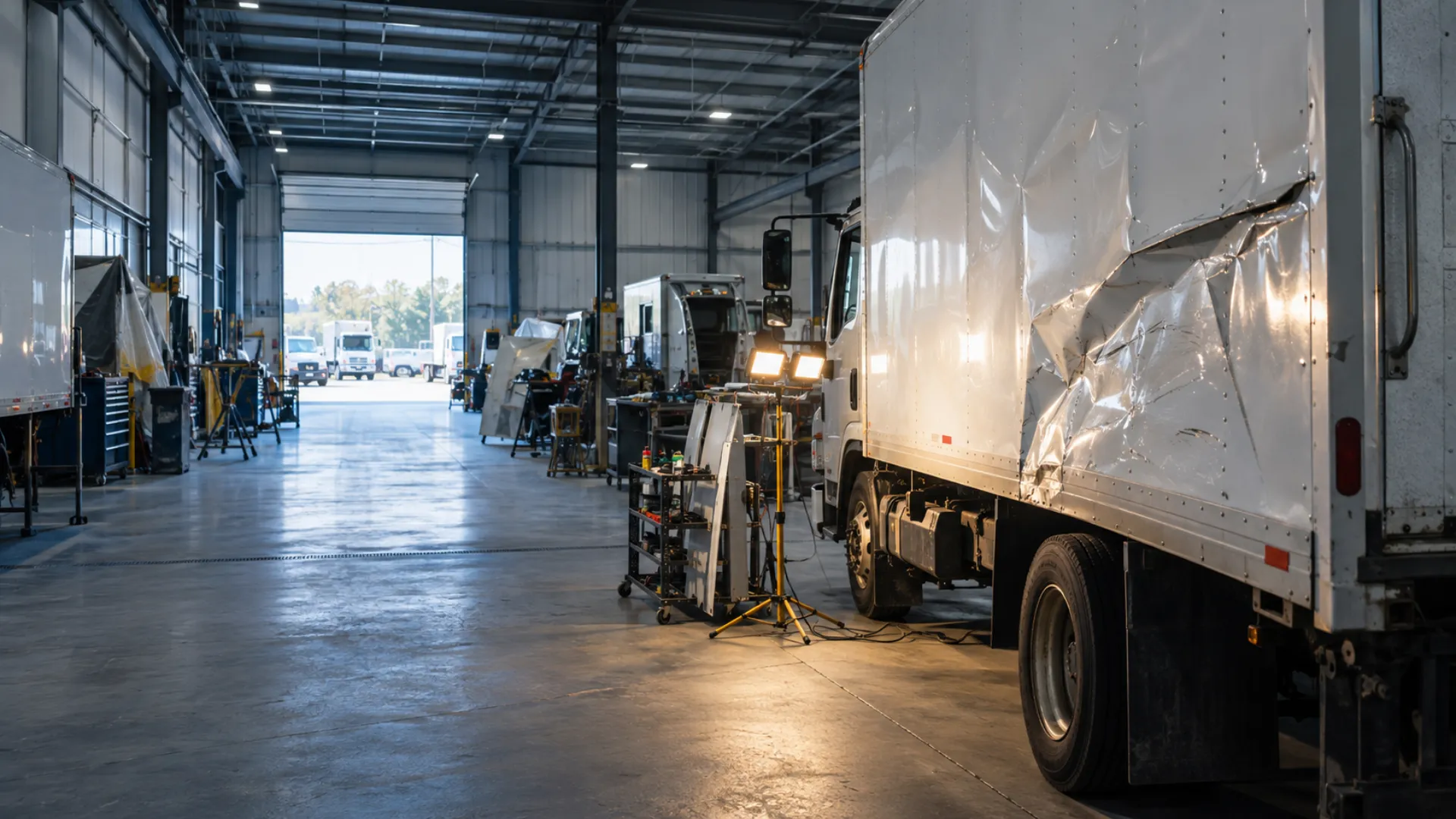
A US vehicle repair estimating software company wanted AI vehicle damage estimation because pricing each truck job from photographs took 45 to 60 minutes. Brainy Neurals built a pipeline that uses computer vision to find each damaged part, then machine learning to predict its repair hours. Estimators on the client’s platform now open a checked first draft instead of reading every photo by hand. A first draft now takes about five minutes of pipeline time, roughly a 90 percent cut in estimator time per job.
~5 min
To a first estimate draft
~90%
Less estimator time per job
Every line
Carries its photo evidence

Published October 2026
At a glance
Brainy Neurals built a vehicle damage detection pipeline for a US vehicle repair estimating software company.
What problem did this solve?
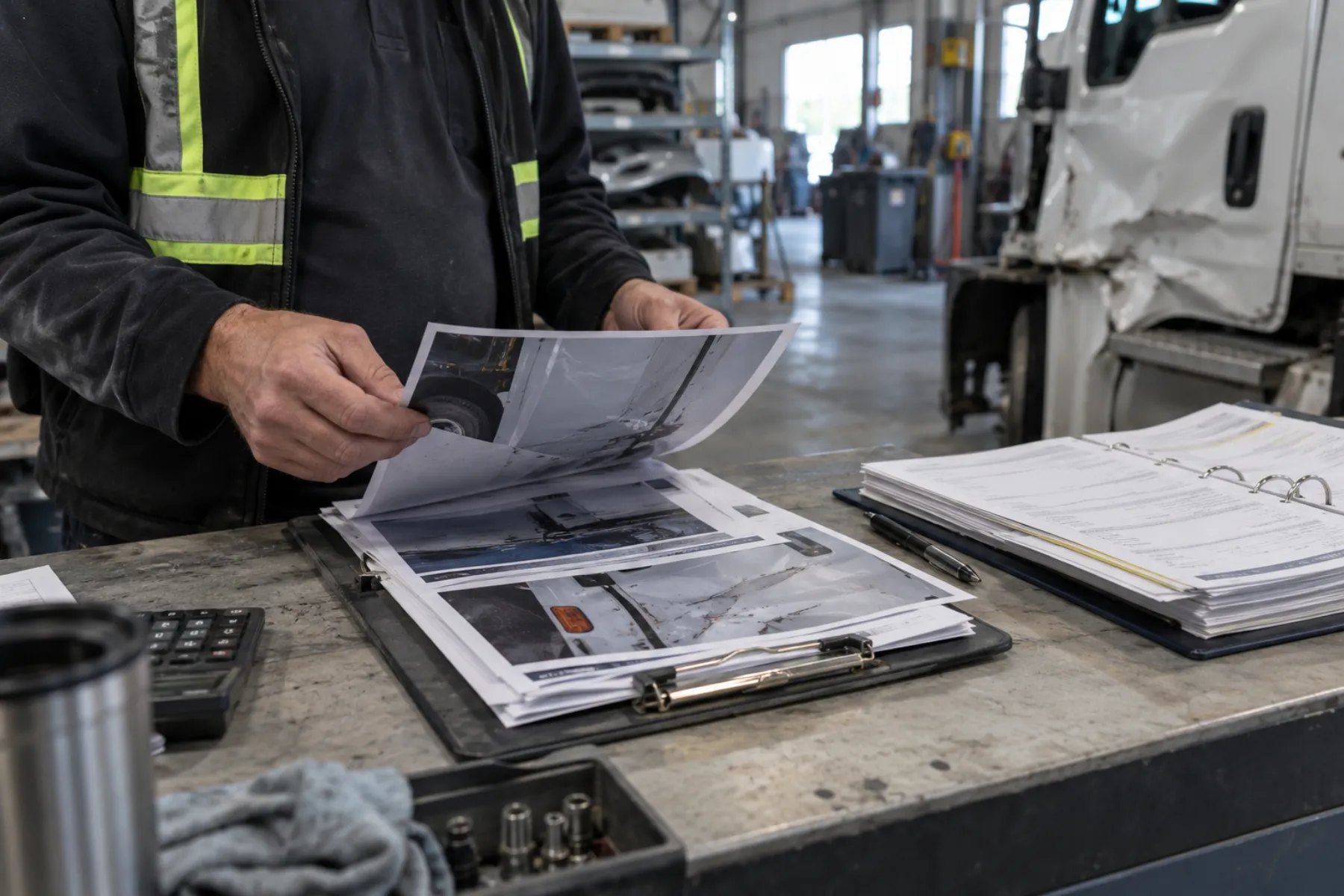
Commercial vehicle damage estimates ran on manual photo review. Each job took 45 to 60 minutes of estimator time, & two estimators often priced the same truck differently.
What did the pipeline change?
The pipeline checks every damage finding twice before it predicts the labor hours. Estimators now start each job from a checked draft instead of a blank sheet.
What changed after it went live?
A checked first-draft estimate now arrives after about five minutes of pipeline time per job. Findings the models can’t settle go to a human reviewer instead of into the total.
Who else could use this?
Photo-based damage estimation fits insurers, fleet operators, rental companies & repair networks. Any business that judges condition from photos & prices the labor could use the same approach.
Engagement facts
| Fact | Detail |
|---|---|
| Industry | Automotive claims technology |
| Sub-industry | Commercial vehicle estimating |
| Client | US estimating software company |
| Engagement | AI estimation pipeline |
| Timeline | Not disclosed |
| Capabilities | Computer vision & machine learning |
| Delivery | Project-based delivery |
Why did every estimate take an hour?
Every estimate took an hour because estimators read each photo by hand, so the client wanted AI vehicle damage estimation instead.
A US vehicle repair estimating software company serves the shops & fleets that keep work trucks running. Its users price collision repairs from photos, one vehicle view at a time. The company asked Brainy Neurals whether computer vision development could carry that reading instead.
Where the hour went
- Reviewing one job’s photos took five to ten minutes before the first damage line even existed.
- Two estimators pricing the same truck could reach two different totals, & neither could prove the other wrong.
- A dent photographed from four angles turned into four line items, each with its own labor charge.
- A replaced hood sometimes went out without the related operations that a hood replacement always needs.
- Body & paint hours depended on whichever estimator happened to be working that day.
- Collision estimating guides once arrived every year as thick printed books, big enough to prop open a shop door.
None of this was unusual for the trade. A 2025 systematic review found manual vehicle inspection slow work that invites errors[1].
What do estimating teams try first?
Estimating teams usually try one of four routes before they bring in an AI partner, & each route has a fair case behind it.
| Approach | What it gets right | Where it stops | Who it suits |
|---|---|---|---|
| Keep it manual | Expert eyes on every photo | An hour per job, plus drift | Low volumes & unusual builds |
| Generic damage AI APIs | Fast to connect | Trained on cars, lost on trucks | Quick triage |
| Estimating templates | Faster data entry | Judgment stays in one person’s head | Shops with one senior estimator |
| Our route | Checked lines & hours in minutes | Needs labeled photos & rule work | Platforms estimating at volume |
Training data explains part of the gap. The first large open dataset of car damage only appeared in 2023, & it was built around passenger cars[2].
How the AI vehicle damage estimation pipeline works
The pipeline works as a chain of checks, so every damage line has to earn its place in the estimate. A detection model reads each photo & proposes findings. Each finding carries a type, a location, a side & a confidence score. No damage line reaches the estimate until a second model has checked the same damage.
The first design choice was where an estimate’s judgment should live. We turned down a single-pass design that priced whatever the detector found, because dirt on a truck looks like damage to a camera.
So every finding goes to a second model before anything gets priced. That model sees the full photo & a close crop of the damage. Anything it can’t settle goes straight to a person.
The second choice kept the rules apart from the models. Related repair operations are written rules that an estimator can read & argue with. Only the labor hours are learned from past estimates, & a guardrail caps any prediction that runs too high.
The result is workflow automation built around checks, & those checks are what make each draft ready to bill.
No damage line reaches the estimate until a second model has checked the same damage.
A damage line must pass verification before the rules & hour models can price it.
The technology stack we used
The technology stack exists to make every damage line defensible in front of a customer. The export layer writes each estimate in a form that document AI systems can read.
Seeing the damage
Photo intake
Uploads are sorted by vehicle view, six views per job, so no photo gets read out of context.
Ruled out: a loose photo dump
Damage detection
A detector trained on vehicle damage reads the part, type, side & material in each frame.
Ruled out: generic vision APIs
Verification
A second model looks at the full frame & a close crop, then rejects glare & grime before pricing.
Ruled out: a single opinion
Turning findings into lines
Duplicate merge
Matching across photos by part & location turns one damage into one line, however many photos caught it.
Ruled out: one line per photo
Estimating rules
Written rules add the related operations, & an estimator can audit every one of them.
Ruled out: learned end-to-end estimates
Hour prediction
Regression models predict body & paint hours for each line, with a cap for predictions that run high.
Ruled out: flat averages
Getting the estimate out
Review queue
A human lane catches unclear findings, so doubt costs a reviewer minutes instead of costing trust.
Ruled out: silent auto-approval
Export
Each job leaves as a spreadsheet plus CSV & JSON files, with the evidence attached, so no one retypes a line.
Ruled out: a PDF no system can parse
How does one job get estimated?
One job gets estimated in six steps, & the pipeline runs them in the same order every time.
- An estimator opens a job number & uploads the photos by vehicle view, from front bumper to interior.
- The detection model marks every damaged part in each photo with its type, location, side, material & confidence.
- The pipeline drops weak findings & merges the same damage seen in several photos into one line.
- A verification model checks each remaining line against the full photo & a close crop of the damage.
- Estimating rules add the related operations, & trained models then predict the body & paint hours.
- The job exports as a spreadsheet plus CSV & JSON files, & every line keeps the photo evidence behind it.
A person appears in only one of the six steps, at step four, when verification leaves doubt.
Findings narrow at every stage, & only the unclear findings from step four reach a person.
What nearly stopped the build?
Two photo problems & one model problem nearly stopped the build, in the order shown below.
Better detection made the finished estimates worse at first. One cracked fender photographed from four angles came back as four billable lines, & the extra labor inflated every draft. Damage seen across several photos is still an open research problem, & most published methods assume a single photo[3].
Work trucks fool a camera all day long. Road grime & panel glare kept scoring as fresh damage, & so did old repairs from before the claim.
The hour models behaved well until they suddenly didn’t. Rare damage on rare panels sometimes produced an absurd labor prediction, & one absurd line can discredit a whole estimate.
Weeks like these are when platform teams start asking about specialist engineers instead of learning everything the slow way.
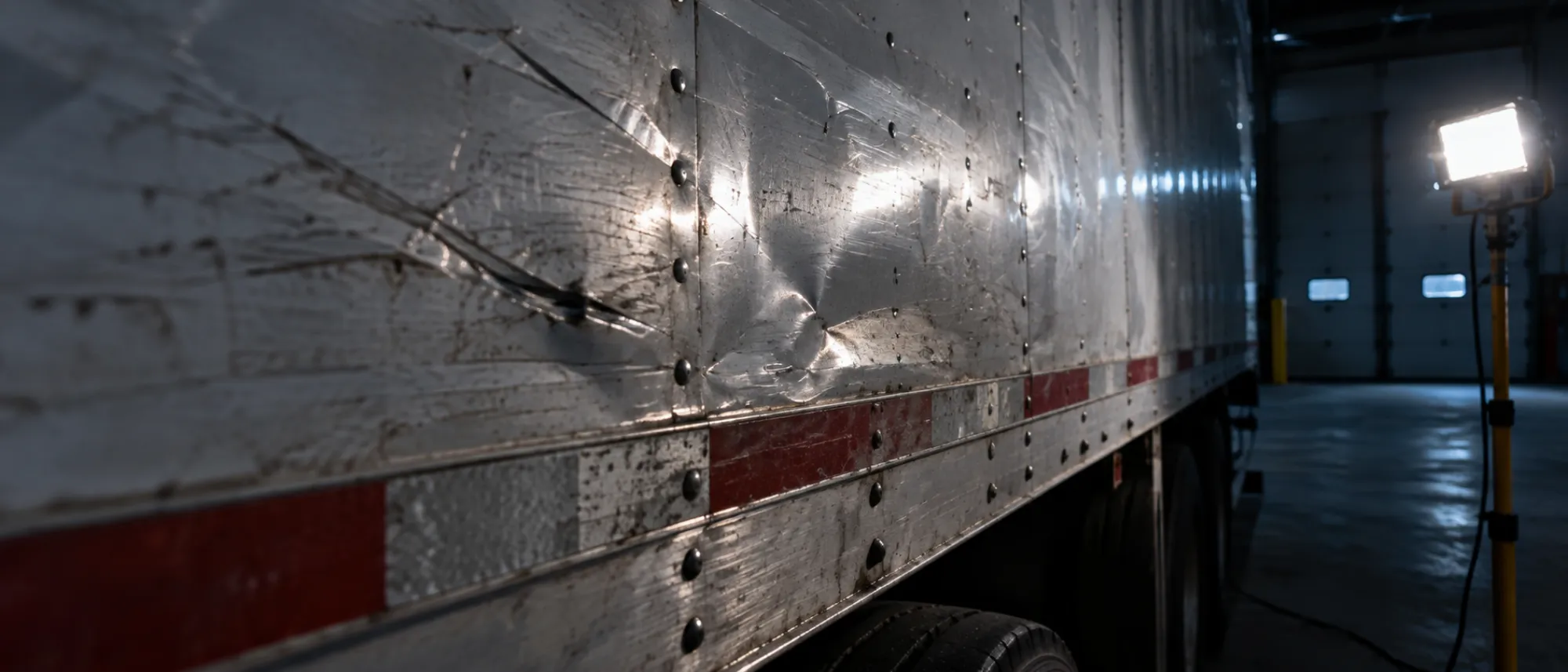
How each problem got fixed
Each problem got its own check, & each fix sounds simpler now than it was to find.
Duplicate lines
We merge findings across photos before anything is priced, matching on the part, the side & the location. One damage becomes one line, whether two photos show it or ten. The double-billed labor left the drafts along with the duplicate lines.
False damage
We stopped letting a single model’s opinion price a repair. The verification model sees what the detector saw, plus the whole scene. When the two disagree, a person decides, so doubt costs a reviewer minutes instead of costing trust.
Runaway hours
We capped the hour models against typical bands for each repair operation. A prediction that breaks its band gets flagged for review instead of printed. All of these problems surfaced early, during the AI proof of concept, well before anything had been promised to the client.
Each fix is a check that the estimate must pass before a customer sees it.
What changed once it went live?
Going live cut the time to a first estimate from an estimator’s hour to about five minutes of pipeline time.
| What | Before | After |
|---|---|---|
| Time to a first estimate | 45 to 60 minutes of estimator work | About 5 minutes of pipeline time |
| Reading the photos | An estimator, one by one | The models, with people on unclear findings |
| Duplicate damage lines | Found by eye, when found | Merged before pricing |
| Related operations | Remembered or missed | Added by written rules |
| Body & paint hours | One estimator’s judgment | Predicted & capped |
A first-draft commercial vehicle damage estimate now takes about five minutes, against the client’s reported 45 to 60 estimator minutes. That comparison is the roughly 90 percent cut in estimator time claimed on this page.
We haven’t published production accuracy or correction figures, & the client’s modeled monthly savings stay off the page as well. The client set targets for both, & a target isn’t a result.
Day to day, an estimator now opens a finished draft instead of a folder of photos.
The first draft moved from an estimator’s hour to about five minutes of pipeline time.
Still pricing damage from photos by hand?
Tell us what your estimators still read by hand today. We’ll show you where a checked first draft would save the most time in your workflow.
What runs in production now
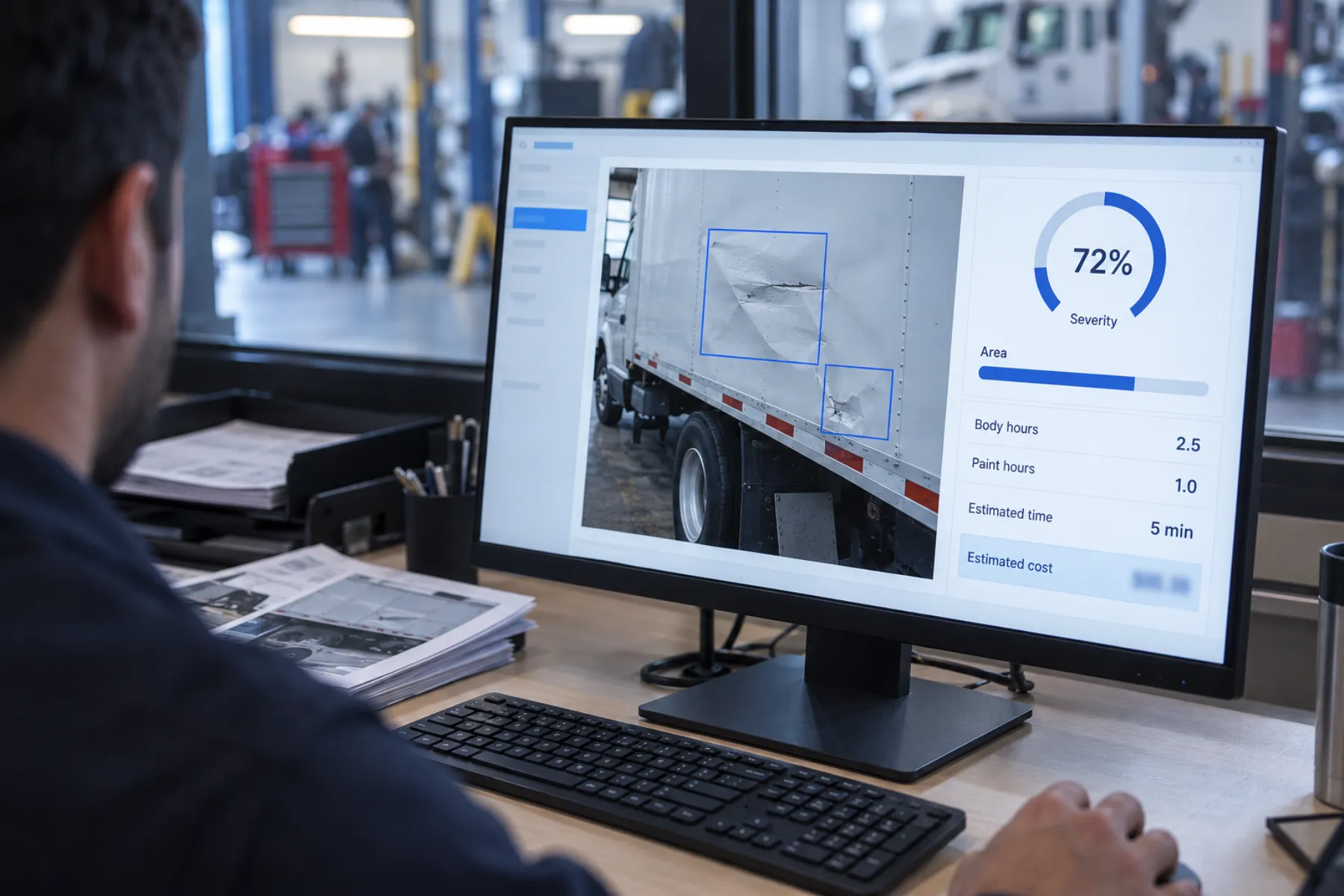
AI vehicle damage estimation now runs in production inside the client’s platform, on live commercial vehicle jobs. First drafts land in about five minutes, & unclear findings still go to a person for review.
Estimators adjust the draft where needed & then approve the estimate that ships. The platform’s users price the repair straight from the draft, which shows its evidence. Every exported line keeps its photo attached, & that matters most once an insurance claims conversation starts.
What we would change next time
Next time we would change four habits, starting with how early duplicates get merged.
Merge duplicates first
We tuned detection first & watched better recall multiply the duplicates. The merge should have existed on day one, because every upstream gain made the drafts worse.
Collect messy photos early
The first training sets were clean & well lit, & real jobs are neither. Glare & grime arrived with the pilot users & caught the models unprepared.
Cap the model from day one
The guardrail on hour predictions only went in after one alarming output made the case. A model that is usually right still needs a plan for the day it is not.
Staff the review queue on purpose
We treated human review as a temporary crutch to remove later. Review turned out to carry real weight, & staffing it deserves the same planning as training the models.
A model that is usually right still needs a plan for the day it is not.
Where else does photo estimation fit?
Photo-based damage estimation fits any business that judges condition by eye & prices the repair by hand. The approach turns photos of a damaged asset into checked repair lines with predicted labor hours.
| Industry | The equivalent problem | What changes in the build |
|---|---|---|
| Insurance | Claims priced from policyholder photos | New damage classes on the same checks |
| Fleet & logistics | Depot check-in before trucks leave the gate | Fixed camera angles, with events sent to the fleet system |
| Equipment rental | Return inspections that settle disputes with photos | Deposits instead of labor hours |
| Manufacturing | End-of-line quality inspection of paint & panels | Tighter tolerances & a reject signal |
| Retail returns | Grading returns for resale from photos | Cosmetic grades instead of repair operations |
For insurers, the same pipeline becomes AI insurance damage assessment on policyholder photos. Moving to a new asset starts with a detector retrained on it & rules rewritten around it. The hour models then refit to whatever labor guide that industry prices from.
The pattern already runs at a depot gate for fleet operators, & on the production line as quality inspection.
Retrain the detector & rewrite the rules, & the same checks move to a new industry.
The questions buyers keep asking
Can AI detect vehicle damage from photos?
Yes, once the model is trained on the damage it will actually meet. Detection alone doesn’t make an estimate, though. Reflections & grime produce false findings, so this build checks every line before it prices anything.
How does AI predict repair labor hours?
Machine learning models trained on past estimates predict body hours & paint hours for each damage line. A guardrail caps predictions that fall outside typical bands, & capped lines go to a person instead of into the draft.
Will AI replace vehicle damage estimators?
The pipeline writes the first draft, & an estimator decides what ships. Complex structural damage & disputed totals stay with people. The models took over the photo reading that used to fill the estimator’s hour.
How long does an AI vehicle damage estimation build take?
A proof of concept on your own photos takes a few weeks. Production takes months, because the rules & the review workflow each need their own pass. Then real jobs run beside your estimators until drafts hold.
How much does AI damage estimation cost?
The cost of an AI vehicle damage estimation system depends on your damage classes & the systems downstream. Brainy Neurals scopes it from a short conversation & a look at your photos, then quotes a fixed price. An AI readiness assessment tells you first whether your data can support the models.
Does photo-based estimation work for commercial vehicles?
Yes, & the training data makes the difference. Public damage datasets center on passenger cars, so a commercial pipeline needs its own labeled photos. Trucks also bring bigger panels & more glare than public data covers.
Services behind this case study
Brainy Neurals drew on the services below to build & run this pipeline for the client.
Computer vision development
Detection & verification models trained on your damage classes & on the photos your users actually take.
AI agents & workflow automation
Pipelines that chain models with written rules & a human review queue.
Document AI
Structured extraction from the claim files & estimates this industry trades every day.
Generative AI applications
Language & vision models for the reports that sit on top of the numbers.
Hire AI developers
Machine learning engineers who extend your team when the photos fight back.
AI in banking & finance
Claims & appraisal automation for insurers & the platforms that serve them.
An AI proof of concept is the fastest way to test this on your own photos. AI consulting helps you choose which workflow to automate first. An AI readiness assessment shows whether your data can carry it, & the industries hub shows where the pattern already runs.
Similar case studies
Brainy Neurals has shipped other builds with the same shape, pairing models with rules & keeping a person in the loop.
Overhead Line Geometry Measurement
Stereo cameras measure wire geometry from a moving train, with inference running on board.
AI Diet Assistant for Gastroenterology
Clinical dietary guidance generated under review gates, live in a healthcare setting.
Personalised AI Meal Planning for Chronic Care
Structured plans built from messy personal health data, grounded & reviewable.
Cite this case study
Ronak & Arsh. AI Vehicle Damage Estimation for Commercial Truck Repair. Brainy Neurals, September 2026. https://brainyneurals.com/case-studies/ai-vehicle-damage-estimation/
Sources cited on this page
- Hasan MJ, Nguyen CK, Boo YL, Jahani H, Ong K-L. Vehicle Damage Detection Using Artificial Intelligence: A Systematic Literature Review. WIREs Data Mining and Knowledge Discovery. 2025;15(2). DOI 10.1002/widm.70027.
- Wang X, Li W, Wu Z. CarDD: A New Dataset for Vision-Based Car Damage Detection. IEEE Transactions on Intelligent Transportation Systems. 2023;24(7):7202-7214. DOI 10.1109/TITS.2023.3258480.
- Peng J, Dong S, Yuan H, Zheng X. Car Damage Detection Based on Multi-View Fusion and Alignment: Dataset and Method. IEEE Transactions on Intelligent Transportation Systems. 2025;26(4):4717-4730. DOI 10.1109/TITS.2025.3542174.