What Is a Rescue AI Engineer, and When Does Your App Need One?
91% of audited vibe-coded apps had a vulnerability. See what a rescue AI engineer owns, the 4 signs you need one, the first 2 weeks and when to skip it.

Quick answer: A rescue AI engineer takes ownership of an app built with AI coding tools once users depend on it. The role owns a severity-ranked audit, a keep-versus-rebuild call, the hardening and the handoff. If you have paying users, an investor asking for the repo, features that break older ones or code your team
can’t read, you need one now.
An app built through chat starts life with a bus factor of zero. You know what the product should do, and the model wrote how it does it, yet no human holds the map between those two things. The model doesn’t hold it either unless someone wrote it down. In a study of 133 popular GitHub applications, Avelino and colleagues found 46% had a truck factor of one, meaning a single departure could stall the project. By that measure, an AI-built app with no one who can read its code begins a full step below the weakest projects in that sample.
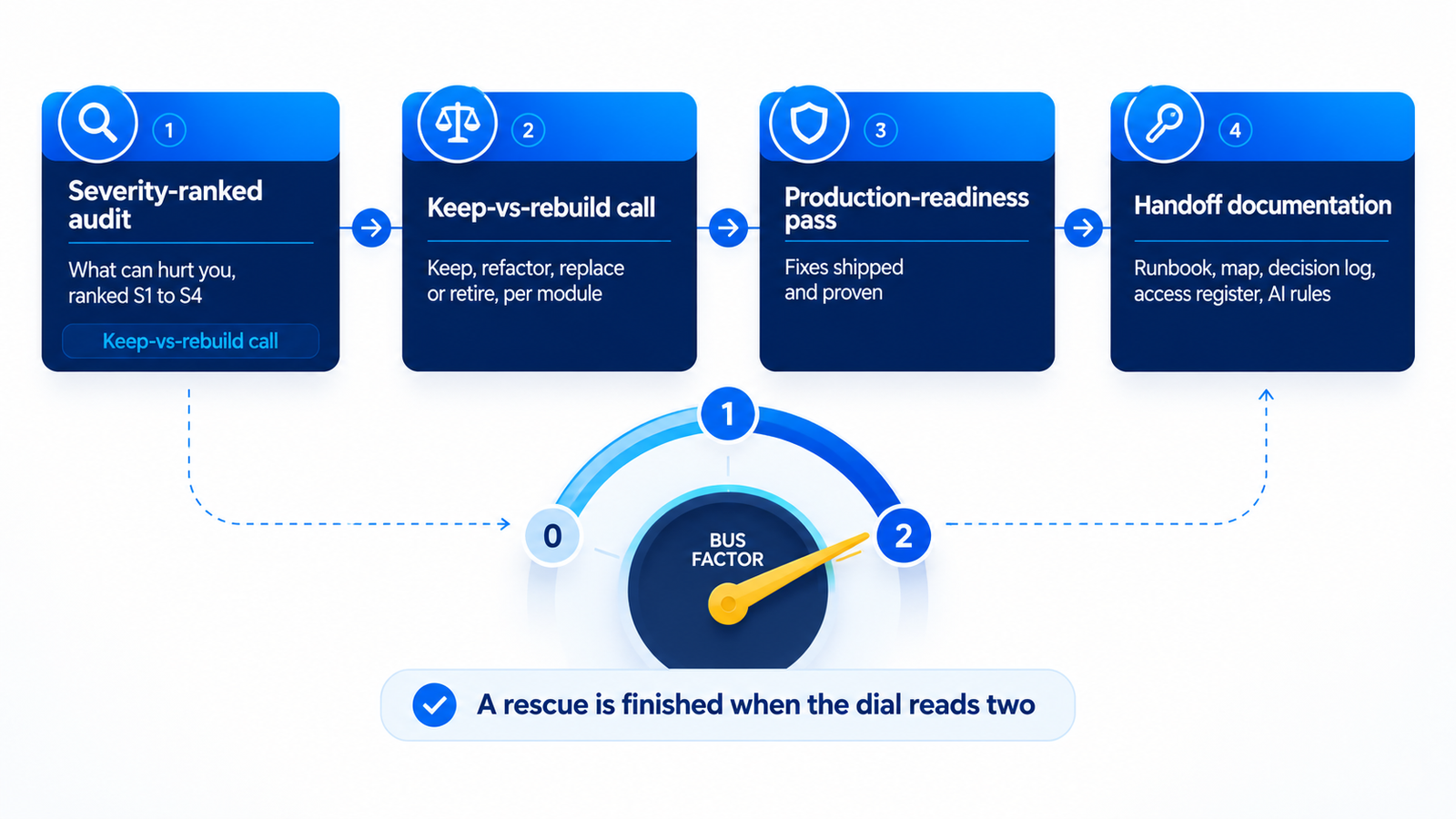
None of this is a verdict on vibe coding, which did its job the day your first customer paid. A rescue AI engineer exists to move your bus factor from zero to at least two, and the role is defined by what it owns before any new feature ships. It produces a severity ranked audit, makes an honest keep-vs-rebuild call, does the hardening work and writes handoff documentation the next engineer can run with.
What is a rescue AI engineer?
A rescue AI engineer is a senior engineer who takes temporary ownership of a codebase written mostly by AI coding tools, once real users depend on it. The code might come from Lovable, Bolt, Replit, v0, Cursor or Claude Code. Either way, the job is making the app safe to change and possible to hand over.
The role exists because the codebases do. In March 2025, Y Combinator managing partner Jared Friedman said about a quarter of the Winter 2025 batch had codebases that were 95% AI-generated. Collins Dictionary named vibe coding its 2025 Word of the Year that November. Inside larger companies, Gartner predicts that by 2028, prompt-to-app approaches adopted by citizen developers will increase software defects by 2,500%.
The AI in the name points two ways. An AI model wrote most of the code, so the engineer must read machine-written code fluently. If your app calls a large language model (LLM) in production, the rescue covers exposed provider keys, prompt injection, missing rate limits and uncapped token spend, where our generative AI development work overlaps.
Brainy Neurals runs this work as the opening phase of taking an AI-built prototype to production. The rest of this post describes it closely enough that you can hold any provider, including us, to the same standard.
Under the AMI Test we use to define every AI engineering role, the rescue shape’s Artifact is the codebase plus a handoff pack that lets someone else own it. Its Metric pairs open S1 and S2 findings (exposure and data-loss risks), which must reach zero, with a bus factor that must reach two. The Interface faces you for decisions and the next engineer for the handoff. That Metric counts down by design, because a finished rescue means the next engineer owns the app, and our full role map shows how this role differs from the other eleven.
What does a rescue AI engineer own?
A rescue AI engineer owns four deliverables, and the engagement isn’t finished until all four exist in writing. They are a severity-ranked audit, an honest keep-vs-rebuild call, the hardening work itself and handoff documentation that still works after the rescue engineer leaves.
What goes into a severity-ranked audit?
A severity-ranked audit is a written list of everything in the app that can hurt you, ordered by how much damage each item can do and how soon. Severity sets the order of work, so a missing access rule on your customer table outranks the slow dashboard your users keep mentioning. The ranking matters because AI built apps fail in recognizable places. A June 2026 audit of 200 deployed vibe-coded apps found at least one vulnerability in 91% of them. Of the 1,186 findings, 65.8% were rated Critical or High, and they were concentrated in flaws that let the wrong person reach data or let attacker-controlled input run as code.
We rank every finding on a four-level ladder, and each level carries a fix window you can hold us to.
The S1 to S4 Rescue Severity Ladder
| Level | What it means | Examples in AI-built apps | Fix window |
|---|---|---|---|
| S1 Exposure |
Data or money is exposed to outsiders right now. | Weak row-level security; unprotected admin routes; API or LLM keys in browser code; unsigned payment webhooks. | Within 48 hours Before feature work. |
| S2 Loss |
One bad deploy or agent command could destroy data permanently. | Untested backups; shared dev and production databases; direct production schema changes; former contractor-owned accounts. | Week one |
| S3 Breakage |
Changing one feature breaks another. | No signup or checkout tests; duplicated business logic; no staging environment or CI. | Weeks 2–6 Hardening phase. |
| S4 Drag |
The app works, but costs too much to run or change. | Uncapped LLM spending; dead code; too many dependencies; missing documentation. | Roadmap Schedule the work. |
Our companion post on what breaks first covers the order these failures surface in once traffic grows. Whatever the order in your app, S1 work starts first and S4 waits, because an exposure costs you customers’ trust while drag costs you time.
An exposed customer table outranks every complaint in your support inbox, because complaints describe bugs and an exposure describes a breach.
How does a rescue engineer make the keep-vs-rebuild call?
The keep-vs-rebuild call is a written verdict on each module of the app, drawn from the audit evidence. Each module is kept, refactored, replaced or retired, and the memo says why in terms you can check. Ask any provider for that verdict per module, and treat a blanket rebuild recommendation with suspicion until someone shows you why the foundation itself can’t hold. We cover the decision criteria in depth in rescue or rebuild.
What is a production-readiness pass?
The production-readiness pass is the hardening work itself, and the rescue engineer ships the fixes and proves they hold. It starts with every S1 and S2 finding and ends with guardrails that stop those findings from coming back. We build the pass around five pieces of work.
- Access rules tested with a second account. Supabase row-level security policies, or your database’s equivalent, count as working once a test user fails to read another user’s records.
- Secrets moved server-side and rotated. Any key that ever shipped in browser code gets replaced and revoked, and LLM provider keys move behind your own server with per-user rate limits.
- Backups with a completed restore drill. A backup counts once someone has restored it into a scratch database and written down how long recovery took.
- Separate staging and production. Coding agents and humans test against staging, and only reviewed merges reach production. After a Replit agent wiped SaaStr founder Jason Lemkin’s production database during a code freeze in July 2025, Replit shipped automatic separation of development and production databases.
- Tests and alerts on the money paths. Signup, checkout, billing webhooks and the core workflow get automated tests in continuous integration, and a failure pages a person within minutes.
For an external yardstick, the OWASP Top 10 and NIST’s Secure Software Development Framework cover the same ground, and our AI consulting and strategy team maps findings to both when a board asks.
What does good handoff documentation contain?
Handoff documentation is the written system that lets the next engineer run your app without you or the rescue engineer in the room. It replaces the chat history as the record of why the code works. A complete handoff pack has five parts, and each one answers a question the next engineer would otherwise ask you.
- A runbook. It holds paste-ready commands to deploy, roll back, restore from backup and rotate a secret.
- An architecture map. One page shows how a request travels from the browser through your server to the database and out to services such as Stripe or your LLM provider.
- A decision log. Short entries record why each non-obvious choice was made.
- An access register. It lists every account the app depends on with its owner and recovery path, and every account sits in a company name.
- AI working rules. A rules file in the repo tells your AI coding tools which conventions and boundaries to respect before they write code.
We close every rescue with the One-Day Handoff Test. An engineer who has never seen the code must clone it, run it locally, deploy a change to staging and roll that change back within one working day. They do it without asking you anything and without opening the old chat history. Passing the test is the evidence that your bus factor has reached two, and it marks the point where we hand the keys back.
If a new engineer can’t clone, run, deploy and roll back your app in one working day without asking you, the rescue isn’t finished.
When does your app need a rescue AI engineer?
Your app needs a rescue AI engineer as soon as any one of four conditions is true. Each of them moves the cost of an unknown flaw away from your own evenings and onto your customers’ data or your company’s credibility with investors and buyers. Two or more together mean the audit should start this month.
Are paying users already on the prototype?
Paying users turn every S1 finding from a theoretical risk into a reportable incident. Once an email address or a health detail sits in your database, a leak can trigger notification duties under laws such as the EU’s General Data Protection Regulation. Escape’s scan of more than 5,600 vibe-coded apps found over 400 exposed secrets and 175 instances of exposed personal data, including medical records and bank account numbers.
Inside a larger company, the same trigger is a vibe-coded internal app that now holds customer records. In May 2026, RedAccess reported about 5,000 vibe-coded apps built for corporate use, roughly 2,000 of them exposing sensitive data, though the platforms questioned the findings.
Has an investor or customer asked to see the code?
An investor’s technical due diligence or an enterprise customer’s security review puts an outside engineer inside your repo, and you want your own severity-ranked audit in hand before theirs lands. Expect the reviewer to check data protection, recovery from a bad deploy, test coverage on the money paths and whether anyone besides the founder understands the system. An enterprise buyer’s security questionnaire asks the same questions in a different format, mapped to frameworks such as SOC 2. YC president Garry
Tan flagged the risk when the 95% figure surfaced, questioning whether such products would hold up at scale and saying “the first versions of reasoning models are not good at debugging.”
Does every new feature break two older ones?
If your vibe-coded app keeps breaking every time you ship, the cause sits in the structure of the code more than in any single bug. The person to hire is an engineer who adds the tests the original prompts never created. GitClear’s analysis of 211 million changed lines found that duplicated code blocks grew eightfold during 2024 while moved, or refactored, lines fell 39.9%. When one business rule lives in four places, the model edits the copy in front of it and the other three keep the old behavior until a customer finds the difference.
Can anyone on your team read the repo?
If no one on your payroll can explain how a request travels from the browser to the database and back, your bus factor is zero. That person may have been a contractor who left, or there may never have been one. Each prompt now edits a system no human has reviewed, and in Stack Overflow’s 2025 survey of more than 49,000 developers, 45.2% of those asked named debugging AI-generated code as more time-consuming. A rescue engineer’s first job in this situation is reading, and the handoff pack exists so that your team never ends up here again.
What happens in the first two weeks of a rescue?
The first two weeks of a rescue produce written decisions before new code. By day 10 you should hold four documents, the access register, the severity-ranked audit, the keep-vs-rebuild memo and a dated hardening plan, and every S1 finding should be closed.
- Days 1 and 2, take inventory and secure access. Move every account the app depends on into company ownership, including the repository, hosting, database, domain, payment processor and LLM provider. Turn on automated backups, take a production snapshot, freeze changes to authentication and payments, and record a 60-minute walkthrough of what the product should do.
- Days 3 to 5, run the severity-ranked audit. Map data flows, authentication, row-level security policies, payment webhooks and every LLM call, then run dependency and secret scans and reproduce the bugs your users keep reporting. Each finding gets an S1 to S4 rating with the evidence attached.
- Days 6 to 8, close S1 findings and make the keep-vs-rebuild call. Fix every exposure first, rotate any secret that ever reached the browser, split development and production databases, and write the keep, refactor, replace or retire verdict for each module.
- Days 9 and 10, set guardrails and schedule the hardening. Add continuous integration with branch protection, write tests for signup and checkout, draft the runbook, commit the rules file your AI coding tools will read, and date the plan for weeks three to six.
We run the audit under the same ISO 27001 controls that govern our own systems, so every credential you share is logged and revoked at handoff. New features wait until day 11, and so does any rewrite, because neither is safe to start until the audit shows where the risk sits.
Is one of the four triggers true for your app?
Email ai@brainyneurals.com with your stack and the symptoms you see every week, and our NVIDIA Certified AI Architect will reply with the severity level we’d expect to find before any call is booked.
How is a rescue AI engineer different from a freelancer, an agency or a new hire?
A rescue AI engineer differs from the alternatives in what they own. A freelancer owns the ticket, a rebuild first agency owns the codebase it proposes, a full-time hire owns everything after onboarding, and a rescue engineer owns the four deliverables until someone else can.
| What you’re comparing | Freelance bug fixer | Rebuild-first agency | Senior hire | Rescue AI engineer |
|---|---|---|---|---|
| Scope and first output | Fixes one bug | Proposes a rebuild | Plans after onboarding | S1–S4 audit by day 5; keep-or-rebuild verdict |
| Security and documentation | Only if bug-related | Covered in the new build | Depends on the role | Audits access, secrets and AI risks; documents the system |
| Ownership and handoff | Limited to the fix | Often tied to the agency | Knowledge rests with one hire | Runbook and handoff test; at least two people can maintain the app |
Re-prompting the app yourself belongs on this list too, and it works for features on a codebase that already has tests and guardrails. On an unaudited codebase the risk compounds, and Veracode’s 2025 GenAI Code Security Report found OWASP Top 10 flaws in 45% of test cases across more than 100 models. The June 2026 audit of 200 vibe-coded apps reached a similar conclusion, finding that better agent tooling and prompting reduce vulnerabilities without eliminating them. So keep prompting for features if it suits you, and bring in an engineer to own the system those features run on before the next customer signs up.
“Across the 40+ AI systems we’ve shipped for 12+ years, the ones still running in year two had a second engineer who could run, change, debug and roll back the system without calling the first. A rescue engagement exists to create that second engineer, and everything in the first two weeks, the audit included, serves that goal.”Mitesh Patel, NVIDIA Certified AI Architect, Founder & Director, Brainy Neurals
What do the numbers say about AI-built code in production?
The research says AI-built code reaches production quickly and carries risk that someone has to own. Each figure below maps to a level on the severity ladder. Treat them as the cost of skipping ownership, since the speed behind them is the reason your product has users worth protecting.
- 91% of 200 audited vibe-coded apps had at least one vulnerability (arXiv, June 2026).
- 45% of AI coding test cases introduced OWASP Top 10 flaws, a rate Veracode measured across more than 100 models and found flat as the models improved (Veracode, 2025).
- Duplicated code blocks grew 8x in 2024 (GitClear, 2025).
- 22.7% of tracked issues introduced by AI-authored commits were still present in the latest revision across 6,299 GitHub repositories (arXiv, March 2026).
- High levels of shadow AI added $670,000 to the average data breach (IBM, 2025).
Check each figure at its source before you quote it to a board, since several of these studies publish revised
versions.
When is a rescue AI engineer the wrong call?
A rescue AI engineer is the wrong call in five situations, and in each one your money does more work somewhere else first. A rescue assumes a product worth protecting and a founder willing to pause risky changes for ten working days.
- You have no users yet. Keep vibe coding until real usage tells you which parts matter, since an audit of a product that changes weekly goes stale before hardening starts.
- The codebase is a small, unvalidated prototype. Regenerating it from a written spec can cost less than rescuing it, and an honest keep-vs-rebuild call will say so in the first week.
- You can’t pause risky changes for ten working days. The audit holds only if nobody pushes changes to authentication, payments, permissions or the database schema while it runs.
- The app handles regulated data at scale. If you store health records or payment card data, two weeks buys triage, and the rest is a compliance program. That program covers Health Insurance Portability and Accountability Act (HIPAA) duties or Payment Card Industry Data Security Standard (PCI DSS) scope, which our healthcare AI and financial services AI teams plan separately.
- You need a permanent team. A rescue ends by design, so hire for ongoing feature work separately and treat the rescue as the step that makes your codebase ready for that hire.
What should you do in the next 14 days?
You can start the rescue before you hire anyone. This week, move every account your app depends on into company ownership and turn on automated backups. Before Friday, restore one of those backups to a scratch database and search your frontend code for every secret key that shouldn’t be there, starting with your LLM provider’s. Then ask yourself whether a stranger could ship a change to your app in one working day without your help. If the answer is no and any of the four triggers applies, schedule the audit before the next feature ships, because every feature added now gets built on findings nobody has ranked. Our AI prototype to production engineering team runs that audit as a fixed-scope engagement, and the four deliverables will stay the same whatever the job title settles into by 2027.
FAQ
Frequently asked questions
Hire a rescue AI engineer first if real users already depend on the app. A freelancer can close single bugs and an agency can quote a rebuild, but the first job is a severity-ranked audit and a written keep-vs-rebuild call. If your vibe-coded app keeps breaking, that audit shows whether a few duplicated modules or a missing foundation is to blame.
The work overlaps, and the labels are still settling. In September 2025, 404 Media reported on LinkedIn profiles advertising a vibe coding cleanup specialist title. Cleanup describes fixing code that already exists, while a rescue AI engineer owns all four deliverables, including the keep-vs-rebuild call and the handoff documentation that lifts your bus factor to two. Ask any provider for those four by name.
A rescue engineer keeps whatever the audit shows is safe to keep. The keep-vs-rebuild call runs module by module, and each module gets one of four verdicts (keep, refactor, replace or retire). A generated front end can survive intact while the data layer and access rules get rewritten underneath it, so a full rebuild should arrive with evidence the foundation can’t hold.
Have admin access ready for every system the app touches, including the code repository, hosting, database, domain registrar, payment processor and LLM provider account. Add the AI tool workspace where the app was built, and export its chat history if you can, since it holds decisions nobody wrote down. We work under ISO 27001 controls, so every credential you share is logged and revoked at handoff.
Expect the investor’s reviewer to check whether customer data is protected, whether you can recover from a bad deploy, whether tests cover the money paths and whether anyone besides the founder understands the system. Those questions map to the top three levels of the severity ladder plus your bus factor. AI authorship itself won’t surprise a reviewer in 2026, so the attention goes to the controls around the code.
Yes, and the handoff is designed for it. Your team keeps Cursor, Claude Code, Lovable or whichever tool built the product, working inside guardrails the rescue engineer leaves behind. Those include branch protection, required tests on the money paths, a staging environment for agent changes and a rules file your AI tools read before writing code. The guardrails catch the almost-right output that 66% of developers in Stack Overflow’s 2025 survey named as their top AI frustration
A bus factor counts how many people could leave before a project stalls for lack of anyone who understands it. Avelino and colleagues found that 46% of 133 popular GitHub applications depended on a single developer. An app built mostly through prompts can start at zero, and raising it to two is the measurable goal of a rescue. The One-Day Handoff Test is how you confirm it.
About the author

Mitesh
Mitesh has shipped 40+ enterprise AI systems across manufacturing, banking and financial services, healthcare, pharmaceuticals, construction and logistics. Brainy Neurals is an NVIDIA Inception Partner and a member of AWS Activate and Microsoft for Startups, and it runs an ISO 27001 certified security program. He holds status at both the individual and company level, a Top 3% ranking, and brings 12+ years of applied AI experience to every engagement.
If you have an AI-built app that needs an owner, Tell us about your use case: Send Inquiry