


Case study · Computer vision and AI platforms
No-code computer vision without an AI vendor
A US industrial group needed real-time computer vision across manufacturing and warehouse cameras without a vendor behind every single deployment. Brainy Neurals built a no-code computer vision platform that site teams operate themselves, from camera stream to live alert. New use cases now go live in days, not months.
- Pretrained object classes
- 70+
- Cut in annotation cost
- 50-70%
- Vendor projects per use case
- 0

Mitesh Patel, Founder & Director, NVIDIA Certified AI Architect.
He designed the platform’s multi-tenant architecture and reviewed each workflow against one blunt test: could a shift supervisor run it.
Published · Last updated · 12 min read
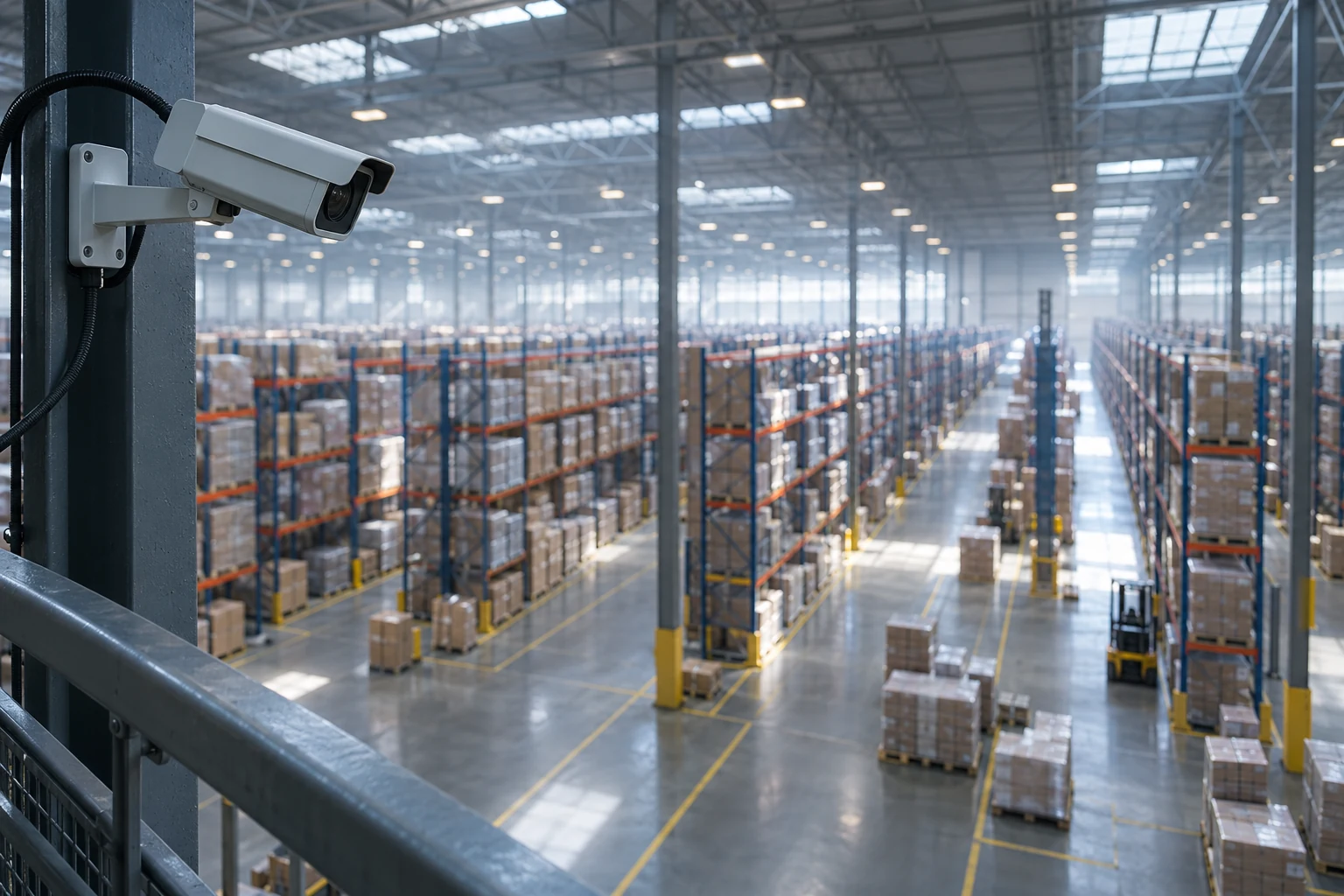
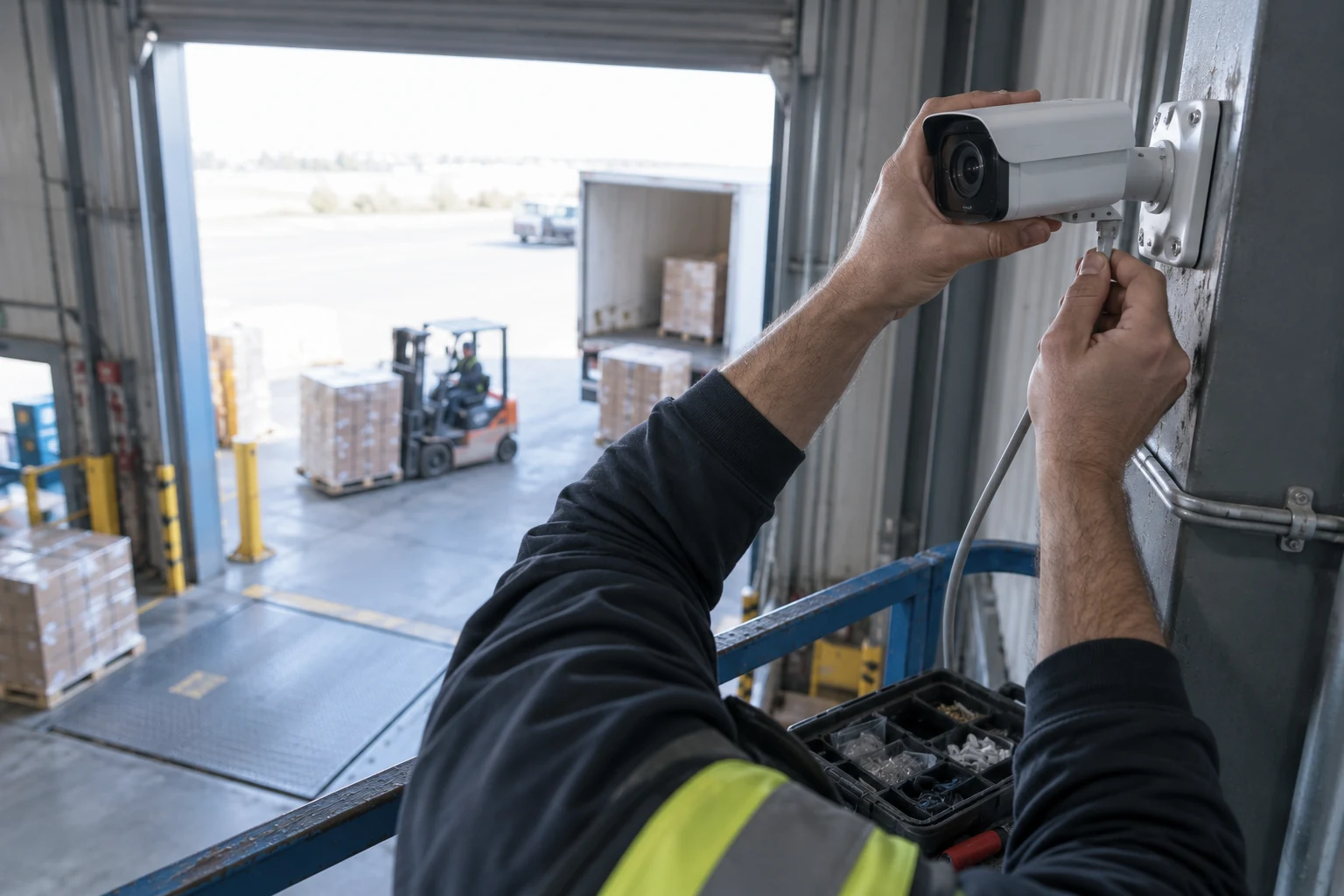
A distribution warehouse aisle under the cameras the platform now runs, none of them replaced.
02 / 16
At a glance
What problem did this solve?
Camera-heavy industrial sites could not deploy their own AI detection. Every new use case meant an outside vendor, a long queue, and a bill that grew with each camera.
What did Brainy Neurals build?
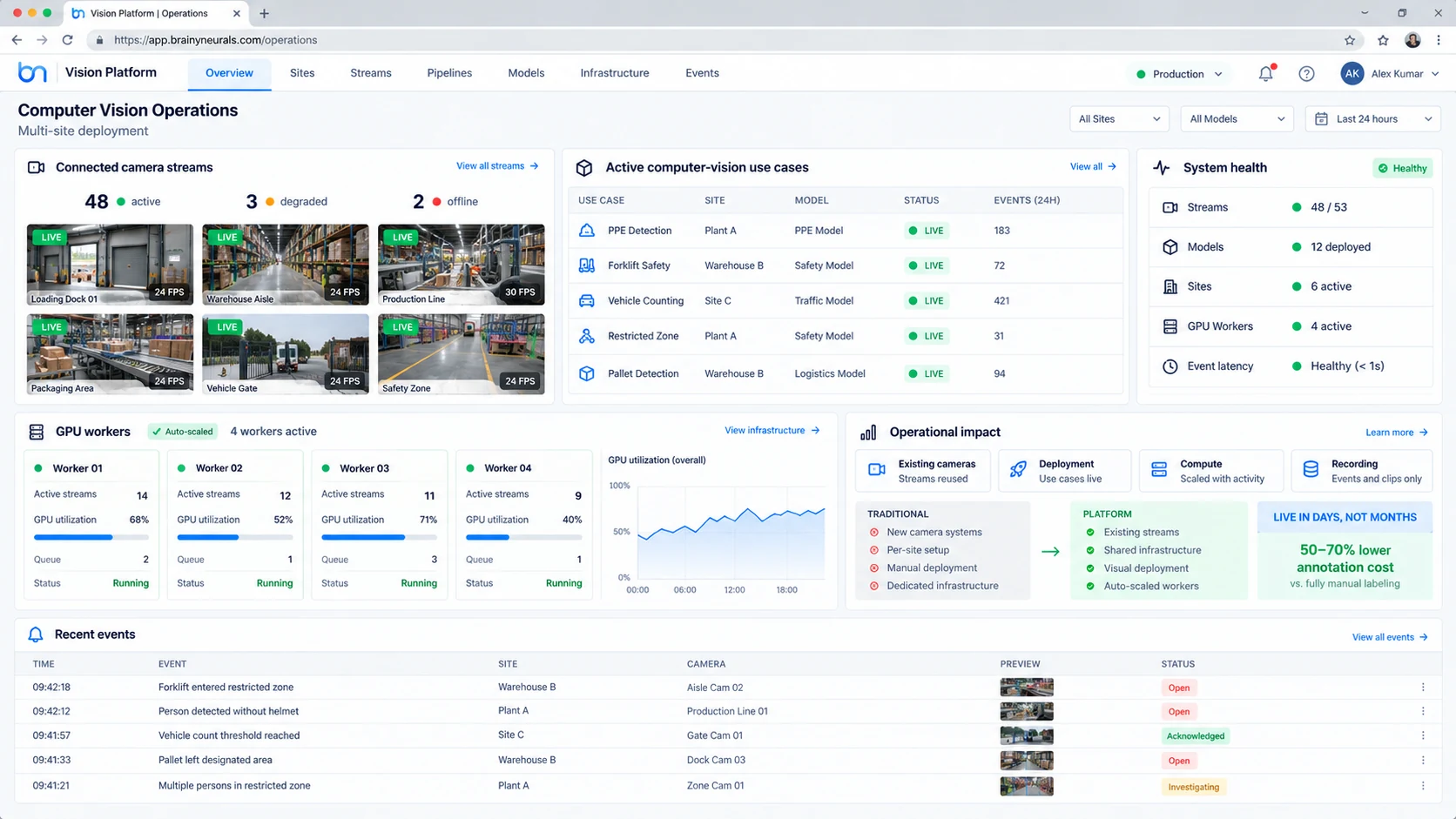
Brainy Neurals built a no-code computer vision platform for a US industrial group. Site teams connect a camera stream, pick or create classes, and deploy detection themselves.
What changed after it went live?
A new detection use case goes live in days instead of months. Annotation costs fell 50 to 70 percent, and no vendor sits in the loop.
Who else could use this?
Any operator of camera-heavy sites can run it. Warehouses, retail stores, banks, malls, and hospitals share the pattern: existing cameras, new detection needs, no AI team.
03 / 16
Why did every use case take months?
A US industrial group runs manufacturing plants and distribution warehouses spread across several states. Every site already carries cameras in the aisles, over the lines, and up above the loading docks. But turning a camera into detection meant buying computer vision development from a vendor, one use case at a time.
Meanwhile, people covered the gap the old manual way. Counts happened on foot, and safety checks ran only as often as somebody could walk the floor.
The pattern repeated for years, the sites kept asking, and the queue never got shorter.
- A vendor quote before anything got smart
- Months from request to first alert
- One new class, back in the queue
- Stock counted on foot, clipboard in hand
- Different vendors per site, no shared learning
None of this is unusual for industrial AI. A 2023 review of machine learning operations found that many machine learning efforts fail to deliver on what they promise [1].

04 / 16
What do teams usually try first?
Four routes to camera detection, all reasonable. Three of them stop at a wall the fourth one clears.
One vendor per use case
- Right
- Strong results on one problem.
- Stops
- Months per rollout, and per-site lock-in.
- Suits
- One-off, high-stakes builds.
An in-house ML team
- Right
- Full model ownership.
- Stops
- A year before the first output.
- Suits
- Firms where AI is the product.
Analytics built into cameras
- Right
- Works on day one.
- Stops
- Fixed classes, a closed roadmap.
- Suits
- Standard objects, single sites.
A no-code platform
- Right
- Use cases in days, owned in-house.
- Stops
- Custom classes still need review.
- Suits
- Camera-heavy operators with no AI team.
A 2021 survey of automated machine learning puts it plainly: good deep learning systems still rely heavily on human expertise [2].
05 / 16
How we designed the platform
Brainy Neurals built the no-code computer vision platform around one user: whoever runs the site, not a data scientist. Everything an engineer used to do here, from wiring camera streams to shipping trained models, became a plain screen action. Connect a stream, pick classes, press train, press deploy.
If a new use case needs our engineers, the platform has failed. That sentence sat pinned above the backlog for the whole build, and it settled every design argument.
The first decision was who deploys. We rejected running detection as a managed service, because a service run by us is just a friendlier vendor. So every workflow, from annotation review to model rollback, had to survive a shift supervisor.
The second decision was multi-tenancy from day one. Each site is a tenant with its own streams, its own datasets, and its own models, on shared infrastructure.
We ruled out per-site installs early on, because separate installs would have rebuilt the exact silos we were removing. Under the hood, the whole thing is simply video analytics, industrialized.
If a new use case needs our engineers, the platform has failed.
06 / 16
The technology stack we used
Every layer had one job: remove a reason to call an engineer, so we chose proven parts everywhere. The one novelty is the annotation assist, from our generative AI development work. The same eight layers serve a two-camera pilot and a busy plant alike.
Streams and inference
Standards-based intake on the cameras already there
No new hardware to buy or bolt up.
Instead of vendor camera kits
A distributed event stream between services
Every service stays decoupled from the next.
Instead of direct service calls
One shared GPU video pipeline
Many camera streams ride a single card.
Instead of per-camera processes
Compact single-pass detectors, 70+ classes
Fast enough for real-time live video.
Instead of two-stage models
Data and training
A vision-language pre-labeler
Reviewing a box beats drawing one.
Instead of fully manual labeling
Managed runs, versioned models
Tracked accuracy and instant rollback.
Instead of notebooks and shared drives
Platform and delivery
Python tooling, Go streams
Each language where it actually wins.
Instead of one language everywhere
Event clips, auto-scaling workers
Costs follow activity, not the clock.
Instead of always-on recording
07 / 16
How does a use case go live?
One use case, from a pasted stream link to live alerts, in the order a site team sees it. Six steps, and not a single one of them is code.
Paste the stream
A site lead pastes a camera’s RTSP link, the standard most IP cameras already speak.
Pick the classes
Choose from 70+ pretrained industrial classes, or name a brand-new one.
Assisted labels
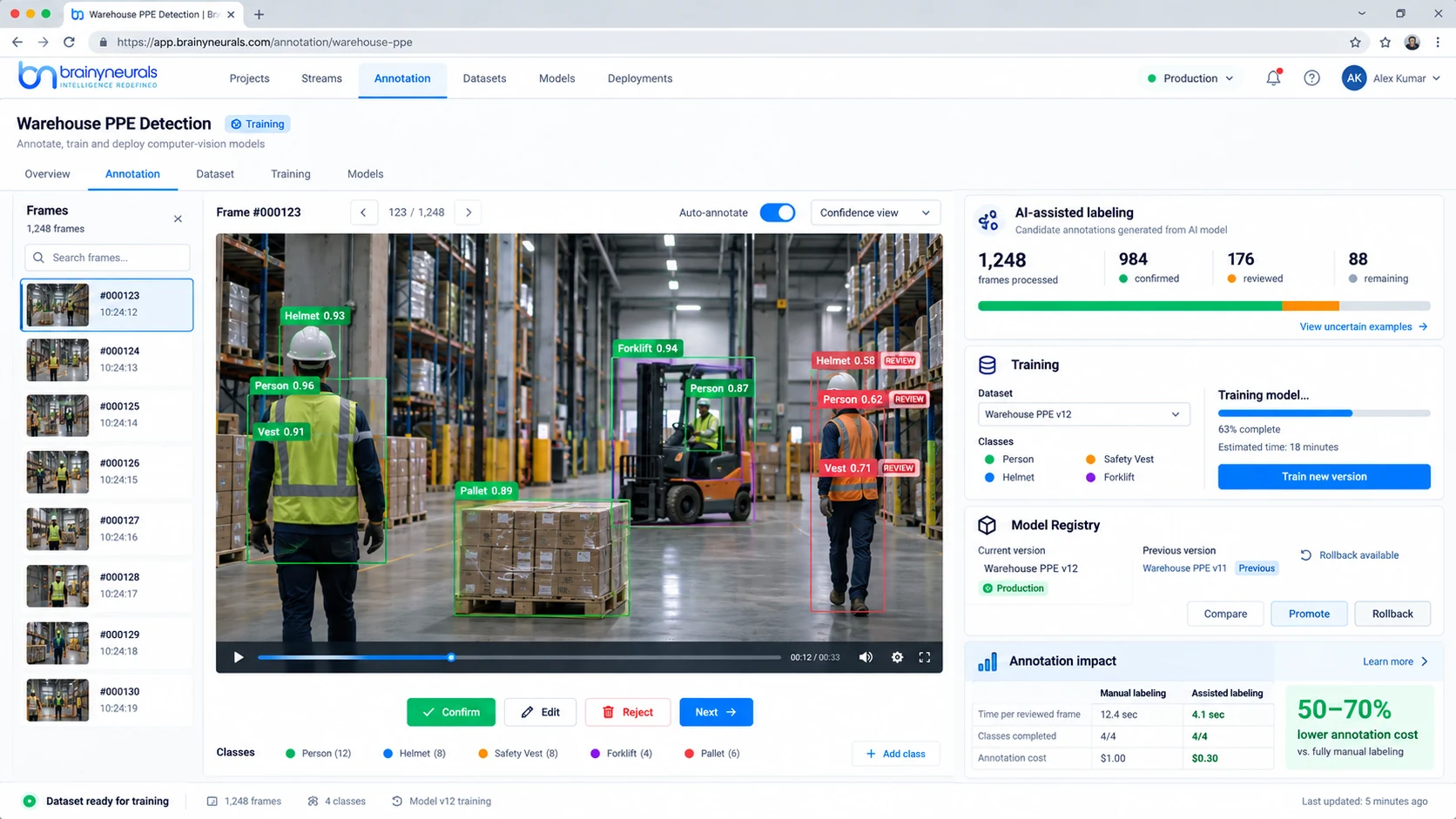
A vision-language assistant pre-labels sample frames; the team confirms each box.
Train and score
A compact detector trains on the set and scores against a held-out slice.
Deploy a version
One click ships the new model to any live stream; the old one stays for rollback.
Events and alerts
Detections flow out as events, clips, and live alerts. No engineer, anywhere.
08 / 16
Three problems that nearly sank the platform
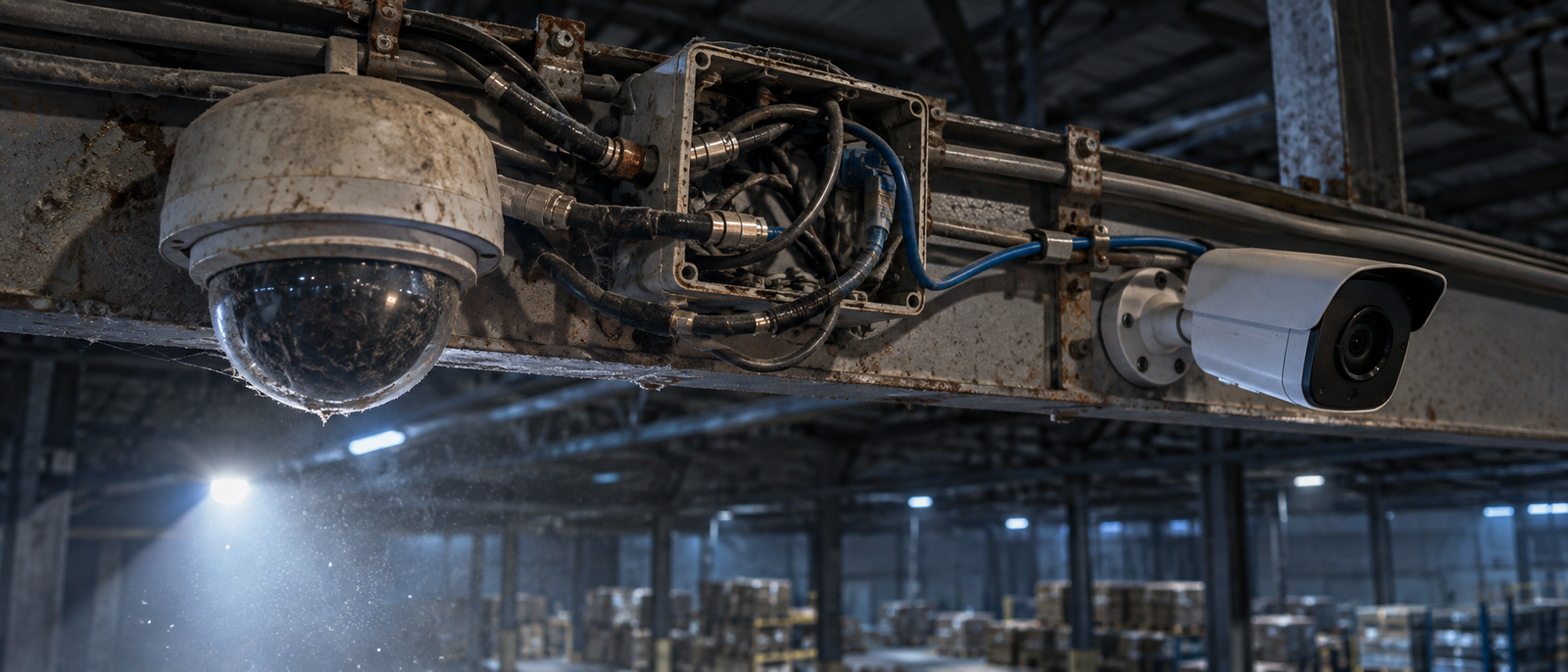
Three things broke, in this order.
Real cameras were hostile in ways the demo rig never was. Feeds dropped mid-frame, clocks drifted, and one plant’s cameras spoke a dialect of RTSP we had never met. One camera, for the record, predated the smartphone.
The annotation assistant was confidently wrong on the classes that mattered most. And reviewers accepted its boxes at a click, because a plausible label invites agreement. So bad labels flowed straight into training runs.
Under shared load, one tenant’s busy dock cameras quietly starved another tenant’s idle ones. The GPUs didn’t care whose frames they dropped. So a rush at one site slowed alerts three states away.
A 2021 survey of deep active learning exists for exactly this reason: deep models are greedy for labeled data [3]. These are the months when firms weigh specialist engineers against a platform that fought them already.
09 / 16
How we solved each one
Each fix reads simple. None was.
Streams
We rebuilt the whole ingest layer to treat every single camera as an untrusted input. Streams reconnect with backoff, clocks resync per feed, and a health monitor flags a dying camera before a tenant notices. Adding a stream stayed a paste-and-go action.
Labels
We put a hard confidence gate between the assistant and every tenant dataset. Sure labels pass with one-click review, unsure frames route to a human queue, and samples of both get audited. Label quality became a number the platform tracks, not a feeling.
GPUs
We made the scheduler tenant-aware. Every tenant holds a guaranteed slice of GPU time, and bursts draw from a shared pool. Auto-scaling adds more workers when the pool runs dry, so a rush now stays at its own site.
Because every one of these surfaced in the proof of concept stage, no tenant ever saw them.
10 / 16
What changed after go-live?
Five things flipped the day the platform went live. What used to be a vendor project became a screen action.
That figure is a comparison, not a guess. Assisted labeling cost 50 to 70 percent less per class than the fully manual work the same teams ran before.
We have not published a per-class accuracy figure. The platform tracks one per version, and the client owns those numbers. A number we have not verified is a number we will not print.
Day to day, the real change is who waits on whom. An idea raised on a Monday can be watching its cameras by Friday. And the vendor line item is gone.
Nobody files a ticket to a vendor anymore. The team that owns the cameras owns the detection that runs on them.
What should your cameras be watching?
No sales sequence. One reply, from the person who would architect it.
11 / 16
What is running today
The no-code computer vision platform runs in production across the group’s plants and warehouses, on the cameras already there. Site teams have shipped use cases that nobody scoped at kickoff, from dock counting to forklift-zone safety.
Brainy Neurals ships platform updates, and the tenants keep their own models, their own datasets, and their own release pace. Nothing about that arrangement changes when a site doubles or even triples its cameras.
Since handover, new manufacturing sites have onboarded themselves by pasting camera links, and the vendor queue has stayed empty.
12 / 16
What would we do differently?
A camera stream is a promise the camera will not always keep.
01Gate the assistant before anyone trusts it
We shipped the assisted labeling first and only added the confidence gate second. The order was backwards, and getting it wrong cost us a full retraining cycle.
02Treat every camera as a liar
A camera stream is a promise the camera will not always keep. So we now soak-test ingest against the worst feeds we can find before any tenant does.
03Version datasets, not just models
A model regression once traced all the way back to labels that had quietly changed. Models were versioned from day one, and now datasets are, too.
04Meter cost per tenant from the start
Shared infrastructure is very good at hiding exactly who costs what. We added per-tenant metering late, and pricing the product got harder for it.
13 / 16
Where else does this platform fit?
A no-code computer vision platform turns ordinary camera streams into AI detection through configuration instead of code. It belongs wherever the cameras outnumber the engineers available to program them.

| Industry | The equivalent problem | What changes in the build |
|---|---|---|
| Retail stores | Checkout queues build before staff notice | People and queue classes, alerts to the floor |
| Banking | Branch lobbies and ATM areas unwatched | Loitering and queue events, strict retention rules |
| Malls and venues | Footfall guessed, restricted doors unchecked | Entry and zone classes, one tenant per operator |
| Hospitals | Corridors depend on whoever walks past | Fall and safety-gear classes, tighter data boundaries |
| Construction sites | Safety checks only on walkthroughs | Helmet and vest classes, rugged mobile cameras |
Porting takes a stream link, the right classes, and a reviewed dataset for custom work. The platform layer itself never needs to change.
14 / 16
Questions buyers usually ask
Can AI video analytics run on existing CCTV cameras?
Usually, yes. If a camera outputs an RTSP stream, and most modern IP cameras do, the platform ingests it directly. Older analog cameras only need a small encoder box, not a full camera replacement.
How does AI-assisted image annotation work?
A vision-language model reads a plain-text description of a class and then draws candidate boxes on sample frames. People then confirm or correct them. Reviewing a drawn box is far faster than drawing one from scratch, which is where the savings live.
Do we need machine learning engineers to run it?
Not to run it. Site teams handle the streams, the classes, the training runs, and the deployments through the interface. Engineers only appear when the platform itself needs to grow a whole new capability.
How long does computer vision take to deploy in a warehouse?
On this platform, days per use case. A pretrained class can start watching a live stream on the same day it is chosen. A custom class adds only the time needed to review an assisted dataset, usually inside a week.
How much does a no-code computer vision platform cost?
Pricing follows camera streams and use cases rather than open-ended engineering hours. Brainy Neurals scopes it from a short call and a camera count, and then quotes a fixed price. An AI readiness assessment shows you first whether your cameras and your site network are ready for it.
How does it scale as cameras are added?
Auto-scaling adds GPU workers as camera streams grow, and every tenant keeps its guaranteed slice. Ten cameras and ten times that many behave the same way, apart from the final size of the bill.
15 / 16
The services this was built from
Computer vision development
The detectors behind the 70+ class library, trained and sized for live video on shared GPUs.
Video analytics
The runtime layer that watches every stream and turns frames into events worth acting on.
Generative AI applications
The vision-language assist that pre-labels frames for review came out of this practice.
Edge AI and embedded services
For sites that need detection with no cloud path, models deploy to on-site boxes.
Hire AI developers
Platform engineers who extend your team when the build is bigger than a use case.
AI in manufacturing
Vision systems for plants, from inspection lines to safety zones, on existing cameras.
A proof of concept is the fastest way to test this on your own cameras. AI consulting helps a team pick the first use case well. An AI readiness assessment checks your cameras and your network, and the industries hub shows where this already runs.
16 / 16
Other builds with this shape
Three more Brainy Neurals builds, each one running in a real environment rather than on a slide deck.
Case study
Overhead Line Geometry Measurement
Stereo cameras on a moving train, measuring live overhead wire geometry as the track rolls past.
Case study
AI Diet Assistant for Gastroenterology
Clinical dietary guidance generated under review gates, live in a working healthcare practice.
Case study
Personalised AI Meal Planning for Chronic Care
Structured meal plans built from messy personal health data, grounded and reviewable.
Sources
- [1]Kreuzberger D, Kuhl N, Hirschl S. Machine Learning Operations (MLOps): Overview, Definition, and Architecture. IEEE Access. 2023;11:31866-31879. DOI 10.1109/ACCESS.2023.3262138.
- [2]He X, Zhao K, Chu X. AutoML: A survey of the state-of-the-art. Knowledge-Based Systems. 2021;212:106622. DOI 10.1016/j.knosys.2020.106622.
- [3]Ren P, Xiao Y, Chang X, Huang P, Li Z, Gupta BB, Chen X, Wang X. A Survey of Deep Active Learning. ACM Computing Surveys. 2021;54(9):180. DOI 10.1145/3472291.
Cite this case study
Patel, Mitesh. No-code computer vision without an AI vendor. Brainy Neurals, August 2026. https://brainyneurals.com/case-studies/no-code-computer-vision-platform/