








Case study · Video analytics and edge AI
AI traffic violation detection for smart cities
An Indian smart-city authority policed traffic violations with manual patrols, and hand-written challans full of errors kept turning into disputes. Brainy Neurals built an AI traffic monitoring system that detects violations at the roadside and reads number plates. Every case carries photo and video evidence and passes human review before a challan goes out.

Mitesh Patel
Founder & Director · NVIDIA Certified AI Architect
He led this build end to end, from filming at street level to the first junctions going live under review. He also set the human-review rule that this page keeps returning to, after the first wrong challans.
Published August 2026 · Last updated August 2026 · 12 min read
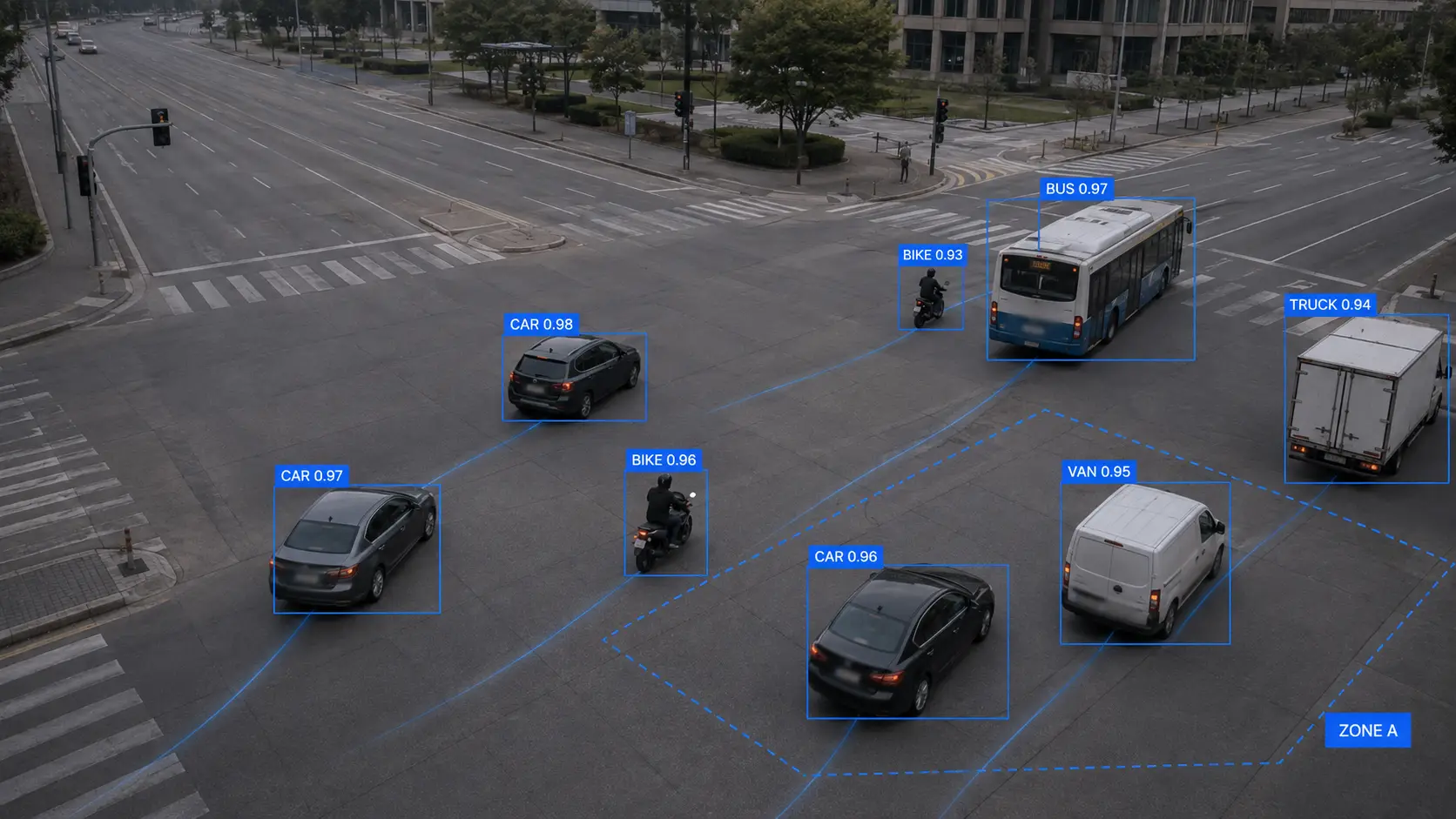
Junctions like this one are where the system watches, counts, and flags violations through the day.
At a glance
What problem did this solve?
Manual traffic enforcement in a fast-growing Indian city missed violations and produced wrongly issued paper challans. Planners also had no reliable picture of how traffic actually moved through the city.
What did Brainy Neurals build?
Brainy Neurals built an AI traffic monitoring system for an Indian smart-city authority. Roadside units detect vehicles, flag eight violation types, read number plates, and feed a human review dashboard.
What changed after it went live?
Violations are caught on camera with photo and video evidence, and every challan passes human review. Traffic counts by vehicle type now drive the city’s road and enforcement planning.
Who else could use this?
Roadside AI monitoring fits operators of roads, parking, yards, and large sites. It suits anywhere cameras must catch events the moment they unfold.
Why did manual enforcement keep failing?
An Indian smart-city authority manages junctions where cars, buses, trucks, auto-rickshaws, and two-wheelers share one stretch of road. Enforcement depended on whichever officer happened to be watching that stretch at that hour. The city had cameras, but no video analytics behind them, so planning ran on complaint letters and occasional counts.
- An officer could watch one corner of a busy junction, and the violation happened at the other three.
- Challans were written out by hand, and a misread plate sent the fine to the wrong owner.
- A dispute came down to word against word, because no evidence existed on either side.
- Riders without helmets passed through freely whenever the nearest enforcement post happened to stand empty.
- Planners choosing where a flyover or a one-way corridor should go had opinions, not counts.
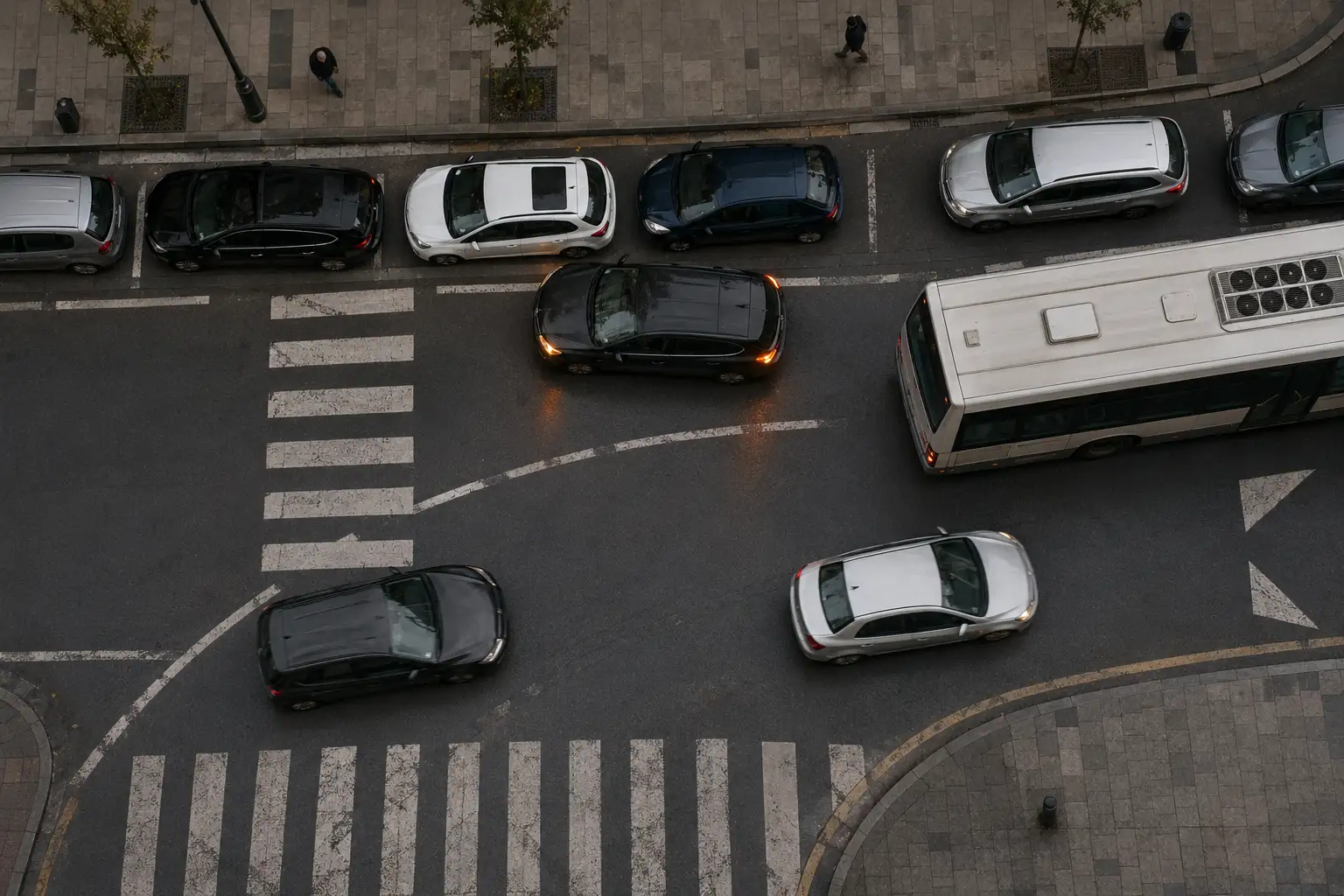
And none of it was small. Helmets cut a rider’s risk of death by roughly two fifths, so every unwatched junction carried a real cost [1].
What do cities usually try first?
Four routes, all reasonable. Each one stops somewhere specific, and the fourth route is the one we shipped.
| Route | What it gets right | Where it stops | Who it still suits |
|---|---|---|---|
| Manual patrols | Human judgment on the spot | One pair of eyes per post | Rare, complex situations |
| Cloud video analytics | Any model size, central updates | Bandwidth and latency per junction | A few cameras, strong links |
| Standalone smart cameras | Quick to install | Fixed functions, closed firmware, siloed data | Single-purpose pilots |
| Edge AI units, our route | Real-time detection, one city data pool | Weeks of engineering per board | Cities running cameras in volume |
A 2016 survey of edge computing listed response time and bandwidth cost as reasons to process data at its source [2].
Tried one of these and hit the wall? Tell us where it stopped.
Tell us where it stopped →How we designed the monitoring system
Brainy Neurals designed the system as a fleet of roadside units feeding one control room. Each unit runs object detection, multi-object tracking, and number plate reading on every stream it captures. Only events, counts, and the evidence bundles ever travel upstream.
DECISION 01
The first decision was where the intelligence in this system would actually live. Streaming every junction’s video to a data center would cost more in bandwidth than the hardware it replaced. So detection had to run at the roadside, on a low-cost embedded board with an AI accelerator.
DECISION 02
The second decision was who gets to issue a challan. The detector flags a violation and assembles its evidence, and a person approves or rejects the case. A wrong challan costs a city more trust than a missed violation ever will.
A wrong challan costs a city more trust than a missed violation ever will.
Operators shape the system themselves and draw restricted zones straight on each camera’s view. They attach a new stream by pasting its address, and detach one just as fast. When an uplink drops, the unit keeps working and syncs its cases when the network returns.
The technology stack we used
Every layer had to survive a roadside cabinet on a public budget, which is the whole discipline of edge AI. The build ran as a pipeline: collect, annotate, train, validate, optimize, field test, deploy, operate.
| Layer | What we used | Why | What we ruled out |
|---|---|---|---|
| The roadside unit | |||
| Cameras and streams | IP cameras or recorded video | Reuse what junctions already have | Proprietary camera lock-in |
| Compute | A low-cost embedded AI board | Affordable citywide | Industrial PCs |
| Runtime | The board’s accelerated video pipeline | No frame copies, hardware decode | Generic CPU processing |
| The models | |||
| Detector | A single-stage vehicle detector | One pass per live frame | Two-stage detectors |
| Tracker | A lightweight multi-object tracker | One vehicle stays one | Fresh detection every frame |
| Plate reader | ANPR tuned on regional plates | Challans need a plate | Cloud OCR services |
| Control room and cloud | |||
| Control room app | A native C++ desktop application | Live walls, playback, plate search | A browser-based video wall |
| Data store | Sealed evidence and audit logs | One citywide, audit-ready picture | Data siloed per junction |
| Data chat | A language model over the data | Plain-language questions, authorized access | Fixed report menus |
How does one violation get caught?
One violation, start to finish. Here is the order the unit sees.
- A junction camera streams live video to the roadside unit, joining however many streams it already carries.
- The detector finds every vehicle in the frame and labels it car, bus, truck, auto-rickshaw, or two-wheeler.
- The tracker follows each vehicle across frames, so one vehicle stays one vehicle from its entry to its exit.
- A track breaking a drawn rule, a wrong-way run, or a rider without a helmet raises a flag.
- The unit reads the number plate, checks it against the watchlist, and saves stills and clip as evidence.
- The case then lands in an operator’s review queue, and only an approved case ever becomes a challan.
Six steps. A person holds the last one. A watchlist hit also fires an instant alert, because a stolen vehicle cannot wait for a review queue.
Want this walked through for your junctions? Book 30 minutes with Mitesh Patel.
No pitch. If it is not a fit, you will know in five minutes.
The four problems that nearly stopped us
Four things went wrong, in order.
The first detection models simply broke on real Indian junctions. Five vehicle classes at every distance, overlapping and weaving, from angles no public dataset covers.
Number plates fought back next. Dirt, bent metal, non-standard fonts, and two-wheeler plates half the size of a car’s.
Then the board sank. A single unit had to carry several live streams, and every naive pipeline copied frames until the frame rate died.
And the very first automated challans included wrong ones. A wrong challan is worse than a missed violation, because the mistake now has a victim.
At four in the morning, the test junction belonged to street dogs and newspaper vans.
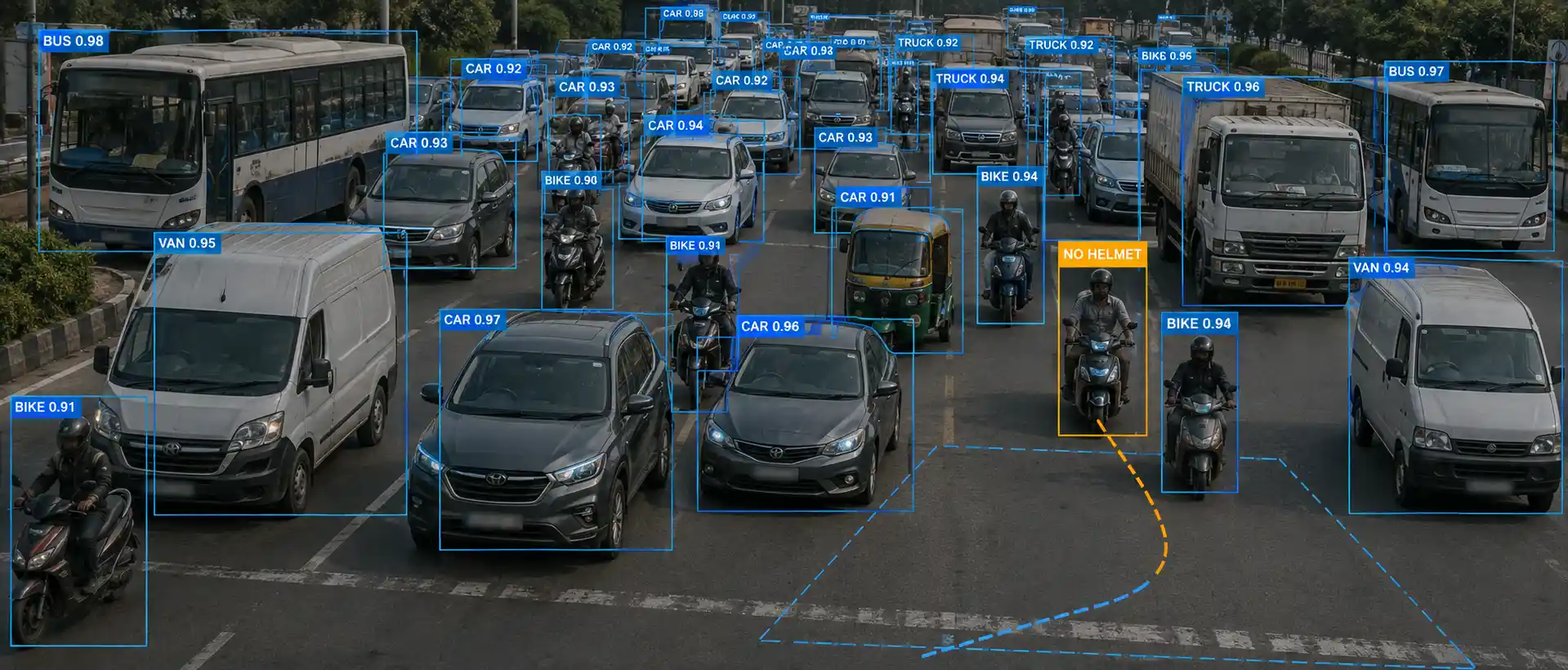
An embedded benchmark measured co-processor detection running roughly ten times faster than the same CPU models [3]. These are the weeks when a city’s integrator brings in specialist engineers.
How we fixed each of them
01FIX 1 · Detection
We collected footage across multiple Indian cities and annotated more than 10,000 images across five vehicle classes. The detector was retrained until live junctions stopped surprising it.
02FIX 2 · Plates
Automatic number plate recognition, or ANPR, needed its own discipline, starting with a reader tuned on regional plates. And we let the tracker vote across frames, because one clean read beats twenty blurry ones.
03FIX 3 · Streams
We moved the whole pipeline onto the board’s accelerated path, so frames decode, batch, and infer without copies. The unit now carries its full set of live streams, and a watchdog restarts any that die.
04FIX 4 · Wrong challans
We put a person in the loop: the system flags, attaches evidence, and waits. An operator approves or rejects every case, and nothing reaches a vehicle owner unreviewed. Duplicate flags collapse into one case, and every decision is logged.
This is what a proof of concept exists to surface.
What changed after go-live?
| What | Before | After |
|---|---|---|
| Catching a violation | An officer had to see it | A camera sees it, with evidence |
| Issuing a challan | Written by hand at the roadside | Reviewed on a dashboard, evidence attached |
| Settling a dispute | Word against word | Photo and video on record |
| Counting traffic | Occasional manual surveys | Continuous, by type, hour, and junction |
| Finding one vehicle | Hours of scrubbing footage | A plate or description query |
We have not published violation-volume or dispute-rate figures, though the client reports errors, effort, and disputes all fell. A number we have not measured is a number we will not print.
The counts now decide real things, like where a new bridge should split the load. The same counts decided which corridors should turn one-way, and where officers should stand at which hour.
Plate reads map journeys and corridor times across the whole network. That same vehicle mix now feeds the authority’s area-by-area pollution estimates.
What should your cameras be catching?
No sales sequence. One reply, from the person who would architect it.
What is running today
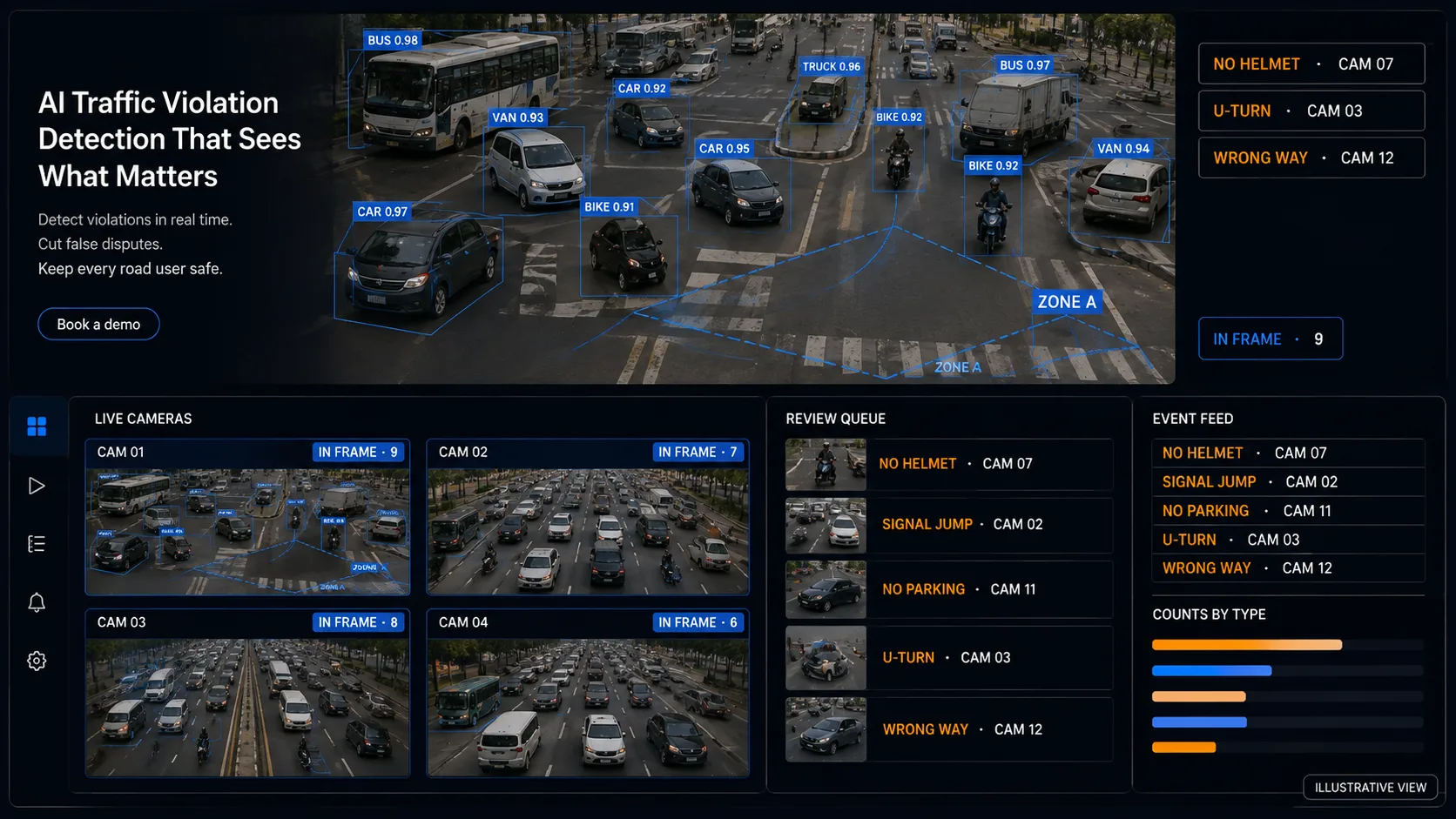
The system runs in production across the authority’s junctions. Operators attach a stream by pasting its address and draw its violation zones. They search recorded footage by plate, vehicle type, or color.
A watchlisted plate raises an alert the moment any camera reads it, a trail for stolen-vehicle cases. A dead stream restarts itself, and model updates roll out junction by junction.
Since handover, the authority also questions its data in plain language, behind authorized access. It’s the same shape as our transportation work: decide at the camera, report upstream.
What would we do differently?
LESSON 1Put the human review in on day one
We added review after the first wrong challans went out, and we spent weeks earning that trust back. Human review should have shipped on day one, not after the first wrong challan.
Human review should have shipped on day one, not after the first wrong challan.
LESSON 2One city’s footage is not a dataset
Our first training set came from too few angles, and the junctions punished it. So collect wide before you train anything at all.
LESSON 3Give operators the zone pen early
Every junction enforces its own local rules differently. Hard-coded zones meant a site visit for every change, and drawable zones ended that.
LESSON 4Budget plates their own timeline
Vehicle detection and plate reading feel like one problem and are two. Plates took their own tuning passes, and planning them separately would have saved us weeks.
Where else does roadside detection fit?
Roadside AI monitoring finds vehicles, people, and events in live video by running detection on hardware at the site itself. It belongs wherever an event must be caught the moment it happens, not minutes after the fact.
| Industry | The equivalent problem | What changes in the build |
|---|---|---|
| Parking operators | Occupancy and overstay, counted continuously | Retrain on bays, add duration rules |
| Construction | Hard hats and site safety at the gates | Helmet detection ports almost unchanged |
| Manufacturing | Forklift lanes and PPE at machine cells | Tighter timing, a signal to the line |
| Logistics yards | Gate check-in and dock counts on patchy networks | More pixels for plates on trucks |
| Campuses and venues | Entry counting and incident flags across many cameras | Fewer vehicle classes, more people logic |
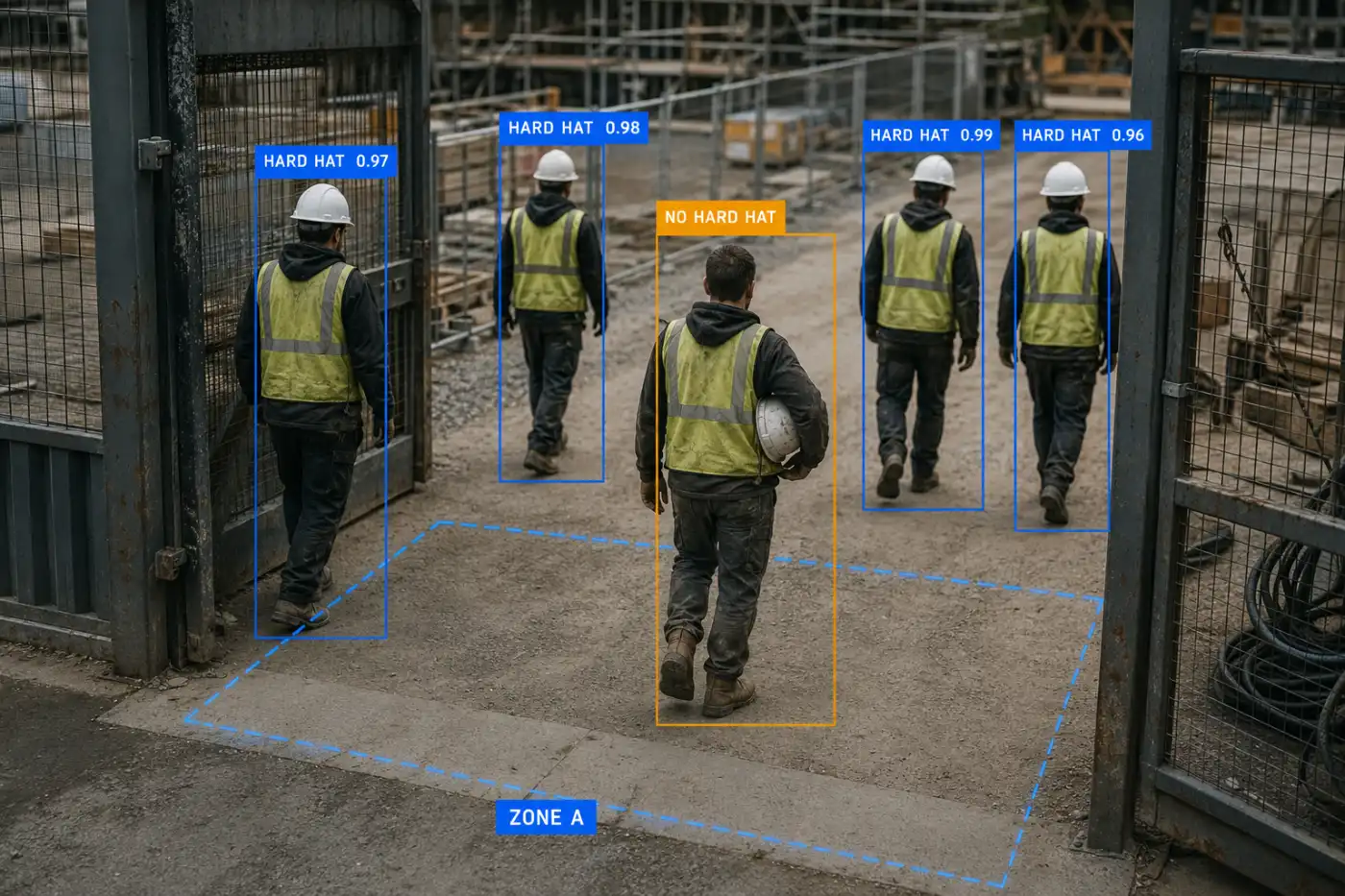
Porting takes a retrained detector, redrawn zones, a synced watchlist, and a proper field test at the new site.
Questions buyers usually ask
How it works
01How does an AI camera detect a traffic violation?→
A detector finds each vehicle in the frame, and a tracker follows it across frames. When a track breaks a rule drawn for that camera, such as a banned U-turn, the system flags it. It captures the stills and the clip in that moment.
02Which violations can be caught automatically?→
This build flags eight violation types, each with a plate read and evidence behind it. Banned U-turns, wrong-way driving, signal jumps, missing helmets, triple riding, missing seatbelts, no-parking stops, and restricted corridors. New types take new zones or training data, not new hardware.
03Does the video leave the roadside?→
Live streams are processed at the junction unit itself. Only cases, evidence clips, plate reads, and counts move to the cloud store, behind authorized access. Continuous video doesn’t stream to a data center.
Time, cost, and rollout
04What happens when the AI gets it wrong?→
Nothing reaches the public, by design. A flagged case waits in a review queue where an operator checks the evidence and approves or rejects it. A rejected case is closed, and no challan ever comes from it.
05How long does a city pilot take?→
A working pilot at one or two junctions usually takes a few weeks once cameras and access exist. Detection quality, plate reading, and the review workflow each need a tuning pass. A citywide rollout follows the pilot’s evidence.
06How much does an AI traffic monitoring system cost?→
Cost depends on the junctions, the camera estate, and what already exists. Brainy Neurals scopes it from a short call and a look at the sites, then quotes a fixed price. An AI readiness assessment tells you first whether your cameras and network can carry it.
If your junctions have cameras and your challans have disputes, tell us what needs to change.
Sources cited on this page
- [1]Liu BC, Ivers R, Norton R, Boufous S, Blows S, Lo SK. Helmets for preventing injury in motorcycle riders. Cochrane Database of Systematic Reviews. 2008;(1):CD004333. DOI 10.1002/14651858.CD004333.pub3. back
- [2]Shi W, Cao J, Zhang Q, Li Y, Xu L. Edge Computing: Vision and Challenges. IEEE Internet of Things Journal. 2016;3(5):637-646. DOI 10.1109/JIOT.2016.2579198. back
- [3]Cantero D, Esnaola-Gonzalez I, Miguel-Alonso J, Jauregi E. Benchmarking Object Detection Deep Learning Models in Embedded Devices. Sensors. 2022;22(11):4205. DOI 10.3390/s22114205. PMID 35684827. back
Patel, M. (2026). AI traffic violation detection for smart cities. Brainy Neurals. Published August 2026. https://brainyneurals.com/case-studies/ai-traffic-violation-detection/
The services this was built from
Video analytics →
Multi-camera monitoring that turns raw junction footage into events, evidence, alerts, and searchable history.
Computer vision development →
Detectors and trackers trained on your objects and tuned for the streets they watch.
Edge AI and embedded services →
Real-time inference on low-cost roadside hardware, sized for every stream it has to carry.
Generative AI development →
Language interfaces over live operational data, so planners ask questions instead of pulling fixed reports.
Hire AI developers →
Vision and edge engineers who extend your team for the weeks the streets fight back.
AI in logistics →
Yard, gate, and fleet monitoring built for operators who move vehicles all day long.
A proof of concept at a single junction is the fastest way to test all of this. AI consulting helps choose the hardware first. An AI readiness assessment checks whether your cameras can carry it. The industries hub shows where this already runs.
Other builds with this shape
Three more Brainy Neurals builds, each of them shipped into a real environment rather than a demo.
Overhead Line Geometry Measurement
Stereo cameras on a moving train measuring live wire geometry, with inference running on the train.
Read the case →AI Diet Assistant for Gastroenterology
Clinical dietary guidance generated under review gates, live in a real healthcare setting.
Read the case →Personalised AI Meal Planning for Chronic Care
Structured meal plans built from messy personal health data, grounded, sourced, and reviewable.
Read the case →