








Home / Case studies / Physical AI Battery Sorting on NVIDIA Jetson for Recyclers
Case study · Battery & e-waste recycling · Edge AI
Physical AI Battery Sorting on NVIDIA Jetson for Recyclers
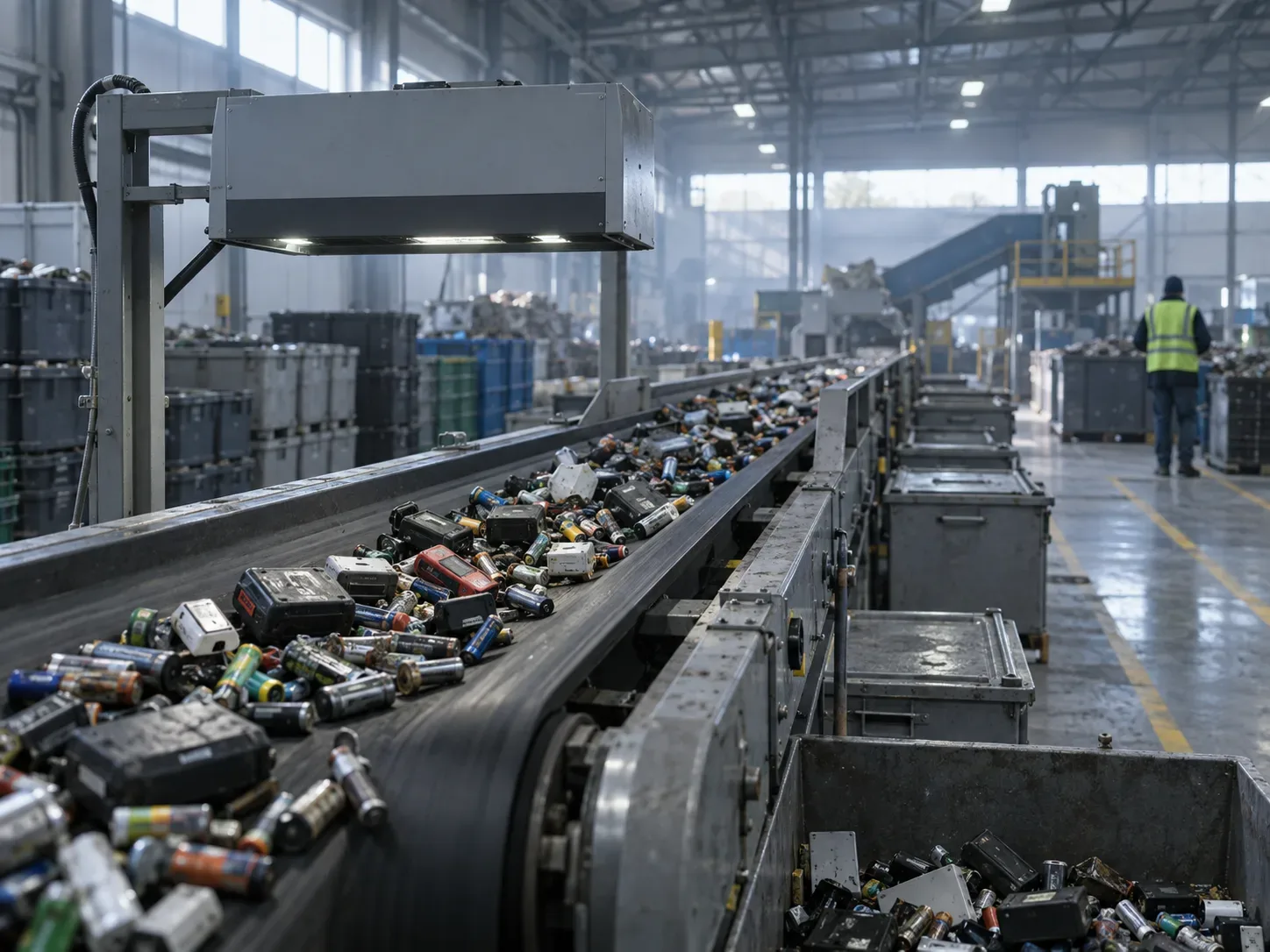
A recycling technology company needed AI battery sorting because its e-waste recovery sites kept no record of the batteries crossing their sorting belts. Brainy Neurals built belt scanners that use a camera model giving one battery many labels to read its type, chemistry, condition & heat. Each scanner decides on an NVIDIA Jetson beside the belt, so operators see live verdicts where a sorter’s glance used to be. Every battery on an equipped line now leaves with six label families & one of three routing verdicts.
6
Label families per battery
On the belt
Where each call is made
Live
Composition view for leadership

Published October 2026
AI battery sorting at a glance
The recycling technology company now has a record of every battery its belts carry, summed up here in four cards.
What problem did this solve?
Battery & e-waste recovery sites kept no per-unit record of the batteries on their sorting belts.
Fire risk & material mix stayed out of sight for operators & leadership.
What did Brainy Neurals build?
We built belt scanners on NVIDIA Jetson that give each battery several labels at belt speed.
A cloud back end turns those labels into live dashboards.
What changed after it went live?
Every battery on an equipped line now carries six label families & one routing verdict.
Scanners flag damaged or hot units while they are still on the belt.
Who else could use this?
Multi-label edge detection suits any conveyor where one item needs several answers at once.
Parcel hubs, electronics returns, scrap yards & food lines all fit.
Engagement facts
Industry
E-waste recycling
Sub-vertical
Battery sorting & recovery
Client
Recycling technology company
Engagement
Edge, cloud & web platform
Timeline
Not disclosed
Capabilities
Multi-label detection, edge AI
Delivery
Project-based delivery
Why can’t sorters spot risky batteries?
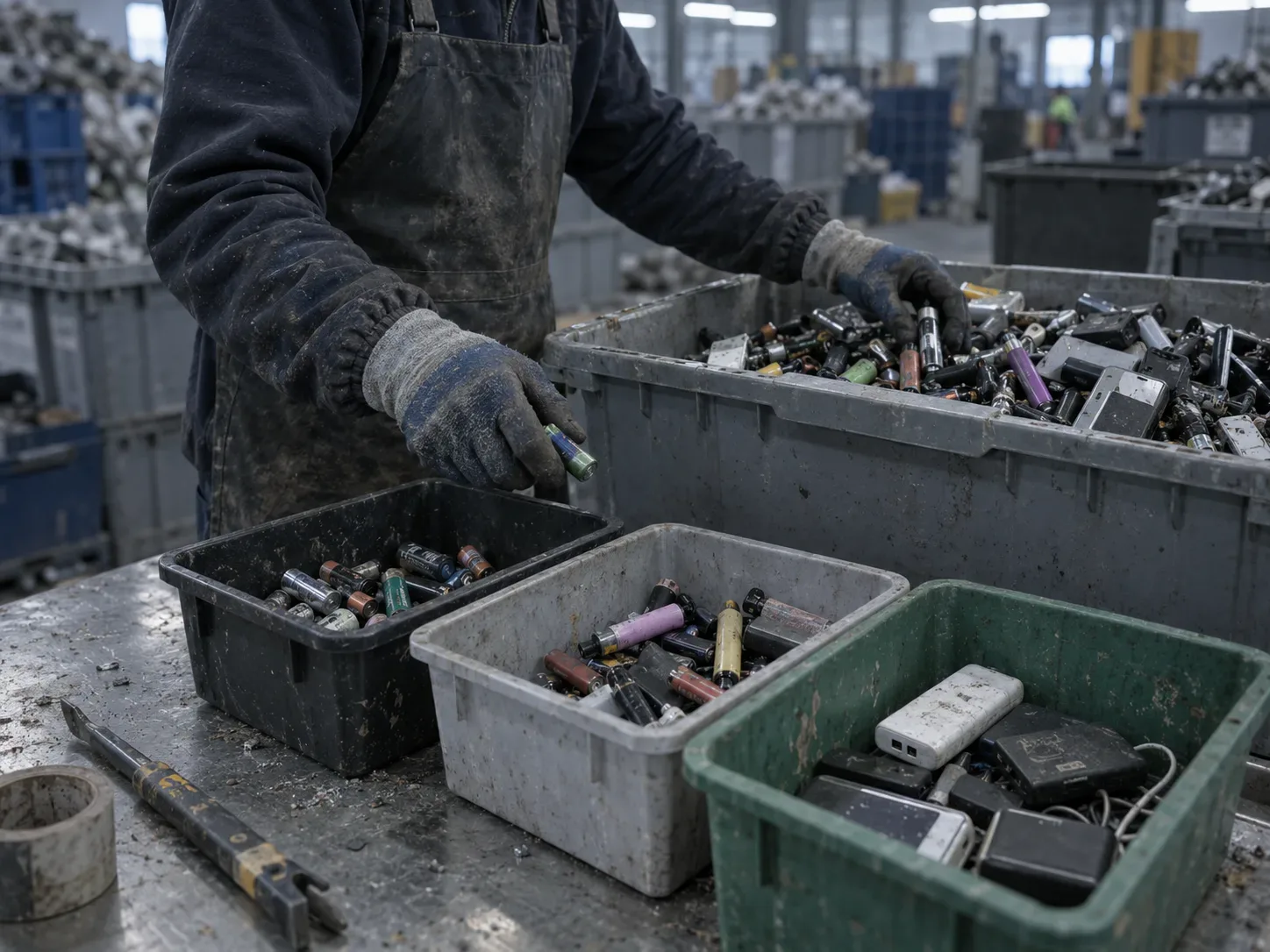
Sorters can’t spot risky batteries because spent cells reach recovery sites tangled with phones, vapes, toys & power tools. Many stay sealed inside the device, & a sorter at the belt gets one glance per item with only their eyes to go on.
So the brief called for AI battery sorting, with computer vision development that reads every unit in real time at belt speed.
The old process broke down in four places.
Chemistry by guesswork
Sorters judged chemistry from casing shape, since labels peel off or hide inside a device.
Damage found late
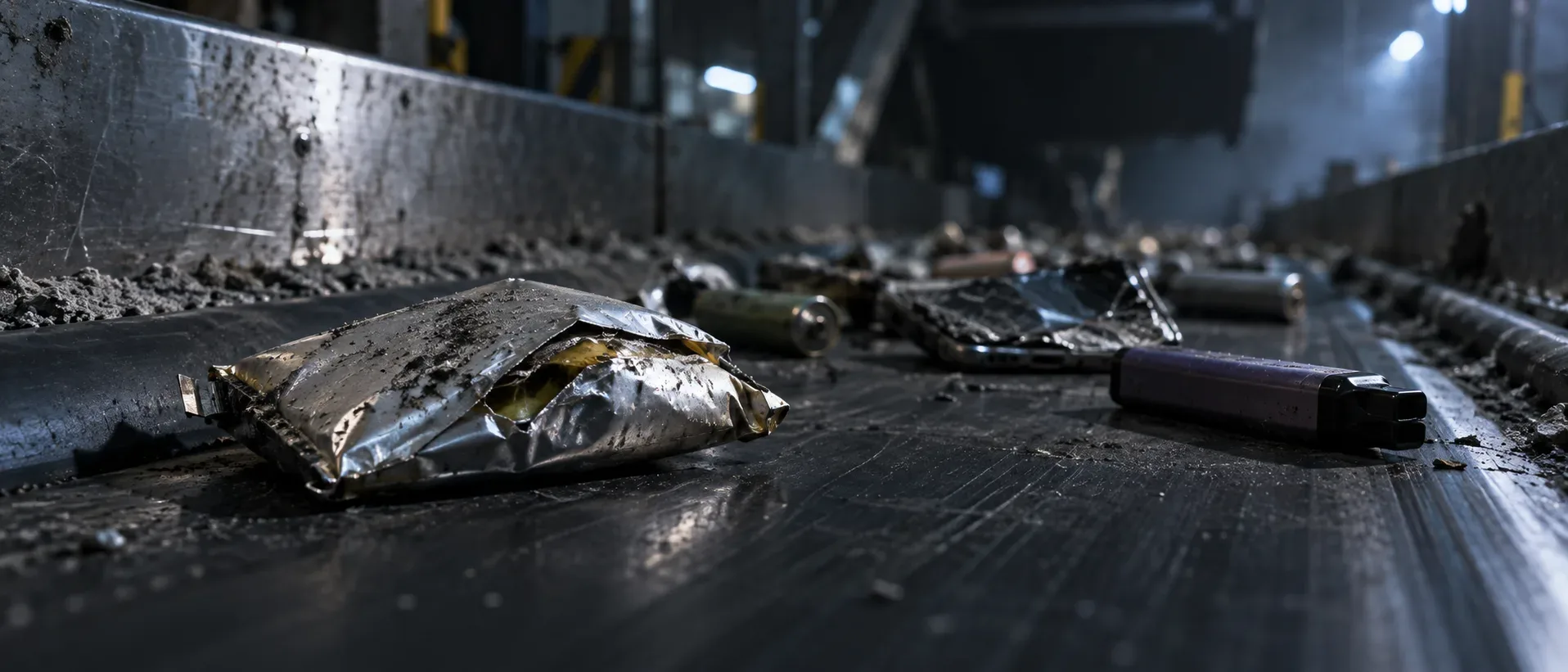
Damage was caught only once a bulge was obvious to the eye.
Heat out of sight
A warming lithium cell looked exactly like every cold cell beside it on the belt.
No live count
Composition was tallied by hand or not at all, which left leadership with no live view.
A US Environmental Protection Agency review tied 245 fires at 64 waste facilities to lithium batteries between 2013 & 2020.[1]
Sorting shapes value too, because isolating high-cobalt cells makes lithium-ion battery recycling pay better & lifts cobalt & nickel recovery.[2]
Why do common battery sorting methods stall?
Common battery sorting methods stall because each one answers only part of what a sorter needs to know. We weighed four routes before building, & each one still fits somewhere.
Hand sorting by eye
Hand sorting is flexible & needs no equipment spend.
Yet it keeps no record & has no sense of heat.
Small volumes from one waste stream still suit it well.
Single-class vision model
A single-class model finds batteries quickly on a belt.
Each item still gets only one answer from it.
Presence checks before shredding still suit this route.
Standalone thermal camera
Thermal imaging sees surface heat directly on the belt.
A bare camera confuses warm rollers with batteries.
Hotspot alarms over bunkers still suit this route well.
Our route, detection at the edge
It reads type & condition alongside heat for every unit.
It needs labeled images from real lines before it works.
Fast streams of mixed, hazardous waste suit it well.
A 2023 study showed real-time detection finding battery-powered devices inside mixed electronic waste.[3]
How we built multi-label battery detection
We built multi-label battery detection by pairing a camera & thermal sensor with an NVIDIA Jetson module in each scanner.
Brainy Neurals built AI battery sorting for a recycling technology company that equips battery recovery sites.
Reading sight & heat at the same instant is sensor fusion, which sits inside our robotics & hardware automation work.
We treated the line as a physical AI problem from the start, because the belt never pauses for a decision. Sensors & compute share one scene with the software, & every call must land before the battery leaves the frame.
Two decisions shaped everything that came after
Let one battery carry many labels at once
A single-class model would force a choice between lithium-ion & damaged, yet a sorter needs both answers.
We rejected a flat class list too, since every mix of traits would become its own class.
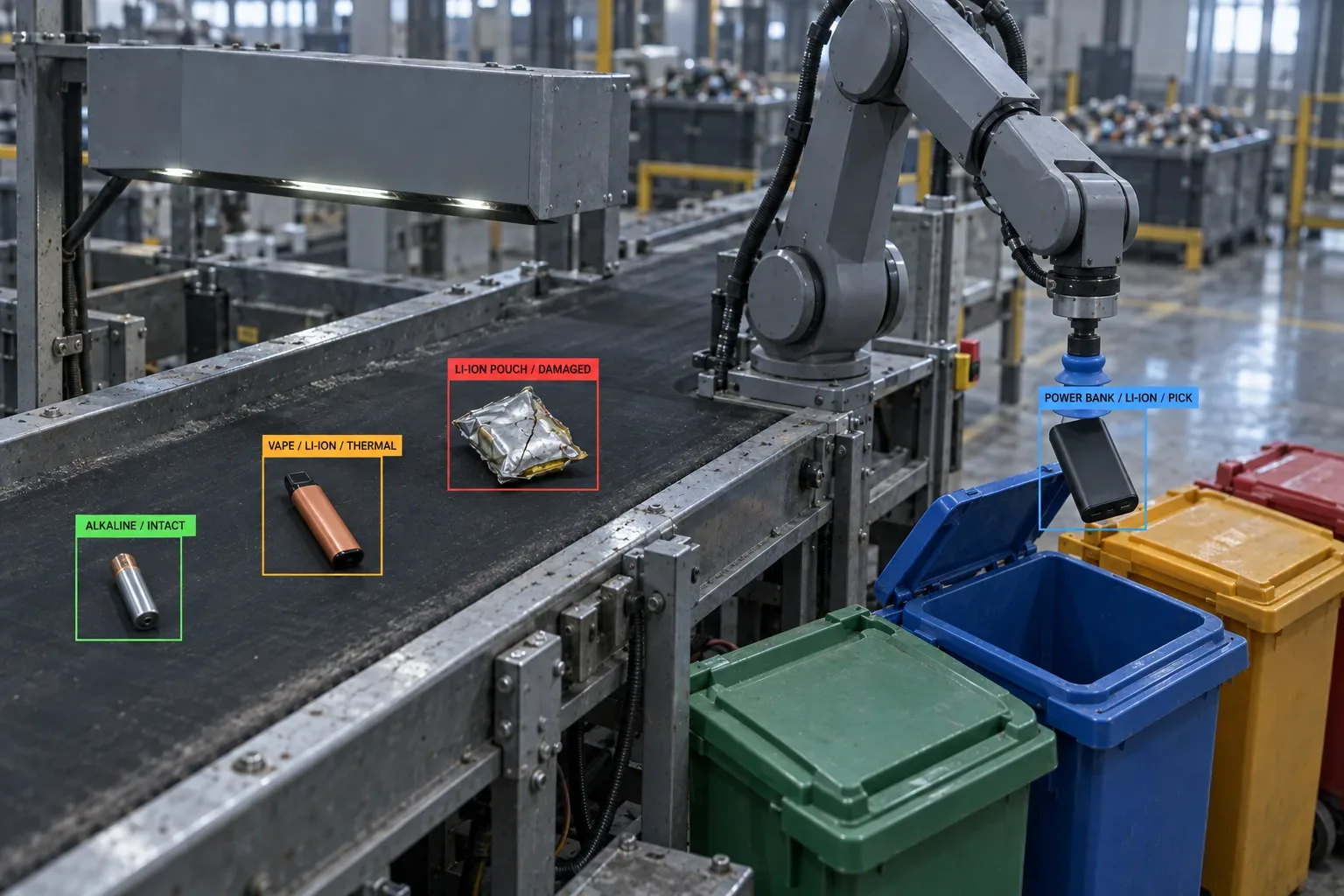
We chose six label families on every detection.
Keep inference on the device
Only structured verdicts travel upstream from each scanner to the cloud.
We ruled out streaming raw video, because bandwidth & network delay would always trail the belt.
Each Jetson decides on the belt & ships the verdict alone.
A single-class model would force a choice between lithium-ion & damaged, yet a sorter needs both answers.
What a device label holds
Device labels follow a three-level taxonomy that runs from broad categories down to exact types.
Its categories include automotive accessories & communications gear.
Types reach down to vapes & power banks, with e-readers at the same level.
One vape reads as consumer electronics, then vapes & e-cigarettes, then disposable vapes.
The other label families
The remaining label families cover chemistry, brand, form factor, voltage & physical condition.
With device type, that makes six label families per battery.
One battery earns six labels in a single detection, & only its verdict crosses into the cloud.
The edge, cloud & web stack
The stack splits the AI work into tiers with one duty each, from the belt up to the browser. Inference lives on the device, because a conveyor never waits for a network.
Past edge AI & embedded services work on Jetson settled the hardware question early.
Mitesh Patel drew the line between Jetson inference on the belt & the cloud back end. He also shaped the operator web app that sits on top of both.
Edge AI, on the line
Edge compute
An NVIDIA Jetson sits in every scanner & decides at the belt.
We ruled out a shared on-site server.
Detection
A multi-label, multi-class detector runs at reduced precision & reads all labels in one pass.
We ruled out a separate model for each attribute.
Heat check
A temperature threshold applies inside the battery outline, so warm machinery raises no flags.
We ruled out hotspot alarms across the whole frame.
Routing
Plain mapping rules turn labels into verdicts that operators can audit.
We ruled out a second model for this step.
Cloud AI & web
Ingest
A containerized service with live sockets takes each unit as it arrives.
We ruled out uploading files once a night.
Storage
A relational database with a time-series extension answers day-to-quarter queries fast.
We ruled out a separate analytics warehouse.
Intelligence
Cached material-flow & brand aggregations keep dashboards fast.
We ruled out recomputing numbers for every view.
Web app
One browser app on managed cloud hosting holds the live feed next to analytics & admin tools.
We ruled out separate tools for each role.
How does one battery become a record?
One battery becomes a record in five steps of AI battery sorting, from the scanner’s view to a dashboard row.
- Capture each unit as it enters the scanner, with a thermal reading per frame.
- Detect the battery & attach each label family, from device taxonomy through chemistry, brand, form factor, voltage & condition.
- Check heat inside the detected outline only.
- Resolve the labels into one of three routing verdicts.
- Stream the record to the cloud, where it joins the live feed & that facility’s reports.
Steps one to four finish on the Jetson module itself. Because each step runs per battery & none waits for a nightly batch, the dashboard mirrors the belt right now.
Steps one to four finish on the Jetson module before any record leaves the scanner.
What went wrong on the live belt?
Four problems went wrong on the live belt once real waste arrived at the scanners.
Labels that flickered
Labels flickered as each battery crossed several frames.
One frame read lithium-ion & the next read alkaline.
A naive counter then logged two units instead of one.
Heat alarms with no battery
Heat alarms fired on objects that were not batteries at all.
Warm rollers & heated neighbors tripped a bare temperature threshold on their own.
A study of Japanese waste plants tied 80 to 90 percent of ignition incidents to lithium-ion batteries.[4]
Rare device types
Rare device types arrived with almost no training examples.
Musical greeting cards & hand warmers turn up rarely, yet each still needs a confident category.
Setup by hand
Every new customer needed our engineers to wire in its facilities & lines, down to each device, by hand.
If your line shows the same symptoms, you can hire AI developers who have already tuned vision on a moving belt.
How we fixed each belt problem
We fixed each belt problem with one change, made either on the device or in customer onboarding.
Flickering labels
We track each battery across frames & let its labels vote before a record leaves the device.
One track now produces one record, so counts match units.
False heat alarms
The thermal condition now joins the detector’s visual judgment with a temperature threshold read inside the battery’s own outline.
Warm rollers outside the outline stopped counting.
Rare device types
The three-level taxonomy lets a rare type fall back to a confident sub-category or category.
Anything still uncertain goes to manual review, which beats a confident wrong answer.
Hand-built customer setup
Guided self-service onboarding now provisions a new customer end to end, from organization down to users & devices.
A new facility no longer waits for one of our engineers to free up.
If you want fixes like these tested on your own line first, start with an AI proof of concept.
Frames vote into one track, & heat is read only inside the detected outline.
What changed once it went live?
Once AI battery sorting went live, every battery crossing an equipped scanner left a record with six label families & one of three verdicts.
We haven’t published a fire-incident or throughput figure for this build. A number the recycling technology company hasn’t measured is one we won’t print, so the cards compare records instead.
Device category & type
Before, a sorter’s glance left nothing on record.
Now every unit gets a taxonomy tag.
Chemistry, brand & form factor
Before, sorters guessed these from the casing.
Now the scanner tags them on the belt.
Voltage
Before, someone read it off a label, if the label was legible.
Now the scanner tags voltage for every unit.
Condition & heat
Before, sorters caught only the damage they could see.
Now each unit carries one of three condition tags, which include a thermal flag.
Routing
Before, the call was the sorter’s alone.
Now each unit passes through or queues for a manual pick.
Units that need a closer look go to review instead.
Reporting
Before, reports meant manual tallies from the floor.
Now the live feed sits beside exports & stewardship reports.
Every battery crossing an equipped scanner now carries six label families & one of three verdicts.
So a hot or crushed cell gets pulled while it is still on the belt. Leadership reads composition over any span from a day to a quarter, without asking the floor for a tally.
Want this walked through for your own line?
Book 30 minutes with Mitesh Patel to walk through your belt & what each item on it needs to read. If it isn’t a fit, you’ll know within five minutes.
Where the system runs today
The platform runs today in production as a multi-tenant service, with each customer walled off from every other.
Operators watch a live feed beside the detection log, with visual & thermal views next to X-ray. Leadership works from Sankey flow charts & brand intelligence. Raw exports from the same data back up stewardship claims.
The platform sits beside our wider AI in manufacturing work.
The word battery first meant a row of cannons firing together. In 1749 an experimenter borrowed it for linked glass jars that held a static charge.
What would we change next time?
Next time we would change four things, & each one is about doing something sooner.
A heat threshold on its own fires at warm machinery, so we tied it to the detected battery outline.
Collect rare-device images from the first week
We waited for rare devices to appear on live belts, & they arrived slowly.
A deliberate collection drive with every customer would have closed that gap sooner.
Agree routing rules before labeling a single image
Operators & managers defined pick & review differently at first.
That mismatch cost a relabeling round that one short AI consulting session could have prevented.
Treat heat as evidence about one battery
A heat threshold on its own fires at warm machinery, so we tied it to the detected battery outline.
That link belonged in the first prototype.
Build self-service onboarding before the second customer arrives
We wired our first customers in by hand.
Earlier provisioning would have freed those engineering hours for the model itself.
Where else does multi-label edge detection fit?
Multi-label edge detection fits wherever one item on a moving line needs more than one answer before it moves on. It’s an on-device vision system that gives each object several labels at once.
The edge-to-cloud frame ports intact, while the label set & the training images change. A parcel hub might tag hazard class, parcel size, damage, destination or an intact seal.
Parcel & logistics hubs
Lithium cells hide inside parcels on the line.
Hazard classes replace chemistry in the label set.
Electronics returns & retail
Returned devices need grading for resale or recycling.
A cosmetic grade joins condition in the label set.
Scrap metal yards
Mixed alloys & contaminated pieces share one belt.
Alloy labels arrive, & the housings get tougher.
Food processing
Size & ripeness apply to the same item as its defects.
Enclosures become food-safe & the mounts are washdown-rated.
Pharmaceutical packaging
Every pack needs its label & seal checked on the line.
The count on each pack needs checking too.
Validation records get kept for regulated audits.
Porting takes new labeled images & a new label set, while the edge-to-cloud frame carries over intact. Related fits sit in AI in logistics & AI in retail.
Questions about physical & edge AI
These questions about physical & edge AI come up on first calls, so the answers sit here in plain words.
How it works
What is physical AI, & how is it different from other AI?
Physical AI is software that senses & acts on the real world through cameras or sensors. Some systems also act through the machines they control. It copes with dust, glare, motion & heat, often on hardware beside the process.
Should real-time visual inspection run at the edge or in the cloud?
Run the decision at the edge whenever an object is moving & a network delay would miss it. Results & review images go to the cloud, where many sites can be compared. Device health reports travel to the cloud in the same way. Our conveyor builds split the work like this.
What is the difference between multi-label & multi-class object detection?
Multi-class detection gives each object exactly one class from a fixed list. Multi-label detection lets one object hold several labels at once, such as its chemistry & its condition. Industrial lines often need both kinds together.
Can AI detect damaged or overheating lithium batteries on a conveyor?
Yes, when vision & temperature sensing work together on the line. A camera model spots dents & swelling, & it also catches casings that have split open. A thermal sensor reads surface heat inside each detected battery.
Cost, time & rollout
How much does an AI sorting or inspection system cost?
The cost of AI battery sorting depends on how many lines you run & how large the label set is. Hardware per scanner adds to that, while dashboards with reporting or multi-customer features add software scope. A one-line pilot gives you a real figure before you commit larger spend.
How long does it take to deploy computer vision on a production line?
Timelines depend mostly on how many labeled images of your real product already exist. We run a one-line pilot first, then roll out line by line once verdicts hold steady across shifts. An AI readiness assessment gives you a dated plan before you commit.
What does your line need to read?
Tell us about the items on your belt & the answers each one needs before it moves on. A short description is enough for us to start.
Services behind this case study
Six Brainy Neurals services sit behind this case study, from computer vision on the belt to AI in manufacturing.
Computer vision development
Multi-label, multi-class detection that reads chemistry, brand, form factor & condition on a moving belt.
Edge AI & embedded services
Jetson deployment at reduced precision, so verdicts form beside the conveyor.
Robotics & hardware automation
Camera & thermal sensor fusion inside scanners that hang above live sorting lines all day.
Video analytics
Live camera feeds in several views beside a per-unit detection log.
AI POC & MVP development
A one-line pilot that proves the label set & routing rules before any fleet-wide rollout begins.
AI in manufacturing
Industrial lines where heat & dust decide what vision must survive.
Weighing a similar build for your own line? Start with an AI proof of concept or an AI consulting session, whichever answers your open question faster. Our page of AI solutions by industry & an AI readiness assessment are gentler first steps.
Similar case studies
One similar case study shares this build’s edge-first shape, with inference beside the moving subject.
Overhead Line Geometry Measurement
Stereo cameras on a moving train measure overhead wire geometry, with inference running on board.
Every other published build sits with the rest of the Brainy Neurals case studies.
Cite this case study
Patel, Mitesh. Physical AI Battery Sorting on NVIDIA Jetson for Recyclers. Brainy Neurals, September 2026. https://brainyneurals.com/case-studies/ai-battery-sorting-jetson/
Sources cited on this page
- US Environmental Protection Agency. An Analysis of Lithium-ion Battery Fires in Waste Management and Recycling. Document EPA 530-R-21-002. July 2021. Link
- Weigl D, Young D. Impact of automated battery sorting for mineral recovery from lithium-ion battery recycling in the United States. Resources, Conservation and Recycling, volume 192, 2023, article 106936. DOI 10.1016/j.resconrec.2023.106936. Link
- Yang SW, Park HJ, Kim JS, Choi W, Park J, Han SW. Study on the real-time object detection approach for end-of-life battery-powered electronics in the waste of electrical and electronic equipment recycling process. Waste Management, volume 166, 2023. DOI 10.1016/j.wasman.2023.04.044. Link
- Terazono A, Oguchi M, Akiyama H, Tomozawa H, Hagiwara T, Nakayama J. Ignition and fire-related incidents caused by lithium-ion batteries in waste treatment facilities in Japan and countermeasures. Resources, Conservation and Recycling, volume 202, 2024, article 107398. DOI 10.1016/j.resconrec.2023.107398. Link