








Why Hospital AI Pilots Stall at Validation: Six Recurring Patterns From Production Failures
Six recurring patterns from production failures — anchored to the Epic Sepsis Model, Sjoding pulse oximetry, Optum-Obermeyer, MD Anderson Watson, and the eGFR reckoning.
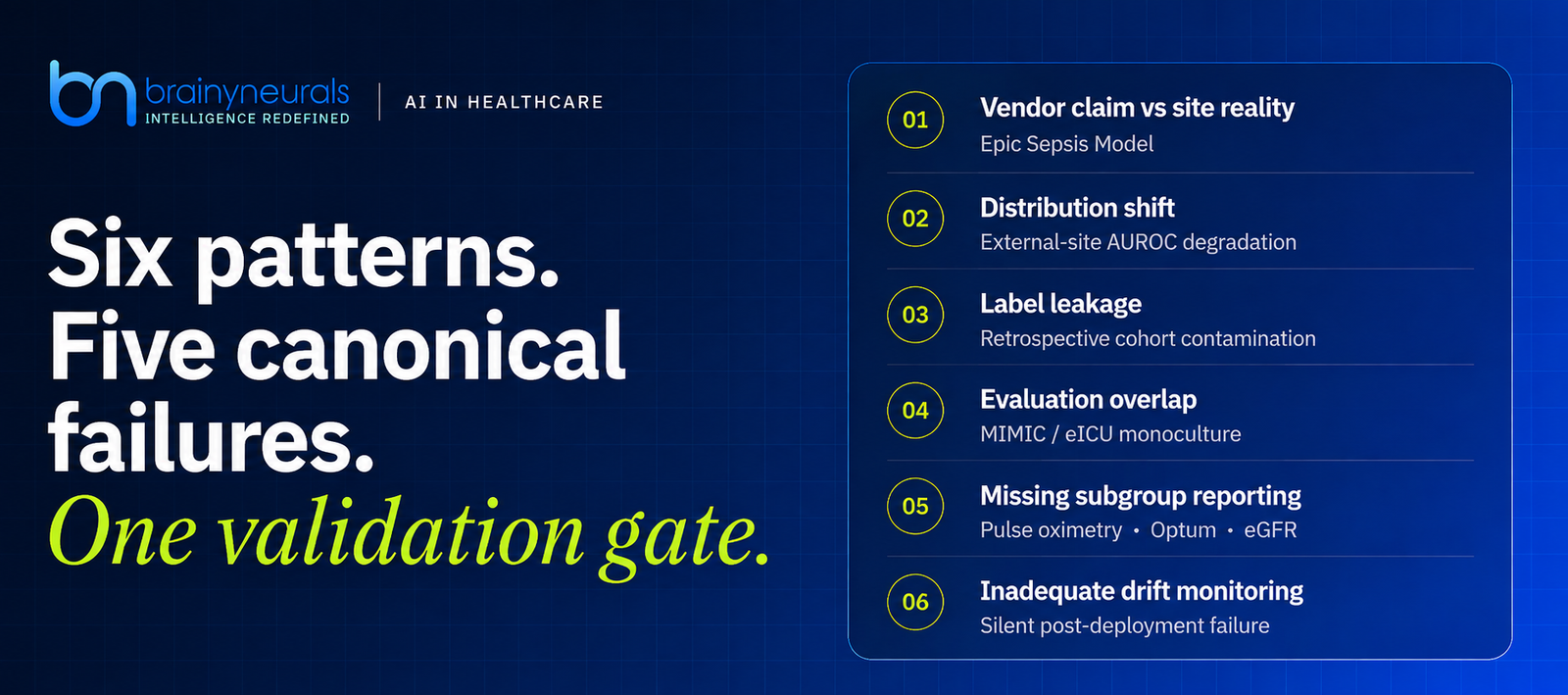
Six recurring patterns kill hospital AI pilots between the vendor demo and clinical go-live: vendor-claimed AUC versus site-realized AUC, distribution shift across sites, label leakage in retrospective cohorts, evaluation-cohort overlap with training data, missing subgroup reporting, and inadequate drift-monitoring infrastructure. Five of the six were the dominant failure mode in the canonical published failures — Epic Sepsis Model, Sjoding pulse oximetry, Optum-Obermeyer, MD Anderson Watson, and the eGFR race-coefficient reckoning. None of these were model-quality problems.
The contrarian observation that sets up this whole post
After auditing the public record of clinical AI deployments — and the half-dozen we have supported in radiology, pathology, and clinical documentation — the validation gate is rarely where the model fails. The model usually works fine on whatever held-out test set the vendor shipped. What fails is the assumption that the test set resembled the data the model will see when it goes live at your hospital.
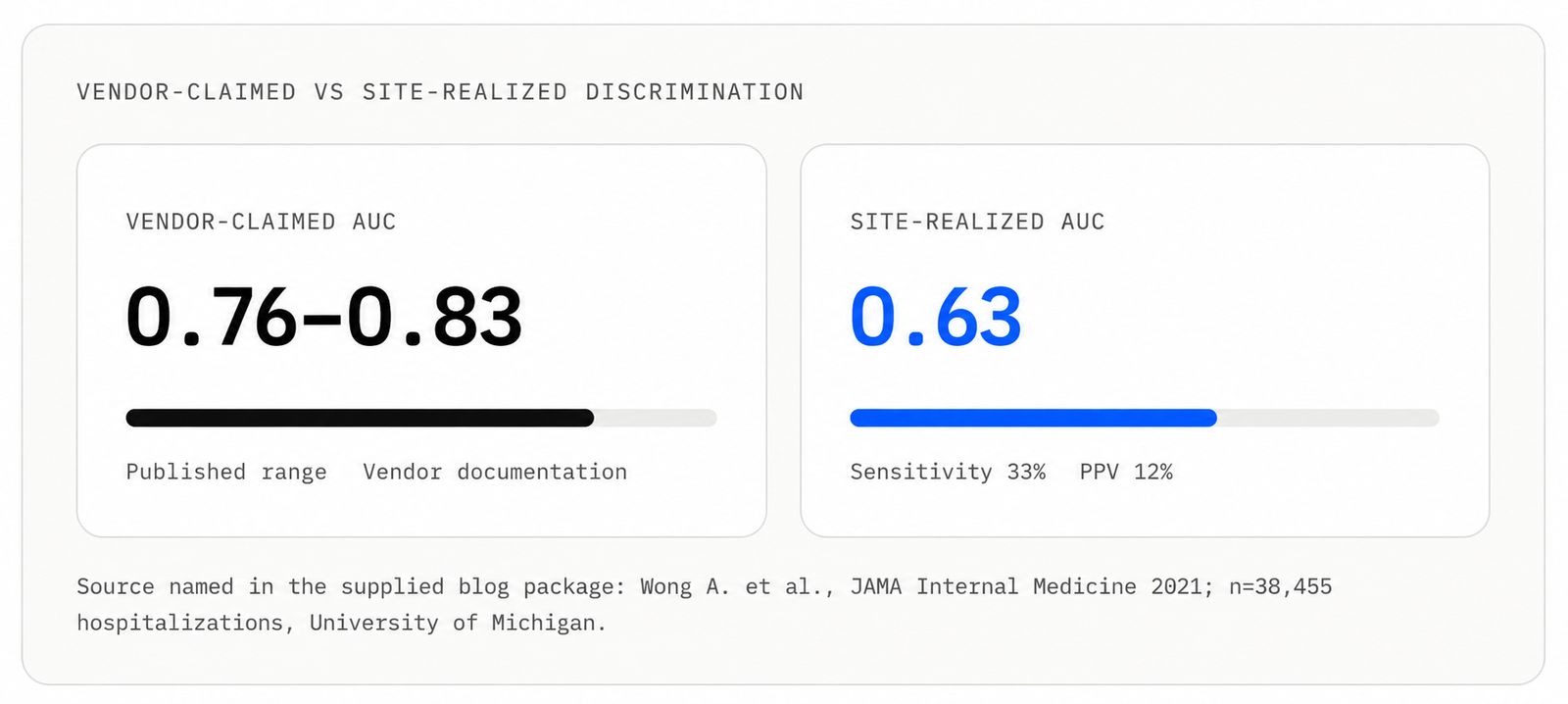
Every canonical failure of clinical AI in the last five years tells the same story. Wong et al.’s external validation of the Epic Sepsis Model showed the published vendor AUC of 0.76–0.83 collapse to 0.63 at the University of Michigan. Sjoding’s NEJM letter on pulse oximetry showed Black patients had nearly three times the rate of occult hypoxemia missed by the device. Obermeyer’s 2019 Science paper showed the Optum risk-stratification algorithm — affecting 200 million patient-years of decisions — was systematically under-referring Black patients because it had used cost as a proxy for need. MD Anderson and IBM cancelled the Oncology Expert Advisor after $62 million because the model was trained on one EHR and the hospital had moved to another. The 2021 NKF-ASN race-free eGFR reckoning forced thousands of hospitals to retire a calculator that had been embedded in clinical practice for two decades.
None of these were model-quality problems. They were cohort-construction and integration problems wearing the costume of model-quality problems. This post catalogs the six patterns we see most often — anchored to the published failures so the reader can verify each claim — and stops short of prescribing a fix. The fix is the next post in this cluster: the validation playbook. The point of this post is to recognize the patterns before you sign the SOW.
What “stall at validation” actually means inside a hospital
The Office of the Assistant Secretary for Technology Policy reports that 71% of US non-federal acute-care hospitals were running predictive AI integrated with the EHR by 2024, up from 66% in 2023. Adoption is not the bottleneck anymore.
Validation is. A 2024 systematic review of 572 machine learning–based ICU deterioration scores found that only 14.7% had been externally validated, rising to 23.9% by 2023. When external validation was performed, the median AUROC dropped by 0.037 — and in 49.5% of studies the drop exceeded 0.05. Translated: the model’s discrimination at your hospital is, on the median, worse than the paper claimed; in half the cases it is materially worse. Two open datasets — MIMIC and eICU — accounted for 83.3% of all external-validation work, which means the field is largely validating against itself.
A pilot “stalls at validation” when one of three things happens: (1) the IRB-approved silent prospective evaluation reveals performance materially below the vendor claim and the local AI governance committee declines clinical go-live; (2) the bias and subgroup audit reveals disparate performance that compliance, quality, or legal cannot accept; or (3) the integration team discovers the model’s output cannot be wired into the workflow that the pilot was supposed to improve, and the project converts into a de facto research project with no production endpoint.
Each of the six patterns below produces one of those three outcomes. Each is rooted in a decision made before the model was ever shown to the hospital — usually a decision the vendor made about the cohort.
Pattern 1 — Vendor-claimed AUC versus site-realized AUC: the Epic Sepsis Model gap
This is the most-cited failure pattern in clinical AI and the easiest to verify externally. The Epic Sepsis Model is a proprietary early-warning algorithm shipped with the Epic EHR and deployed at hundreds of US hospital systems. Epic’s documentation reported a hospital-level AUC in the 0.76–0.83 range. Wong et al., publishing in JAMA Internal Medicine in June 2021, ran the model against 38,455 hospitalizations of 27,697 patients at the University of Michigan and reported an AUC of 0.63 (95% CI, 0.62–0.64), sensitivity of 33%, and a positive predictive value of 12%. The model missed 67% of sepsis cases and produced a false alarm seven out of every eight times it fired.
The gap was not a bug. It was the predictable result of three decisions: the vendor’s training cohort was geographically narrow, the operationalization of the sepsis label differed from the academic CDC Adult Sepsis Event definition the external validators used, and the model assumed a clinician documentation pattern that does not generalize across health systems with different ordering cultures. None of those decisions are visible from a vendor data sheet. They are visible only from a silent prospective evaluation against the hospital’s own clinically-adjudicated outcomes — which is the thing most pilots skip because it is expensive and slow.
The lesson is not that the Epic Sepsis Model is bad. It is that the gap between vendor-claimed and site-realized AUC is the modal experience of clinical AI in production, not the exception. Every later failure in this taxonomy starts here.
Pattern 2 — Distribution shift across sites: why the AUROC drops at almost every external site
Distribution shift is the formal name for the same phenomenon. The training cohort and the deployment cohort differ in patient demographics, disease prevalence, sensor calibration, documentation conventions, ordering patterns, and label definitions — and the model encodes assumptions about all of them.
The 2024 ICU-deterioration systematic review quantified the cost: an average AUROC reduction of 0.037 per external site, with the bottom half of the distribution losing more than 0.05. A separate Nature Communications study (February 2024) examined real-world chest X-ray drift caused by COVID-19 emergence: the input distribution shifted faster than the model could adapt, and downstream performance metrics degraded silently before any single clinician noticed. The drift was detectable in the input distribution at a point when the model’s outputs still looked reasonable in aggregate — precisely the window in which patients are at risk and the hospital does not yet know.
Distribution shift is not a one-time event. It is continuous. Patient demographics change; new variants emerge; the EHR vendor pushes a documentation template change; a new lab analyzer is brought online and the reference ranges shift. Every one of those events produces a small silent shift in the model’s input distribution. The model’s AUC at site go-live is the high-water mark, not the long-run average.
External AUROC dropped on average 0.037 across 572 ICU machine learning models — and in half the cases it dropped more than 0.05. Site go-live AUC is the model’s high-water mark, not its long-run average.
Pattern 3 — Label leakage in retrospective cohorts
Label leakage means a feature in the model encodes information about the outcome that would not be available at the time of prediction in real clinical use. The Princeton group of Kapoor and Narayanan documented the magnitude: in their 2023 Patterns review, they identified leakage as a flaw in at least 294 papers across 17 disciplines — including healthcare — and proposed an eight-type taxonomy.
Three sub-patterns dominate clinical machine learning. Outcome-derived features — a model “predicting” mortality from ICU labs that include the lab orders placed only after the patient deteriorated. Temporal leakage — a feature whose timestamp is after the predicted event because the EHR records orders and observations in clinically convenient rather than chronologically clean order. Preprocessing contamination — a normalization, imputation, or feature-selection step that was fit on the entire dataset including the test split.
The clinical version of the Parkinson’s disease leakage paper (PMC 2025) is the cleanest demonstration. When the modelers excluded “overt motor features” — features that any clinician would already have used to make the diagnosis — nine ML algorithms collapsed to near-random specificity and misclassified most healthy controls as Parkinson’s. Reintroduce the overt features and accuracy returned to >90%. The model was not detecting Parkinson’s; it was detecting features that already required a Parkinson’s diagnosis to exist. The same pattern recurs in sepsis prediction, readmission prediction, and length-of-stay prediction.
Label leakage produces a model that looks brilliant at internal validation, performs respectably at external validation if the same leakage is reproduced, and collapses the moment the model is wired into the workflow at prediction time — when the leaky features genuinely do not exist yet.
Pattern 4 — Evaluation-cohort overlap with training data
The systematic review’s finding that 83.3% of ML-based ICU deterioration validation studies use MIMIC-III, MIMIC-IV, or eICU is not a footnote. It is a structural problem. When the field validates against the same two datasets it trained against, the field’s confidence in its own external generalization is overstated by definition.
Two practical sub-patterns to look for. Patient overlap — the same patient encounter appears in both the training and evaluation splits because the de-identification pipeline did not preserve a stable patient identifier across cohort definitions. Site overlap — the model is trained on one tertiary academic center’s MIMIC contribution and “externally” validated on a different MIMIC contribution from the same center, against the same documentation conventions and the same instrumentation.
The fix is not theoretical. It is to run the silent prospective evaluation against a cohort the vendor did not see during training — and to verify that claim with hash-based audit, not with a vendor’s assertion. Without that audit, “external validation” is a marketing term, not a methodological one.
Pattern 5 — Missing subgroup reporting: where Sjoding, Obermeyer, and the eGFR reckoning converge
This is the pattern with the highest legal, regulatory, and reputational consequence. Three canonical examples illustrate why.
Pulse oximetry. Sjoding et al., NEJM 2020, analyzed 10,789 paired pulse-oximetry / arterial-blood-gas measurements at the University of Michigan and 37,308 paired measurements across 178 hospitals in a multicenter cohort. Black patients had occult hypoxemia at 11.7% in the Michigan cohort versus 3.6% for White patients; in the multicenter cohort, 17.0% versus 6.2%. The aggregate device AUC looked fine; the subgroup-stratified accuracy looked terrible. The difference was discoverable because someone bothered to stratify.
Cost-as-need-proxy. Obermeyer et al., Science 2019, reverse-engineered the Optum risk-stratification algorithm — used in care-management eligibility decisions affecting 200 million patient-years annually — and found that Black patients with the same algorithm risk score were materially sicker than White patients. The proximate cause: the algorithm predicted future cost, and Black patients with equivalent need historically generated $1,800 less per year in measurable cost because of barriers to access. When the team replaced the cost target with a combined cost-and-active-chronic-conditions target, the bias dropped 86%. The fix was a label change. The cohort was the same.
Race-adjusted eGFR. The 2021 NKF-ASN Task Force unwound a multi-decade convention of multiplying the eGFR result for Black patients by 1.159 — a coefficient embedded in MDRD and CKD-EPI 2009. The new race-free CKD-EPI 2021 equation reclassified roughly 3.9% of Black US adults into more severe CKD stages and increased estimated abnormal-renal-function prevalence by 2.9% (NHANES 2011–2018). The race coefficient was not malicious. It was an unexamined statistical adjustment that, downstream, delayed specialist referrals, transplant waitlisting, and SGLT-2 inhibitor eligibility for the patients who most needed access to them.
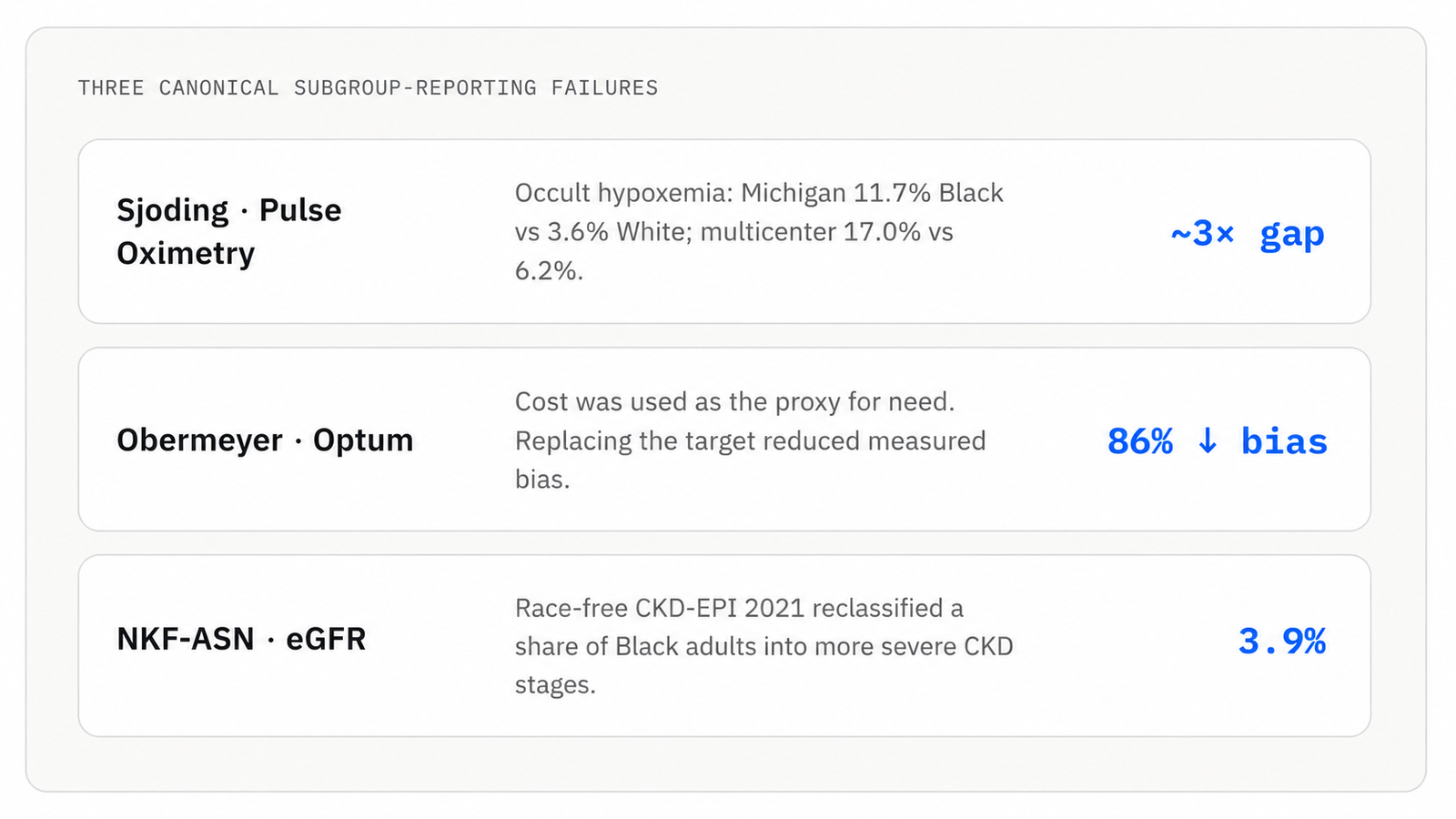
The common pattern in all three: an aggregate metric concealed a stratified metric, and the stratified metric was where the harm lived. Compliance and quality officers reading this should treat any vendor model with no per-subgroup performance disclosure as having unverified subgroup performance — which, under TRIPOD+AI, CONSORT-AI, and ONC HTI-1’s January 2025 model-card requirement, is no longer an acceptable disclosure baseline.
Pattern 6 — Inadequate drift-monitoring infrastructure
Even when the previous five patterns are caught at the validation gate, post-deployment failure remains likely without monitoring. Three categories of drift should be instrumented from day one.
- Data drift. The input feature distribution moves. Population demographics shift, a sensor is replaced, the EHR vendor pushes a template change, or a new analyzer changes the lab reference range. Standard tooling named in the source includes Kolmogorov–Smirnov tests on continuous features, Chi-square on categorical features, and Population Stability Index for ongoing tracking.
- Concept drift. The relationship between features and outcome changes. New treatment protocols change which patients deteriorate; vaccination shifts the prior on a respiratory presentation; a payer-policy change reshapes the population admitted. Detection requires comparing model predictions to eventual clinical outcomes, so an outcomes pipeline has to be part of deployment.
- Label drift. The operational definition of the outcome changes. The hospital adopts a new sepsis definition, the readmission window changes for a payer contract, or an ICD-10 specificity requirement reshapes the coded outcomes the model was trained against.
The FDA’s December 4, 2024 final guidance on Predetermined Change Control Plans is structured to address exactly this category. A PCCP authorized as part of a 510(k), De Novo, or PMA submission lets a manufacturer pre-specify which modifications the model can undergo — retraining triggers, data-source updates, performance-drift thresholds — without requiring a new marketing submission for each change. The August 2025 international harmonization with Health Canada and the UK MHRA reinforces the direction. None of this fixes the problem at hospitals using AI that is not FDA-cleared at all, or the problem of after-clearance silent drift between sanctioned model updates. That gap is yours to instrument.
The Coalition for Health AI’s pivot from “assurance labs” to “assurance resource providers” in 2025 — with Mt. Sinai and Morehouse running the first certified instance via BeeKeeperAI’s secure multiparty infrastructure — is the most-developed third-party answer to date. It is a national-cohort validation service, not local validation, which means it remains useful for cross-site benchmarking and limited for catching drift inside your specific hospital. Plan accordingly.
From Production
“On a HIPAA-compliant medical-coding system we shipped for a US-based Tier-1 health system — Epic-integrated via HL7 FHIR R4 — we cut document-to-coded turnaround from 48 hours to 4 hours and held coding accuracy at 94% across 12 months in production. None of that was the model’s contribution. The model was the easy part. What carried the project was a silent prospective evaluation against the coding team’s adjudicated outcomes for six weeks before clinical go-live, paired with weekly drift monitoring on the input distribution after. The vendor demo numbers were never the operating numbers. They never are.”
Where the six patterns intersect — the validation timeline view
Most pilots that stall hit two or three of the six patterns simultaneously, which is why a single root-cause analysis usually misses the actual fault tree. The matrix below shows where in the validation timeline each pattern surfaces and which canonical published failure most cleanly demonstrates it.
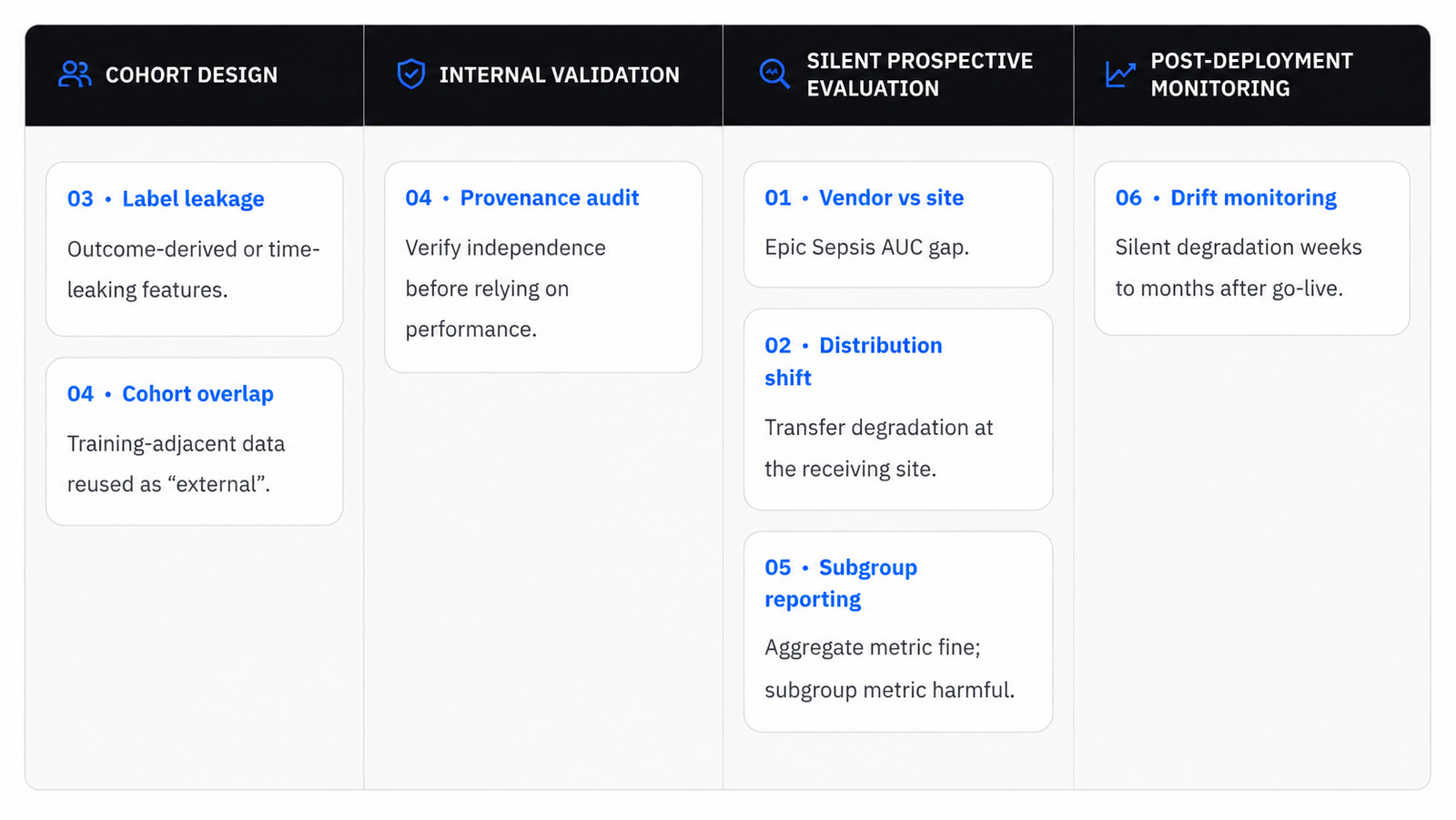
| Pattern | Where it surfaces | Canonical example | Surface symptom |
|---|---|---|---|
| 1 — Vendor claim vs site reality | Silent prospective evaluation | Epic Sepsis Model · Wong 2021 | AUC drops below vendor figure |
| 2 — Distribution shift | Silent evaluation; ongoing | 572-study ICU review · 2024 | AUROC drops on transfer |
| 3 — Label leakage | Cohort review | Kapoor & Narayanan · 2023 | Retrospective brilliance; live collapse |
| Retrospective brilliance; live collapse | Cohort-provenance audit | MIMIC/eICU monoculture | “External” uses training-adjacent data |
| 5 — Missing subgroup reporting | Bias & equity audit | Sjoding · Obermeyer · eGFR | Aggregate fine; subgroup harmful |
| 6 — Inadequate drift monitoring | Post-deployment | MD Anderson Watson · PCCP | Silent post-go-live degradation |
A pilot that hits patterns 1, 2, and 5 is the modal failure: the vendor’s number was flattering, the model does not generalize to your population, and the population most affected by the gap is the one the vendor never stratified for. A pilot that hits patterns 3 and 4 is the academic-paper failure mode: leak the labels, validate against the same dataset you trained on, publish, watch the field cite you for a decade, and then watch the model fail every external implementation.
Aggregate metrics are where vendors live. Subgroup metrics are where harm lives. Any model whose disclosure stops at aggregate AUC has unverified subgroup performance.
Founder Note
Across the seventy-plus enterprise AI systems we have shipped, the pilot-stall pattern in healthcare is the same one we see in BFSI and pharma: the team writing the specification has never sat with the silent prospective evaluation results and watched the gap between the vendor claim and the site reality open up in front of them. Once you have done that twice, you stop trusting any vendor figure that was not generated against your hospital’s adjudicated outcomes.
We have rewritten 40+ AI specifications mid-project to put silent prospective evaluation, subgroup stratification, and drift monitoring into the contractual deliverables. Every time, the model accuracy in production ended up below the vendor figure and above the floor at which clinical leadership would accept the system. That gap is the spec’s job to absorb. If the spec doesn’t, the pilot does — and the pilot loses.
When this taxonomy doesn’t apply
The six-pattern taxonomy fits prediction and risk-stratification AI cleanly. It applies less cleanly in three categories worth naming.
Generative documentation assistants and ambient scribes. The validation gate here is less about discrimination metrics and more about hallucination rate, structured-data extraction accuracy against the clinician’s own note, and downstream coding accuracy. Patterns 5 and 6 still apply. Pattern 1 is harder to anchor because the vendor claim is rarely a single AUC.
Computer vision in pathology and radiology with FDA clearance. The PCCP framework largely covers patterns 1, 2, and 6. Patterns 3 and 4 still require independent audit — FDA clearance does not certify the absence of label leakage, and 510(k) substantial-equivalence comparison does not require external validation against the receiving hospital’s population. CONSORT-AI, TRIPOD+AI, and SPIRIT-AI extension reporting compliance is still your job to verify.
Operational AI — bed management, scheduling, supply. Pattern 5 often does not apply because the targets are not patient-level outcomes. Patterns 1, 2, 4, and 6 still do. The validation gate here is usually less rigorous than for clinical AI, which is why operational AI is where most hospitals have their largest unmonitored production deployments — and where the FDA does not have jurisdiction.
The taxonomy also does not name two adjacent failure modes that are real but lie outside the validation gate: pre-pilot scope creep and post-validation integration debt. Both are the focus of separate posts in this cluster.
What TRIPOD+AI, CONSORT-AI, FDA PCCP, and ONC HTI-1 actually fix — and what they don’t
The reporting and regulatory floor in 2026 is materially better than it was when most of the canonical failures above were published. Four moves to know.
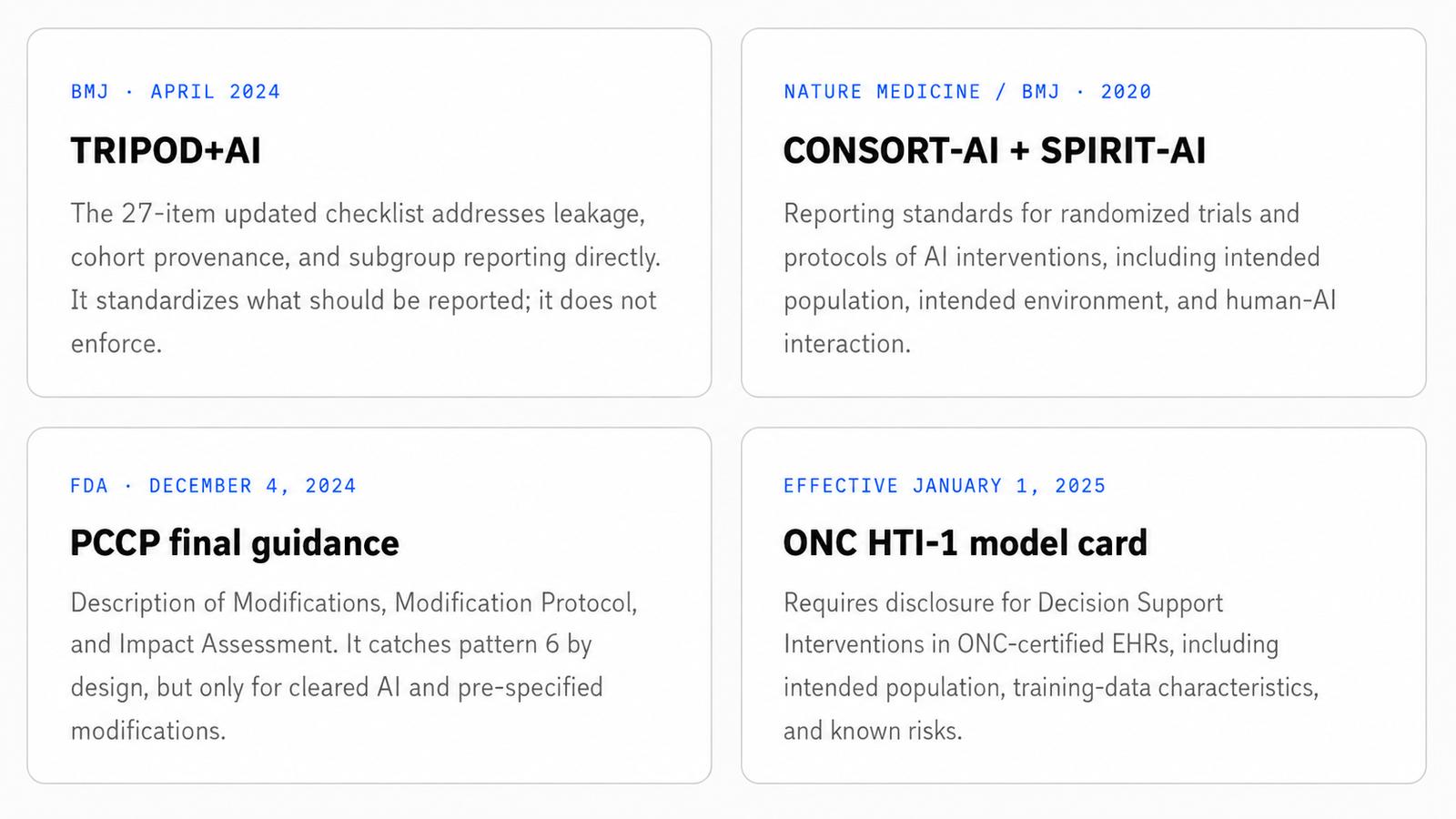
The reporting floor is real and meaningful. The reporting floor is not the validation gate. The validation gate runs in your hospital, against your population, on your timeline. The reporting floor tells you what the vendor is required to disclose; it does not tell you whether the model performs at your institution. Those are different gates. Pilots stall at the second one.
Key takeaways
- Hospital AI pilots often fail at the validation gate, not because the model is intrinsically poor but because the receiving-site cohort and workflow differ from the conditions that produced the vendor number.
- The six recurring patterns are vendor-vs-site performance, distribution shift, label leakage, evaluation overlap, missing subgroup reporting, and inadequate drift monitoring.
- Silent prospective evaluation against the hospital’s own adjudicated outcomes is where several of the most consequential gaps become visible.
- Aggregate metrics are insufficient. Subgroup performance and cohort provenance belong inside the validation gate.
- The 2026 reporting floor helps, but disclosure standards and regulatory frameworks do not replace local validation.
About the author

Mitesh
Mitesh Patel is Director of Brainy Neurals and a NVIDIA Certified AI Architect — a credential held by fewer than 3,000 people worldwide. He has spent nine years building production AI, beginning in C/C++ firmware and edge inference (Jetson, NVIDIA Triton, TensorRT, Qualcomm SNPE) and now leading enterprise RAG, computer vision, and generative AI delivery. He holds a B.Tech in Electronics & Communication and an M.Tech in Embedded Systems, and is an Upwork Top Rated Plus practitioner (top 3%). His team of 20 specialist engineers has shipped 70+ enterprise AI projects across manufacturing, BFSI, healthcare, logistics, and construction. Read more at the founder page or connect on LinkedIn.