





Choosing the Right Depth Sensor
Depth sensors measure the distance between the sensor and objects in their surroundings, providing machines with vital spatial information. From virtual reality and augmented reality to robotics and beyond, depth sensors are key to making these technologies more functional and effective.
What are Depth Sensors?
In many modern imaging applications, RGB cameras are widely used to capture colorful, detailed images of the world around us. While these cameras excel at displaying vibrant visuals, they have a limitation—they can’t capture depth, the third dimension that helps us understand distance and adds realism to our perception.
This is where depth sensors come into the picture. Unlike regular cameras, depth sensors measure the distance between the sensor and objects in their surroundings, providing machines with vital spatial information. This allows them to interpret and navigate 3D environments with much greater precision. From virtual reality (VR) and augmented reality (AR) to robotics and beyond, depth sensors are key to making these technologies more functional and effective.
In this blog, we’ll explore the world of depth sensors in detail. You’ll learn about the different types of depth sensors available, how they function, and their wide-ranging applications across various industries. We’ll also discuss the key factors to consider when choosing the right sensor for your specific needs, offering valuable insights into how depth sensors are transforming modern imaging technology.
A depth sensor or depth camera is a device designed to measure the distance between itself and objects in its surroundings, capturing spatial information in three dimensions. By detecting the depth of objects, it creates a detailed depth map that represents how far each point in the scene is from the sensor. This ability to perceive depth makes depth sensors essential for applications that require an accurate understanding of object positions, shapes, and distances within a 3D space.
RGB cameras show what a scene looks like. Depth sensors add the spatial information machines need to understand where objects are.
Types of Depth Sensors
We will explore each of these depth sensor types in detail, looking at how they work and their practical applications.
- Time of Flight (ToF) Sensors
- Stereo Vision Sensors
- Structured Light Sensors
- LiDAR (Light Detection and Ranging)
Time of Flight (ToF) Sensors
Working Principle
Measuring the return time of infrared light
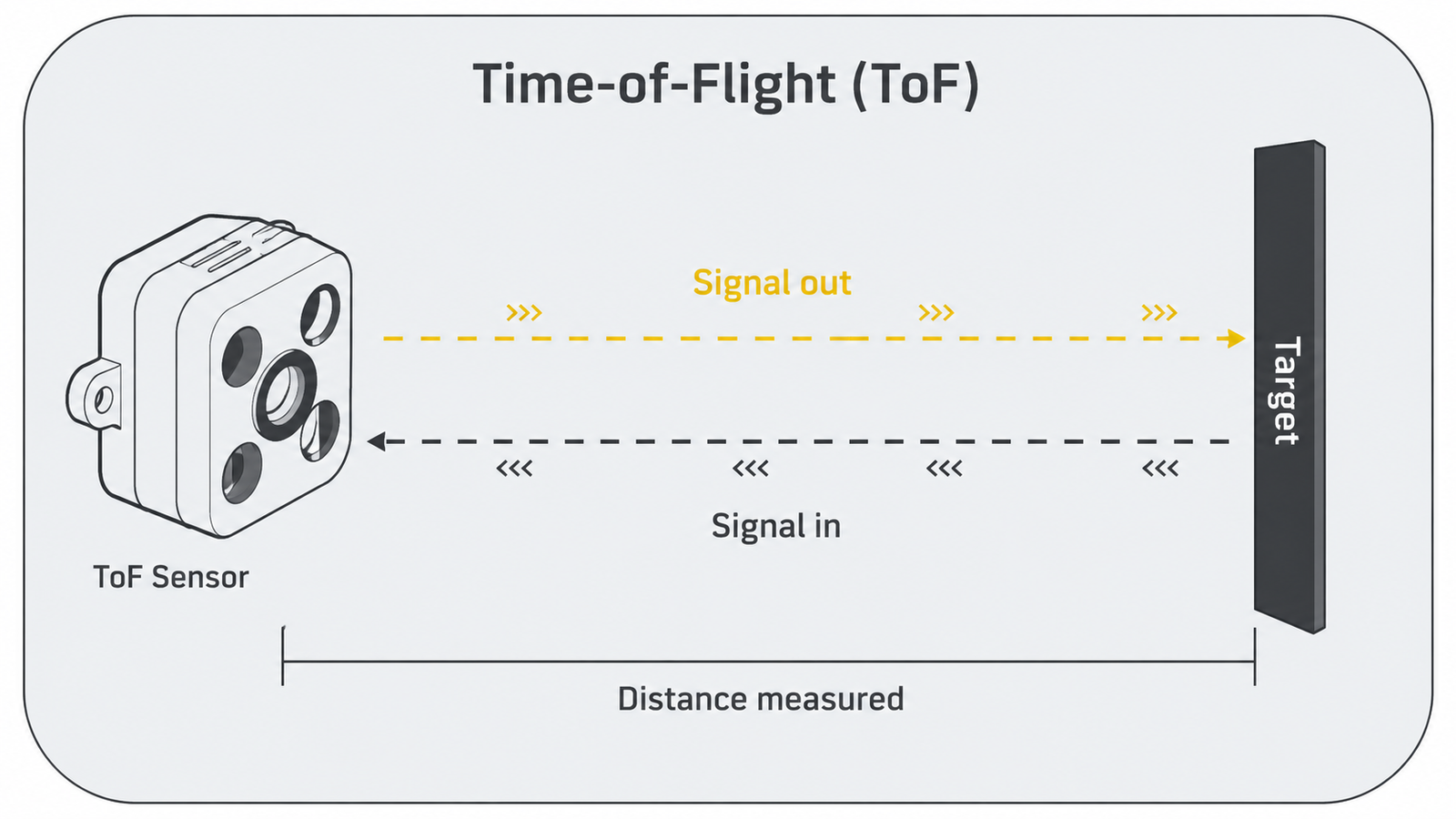
ToF sensors emit infrared light and measure the distance to an object by calculating the time it takes for the light to bounce back after hitting the object.
Since light travels at a constant speed, the time taken for the light to reflect back is used to calculate the distance to the object.
Key Features: Where ToF sensors perform well
- Effective in Low-Light Conditions: ToF sensors perform well even in dim environments.
- Long-Distance Measurement: They can measure distances of several meters accurately.
- Real-Time Depth Data: ToF sensors provide accurate depth information in real-time.
Applications: Common ToF use cases
- Indoor Navigation: Helping users navigate through complex spaces effectively.
- Smartphone Facial Recognition: Used in features like Face ID for secure phone unlocking.
- Touchless Elevators: Allowing users to operate elevators without pressing buttons, simply by using hand movements.
Limitation
While ToF sensors are effective in low-light environments, they are less suited for long-range outdoor use.
Stereo Vision Sensors
Working Principle
Depth perception through parallax
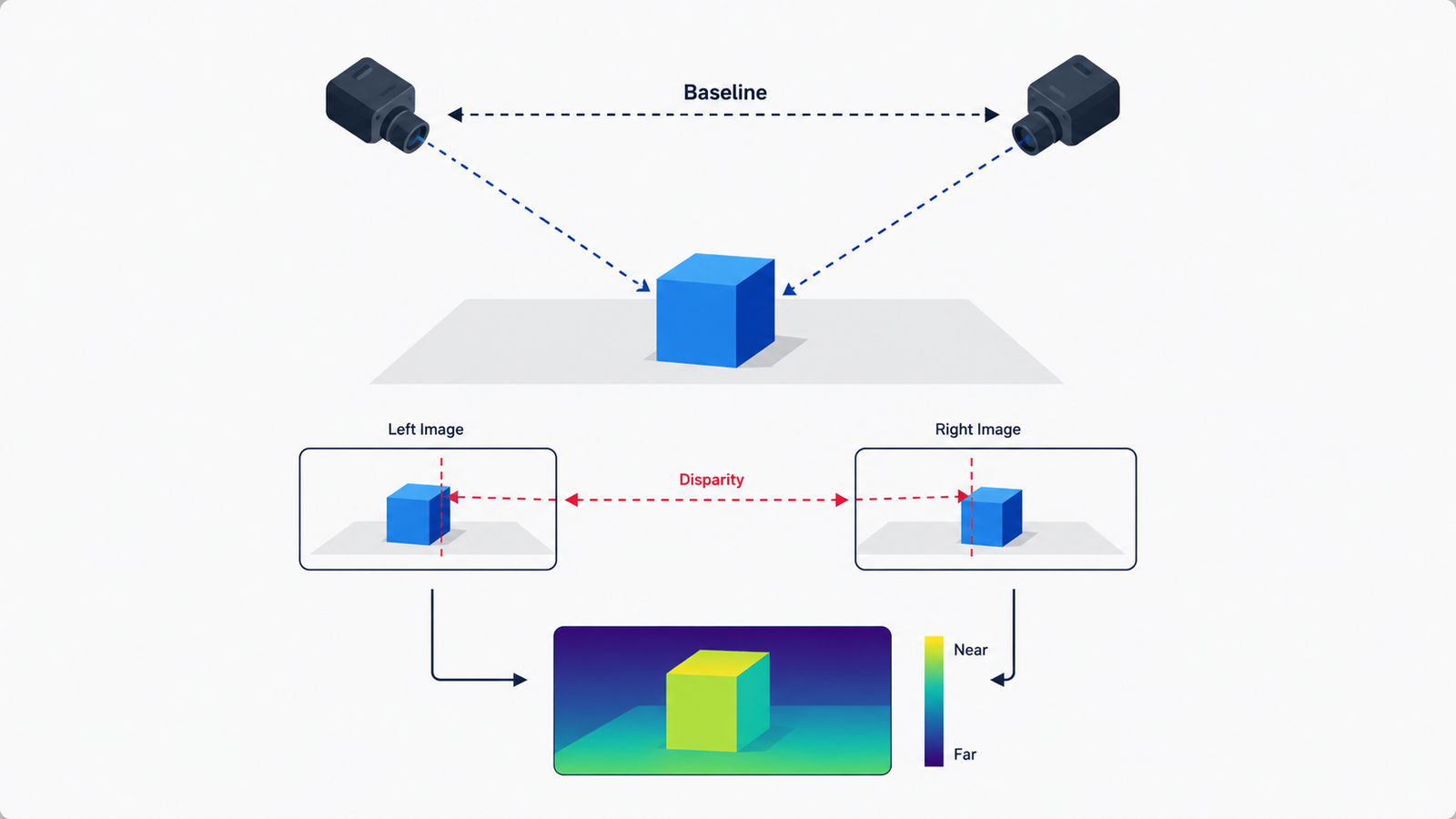
Stereo vision cameras operate similarly to human eyes. They consist of two cameras positioned slightly apart, capturing two different images of the same object or scene. The effectiveness of these cameras is based on the principle of parallax—the apparent shift in an object’s position when viewed from different angles.
The distance to the object is calculated by analyzing the differences between these two images. For example, if there is a significant difference between the images, it indicates that the object is closer; if the images are quite similar, it suggests that the object is farther away.
Key Features: What stereo vision provides
- Accurate Depth Perception: Offers detailed depth information at close to medium ranges.
- Versatile Applications: Suitable for robotics, drones, and autonomous navigation in well-lit environments.
- Human-Like Depth Perception: Effectively detects obstacles, enhancing navigation and interaction.
Applications: Common stereo vision use cases
- Robotics: Enables robots to navigate and avoid obstacles in factories.
- Drones: Facilitates navigation through small spaces, like indoor warehouses.
- Augmented Reality (AR) Apps: Assists in creating virtual layouts by scanning and measuring rooms.
Limitations
Performance can decline in low-light conditions. Reflective surfaces can also confuse depth estimation.
Structured Light Sensors
Working Principle
Calculating depth from a projected pattern
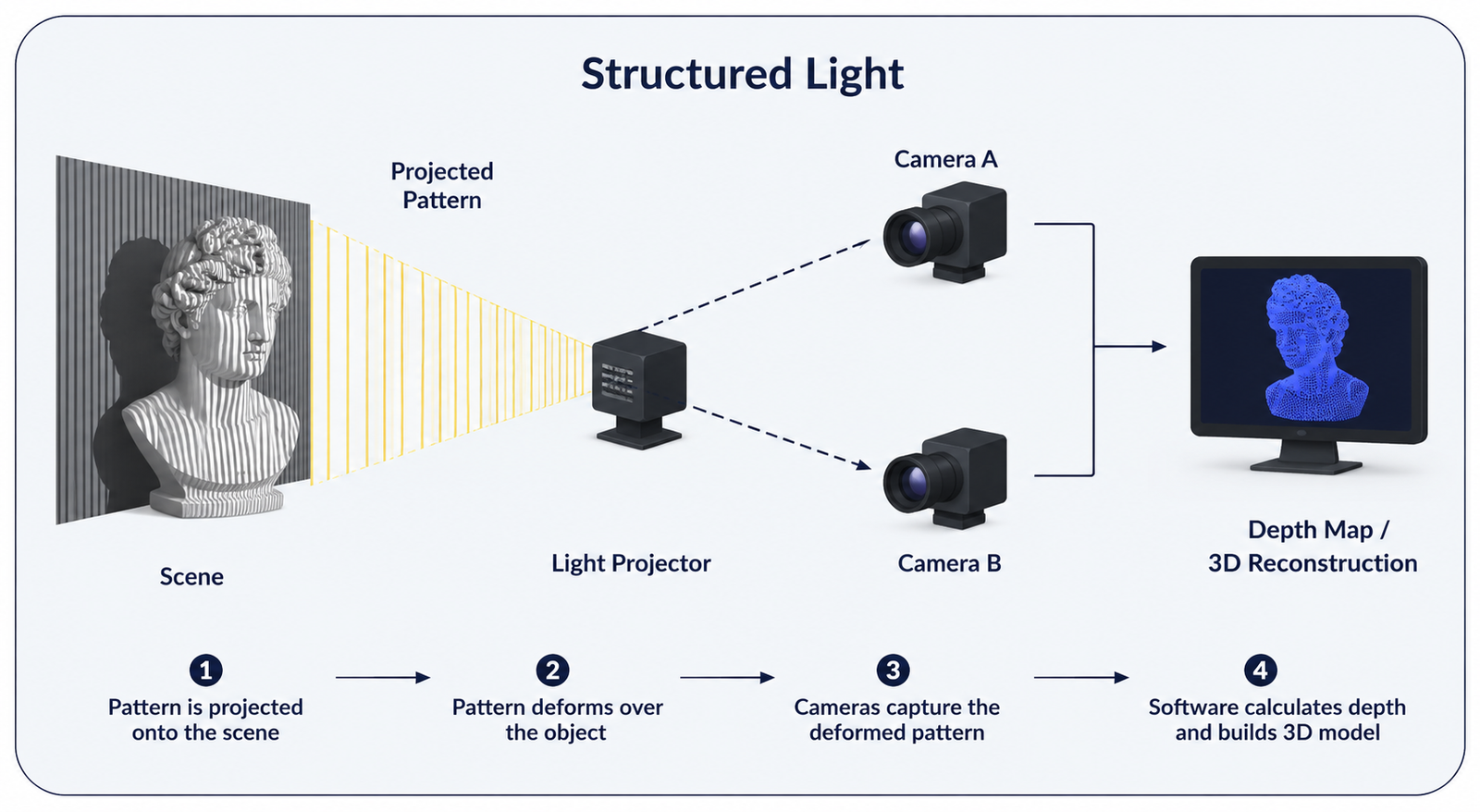
Structured light sensors project a known pattern of light onto a scene, typically using a laser or LED light source.
This pattern is then captured by a camera as it deforms over the surfaces of objects in the environment. By analyzing the distortion of the projected pattern, the sensor can calculate the depth and shape of the objects. The greater the deformation of the pattern, the closer the object is to the sensor. This method effectively creates a 3D representation of the scene.
Key Features: What structured light provides
- High Accuracy: Provides precise depth measurements and detailed surface information.
- Rapid Processing: Capable of capturing depth data in real-time, making it ideal for dynamic environments.
- Robust Performance: Works well in various lighting conditions, although optimal performance is in controlled environments.
Applications: Common structured light use cases
- 3D Scanning: Used in applications requiring detailed object reconstruction, such as product design and reverse engineering.
- Facial Recognition: Employed in devices for secure facial authentication, providing depth information to enhance accuracy.
- Industrial Inspection: Assists in quality control by measuring and inspecting product dimensions in manufacturing.
Limitations
Performance can be affected by ambient light interference, which can distort the projected pattern. Surfaces with low texture or high reflectivity can also pose challenges for accurate depth measurement.
LiDAR (Light Detection and Ranging) Sensors
Working Principle
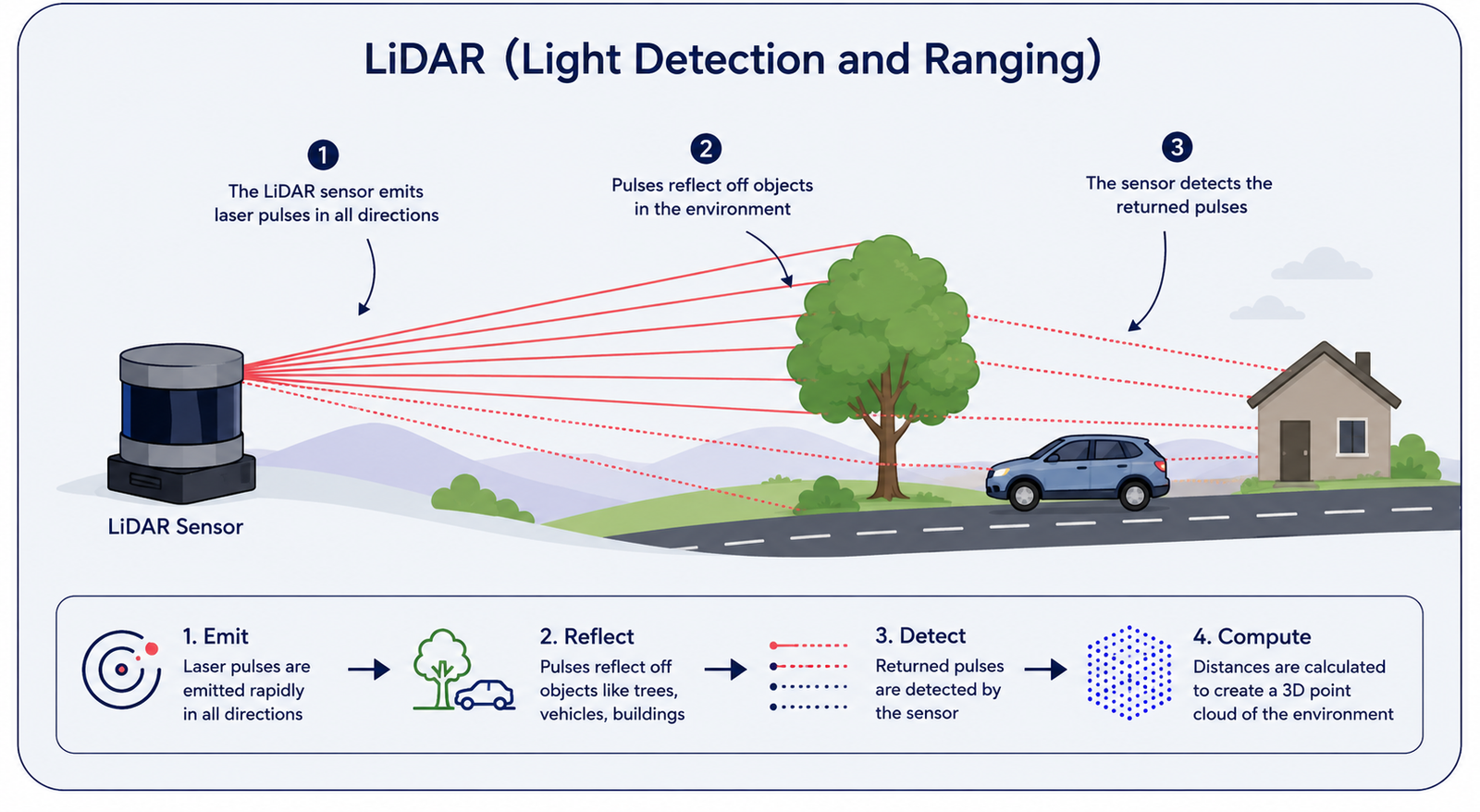
Mapping the environment with laser pulses LiDAR works by sending out laser pulses and measuring how long it takes for each pulse to bounce back after hitting an object. This time-of-flight measurement helps determine the distance to the object.
One of the unique features of LiDAR is its ability to not just map the surfaces of objects but also to see through some materials, allowing it to capture multiple layers of information in the environment. To ensure accuracy, an Inertial Measurement Unit (IMU) keeps track of the LiDAR sensor’s orientation and movement, making sure that the data collected is reliable and precise.
- Long-Range Capabilities: LiDAR can measure distances over large areas, making it ideal for wide-open spaces.
- High Precision: It provides detailed and accurate 3D maps, which are crucial for applications that require precise measurements.
- Versatile Performance: LiDAR operates well in various lighting conditions, meaning it can function both day and night.
Applications: Common LiDAR use cases
- Self-Driving Cars: LiDAR creates 3D maps that help autonomous vehicles navigate safely and avoid obstacles on the road.
- Farming: It is used to monitor crop health and soil conditions over large fields, helping farmers make informed decisions.
- Forestry: LiDAR assists in mapping trees and studying forest structures, offering insights into ecological health and biodiversity.
Key Features: What LiDAR provides
Limitations
LiDAR systems can be more expensive than other depth sensors. The data collected may also require advanced processing, which can be resource-intensive.
Depth Cameras and Computer Vision
Depth Cameras in Action
Adding 3D information to visual understanding
Depth cameras provide critical 3D information about a scene. Computer vision algorithms rely on this depth data to better understand and interpret the environment. By combining depth information with visual data, machines can perceive the world in a more human-like way—identifying shapes, understanding distances, and recognizing objects with more accuracy.
With depth cameras feeding accurate 3D data into computer vision algorithms, it’s possible to create more sophisticated applications in fields like facial recognition, spatial navigation, and scene reconstruction.
The Importance of Choosing the Right Depth Sensor
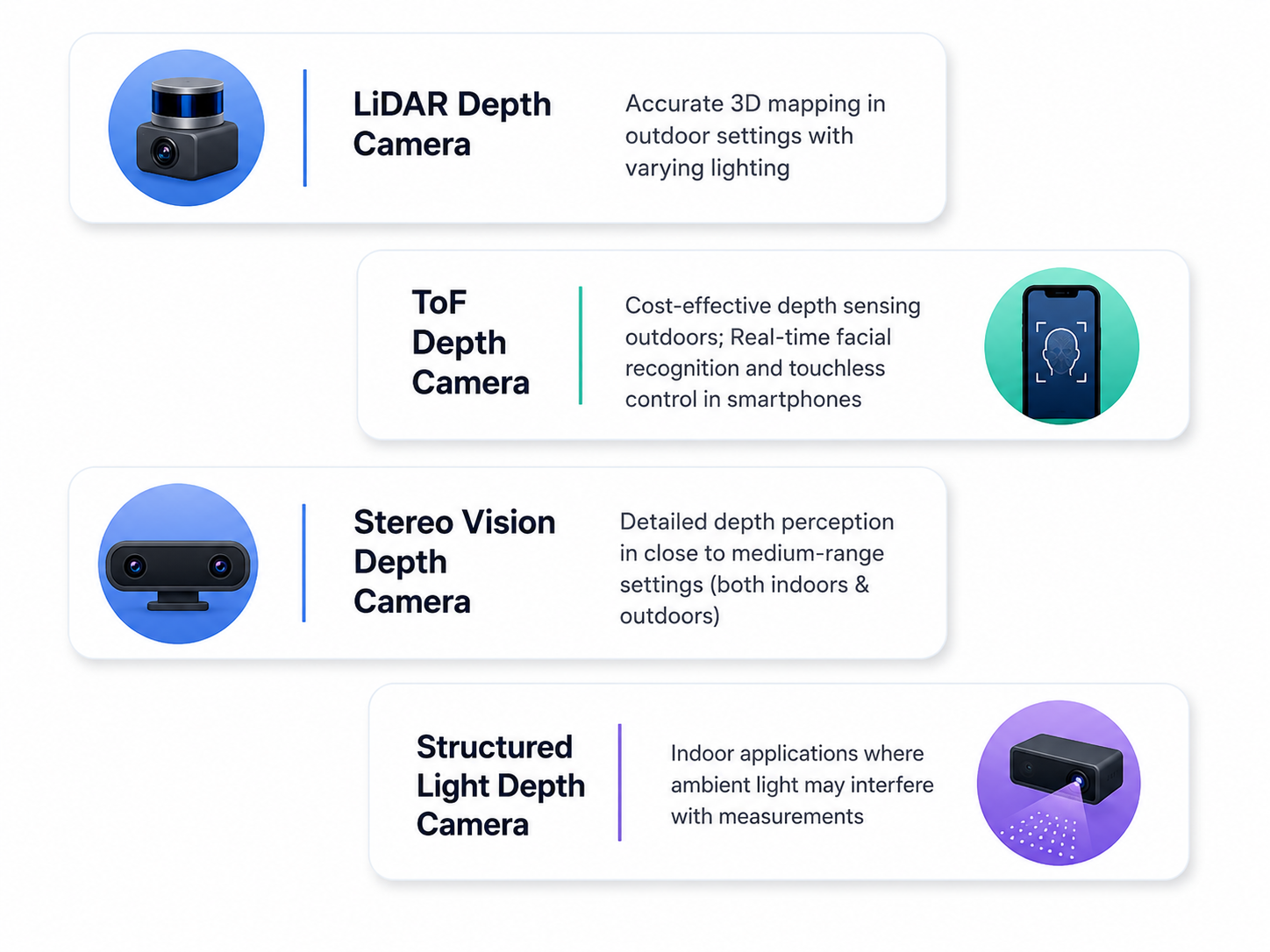
Selecting the appropriate depth camera is crucial for the success of computer vision projects. The right choice depends on the specific application requirements, environmental conditions, and desired data quality. Beyond environmental considerations, factors such as range, accuracy, integration with existing systems, and long-term scalability all play vital roles in sensor selection. Ultimately, choosing the right depth sensor ensures optimal performance, reliability, and cost-effectiveness for your computer vision application, whether indoors or outdoors.
| Sensor type | Best suited for | Main consideration |
|---|---|---|
| Time of Flight (ToF) | Real-time depth, facial recognition, indoor navigation | Less suited for long-range outdoor use |
| Stereo Vision | Robotics, drones, obstacle detection, AR | Depends on favorable lighting and surface properties |
| Structured Light | 3D scanning, facial recognition, industrial inspection | Best performance is usually in controlled environments |
| LiDAR | Long-range mapping, autonomous vehicles, farming, forestry | Higher cost and more demanding data processing |
From sensor selection to deployment
Brainy Neurals builds production computer vision and Edge AI systems that combine cameras, depth sensors, and optimized AI models. Explore our computer vision development services or discuss your hardware and deployment requirements with our engineering team.
Conclusion
In conclusion, depth sensors are essential technologies that significantly enhance our ability to perceive and navigate three-dimensional environments. By accurately measuring distances and creating detailed depth maps, these sensors enable a wide range of applications, from virtual reality and robotics to autonomous vehicles and smart devices. Understanding the different types of depth sensors—such as ToF, stereo, structured light, and LiDAR—allows businesses and developers to select the right technology for their specific needs.
At Brainy Neurals, we recognize the transformative power of depth-sensing technology. By leveraging these advanced sensors, we aim to develop innovative solutions that improve user experiences and drive efficiency across various industries. As depth sensing technology continues to evolve, we are committed to staying at the forefront of these advancements, helping our clients harness the full potential of 3D imaging for their projects. Together, we can create more immersive, intuitive, and intelligent systems that redefine how we interact with the world around us.
About the author